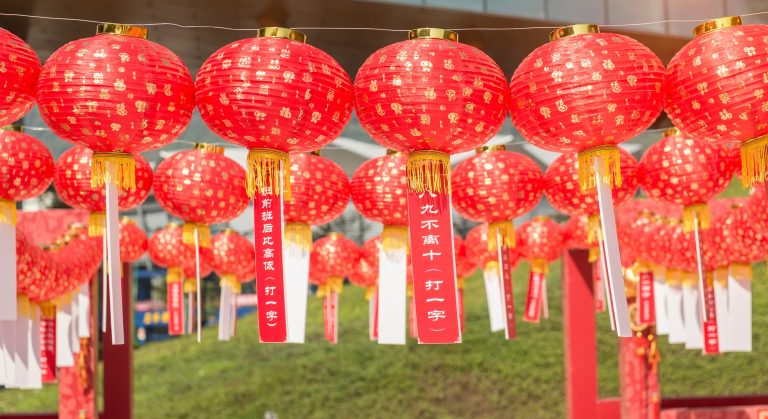
This year, Feb. 12 marks the 15th day — the first full moon — after the Chinese New Year. Traditionally, after a full two weeks of festivities, family gatherings, and religious rituals, the ancient Chinese would end the celebration with the yuan xiao jie (元宵節), better known in English as the Lantern Festival.
Today, yuan xiao jie is largely associated with the glutinous round rice dumplings called tang yuan (湯圓), as well as the colorful lanterns that give the celebration its English name. But the festival goes back to the Han Dynasty 2,000 years ago, as a day of ritual to celebrate the Deity of Heaven and later the Buddha.
In Daoist terminology, the 15th day of the 1st month is considered the birthday of Tai Yi ( 太一) a god responsible for celestial order, and it was called Shang Yuan (上元節), which literally means the Upper Yuan Festival. (In Chinese, “upper” can also imply the meaning of “first”). This custom was begun at least since the time of Han Emperor Wu, an era in which Daoist philosophy and beliefs were mainstream.
Two related festivals, the zhong yuan (中元節, or Middle Yuan) and xia yuan (下元節, or Lower Yuan), celebrated the Daoist gods of Humanity and Earth, and fell on July 15 and Oct. 15 of the lunar calendar, respectively.
Later, during the rule of Emperor Ming in the Eastern Han Dynasty, Buddhism was formally transmitted to China via the western frontier from India. It is said that monks lit their lanterns so as to honor the Buddha.
As the ages passed, the custom developed into grand celebrations throughout Chinese cityscapes as people illuminated the streets with countless lights to represent the triumph of enlightenment over darkness. Officially sanctioned by the emperors of the Tang Dynasty, such events featured intricately designed lanterns such as the White Egret Spinning Lamp (白鷺轉花) and Golden Phoenix (金鳧).
The term Yuan Xiao gained popularity in the Song Dynasty, as did the tangyuan dessert. By the Qing Dynasty, China’s last imperial government, the term “yuanxiao” was being used in some parts of the country to refer to both the festival and the food. The round shape of these rice balls symbolizes family reunion, harmony, and good fortune for the year ahead.
Success
You are now signed up for our newsletter
Success
Check your email to complete sign up