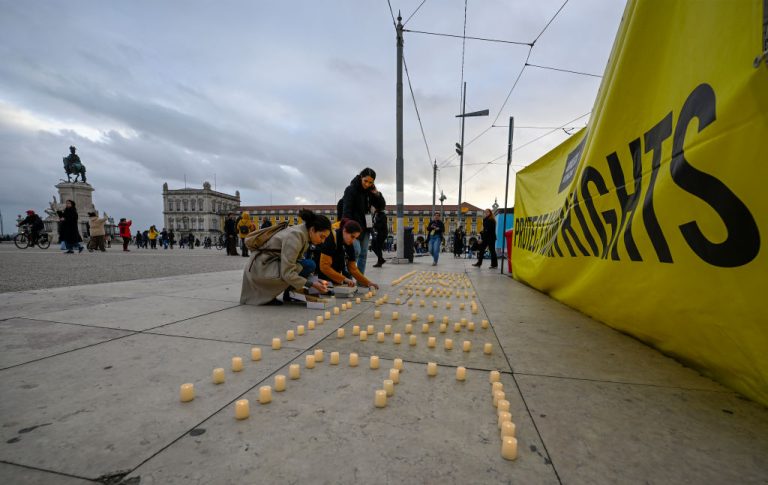
On May 19, Russia banned human rights group Amnesty International for condemning its war on Ukraine and officially labeled it an “undesirable” organization. However, the group vowed to keep covering Russia’s human rights violations by “redoubling” their efforts.
Since its founding in 1961, Amnesty International has reported on human rights cases across the globe, advocating for the freedom of those wrongly accused or treated. It has documented Russia’s invasion of Ukraine since the beginning, while also covering Moscow’s crackdown on dissent.
The Russian Prosecutor General’s Office said Monday that Amnesty’s London office is a “centre for the preparation of global Russophobic projects paid for by accomplices of the Kyiv regime,” state-run media reported. They added that the group tried “everything possible to intensify the military confrontation in the region” by backing supposed extremists in Ukraine.
In response, Amnesty International’s secretary general, Agnes Callamard, declared that the group will double their coverage of Moscow’s abuses.
“You must be doing something right if the Kremlin bans you,” she said, according to Reuters. “This decision is part of the Russian government’s broader effort to silence dissent and isolate civil society.”
Success
You are now signed up for our newsletter
Success
Check your email to complete sign up
“We will redouble our efforts to expose Russia’s egregious human rights violations both at home and abroad,” she added.
Since its assault on Ukraine, Russia has continued to crack down on groups it deems undesirable, and has threatened Russian citizens with up to five years in prison for working with or funding these groups.
Russia’s undesirable list currently has 223 entries including:
- Radio Free Europe/Radio Liberty
- Meduza, an independent Russian news outlet
- Thinktanks like Chatham House
- Transparency International, an anti-corruption group
- Opposition group Open Russia
Moscow also claimed that other Western human rights groups have provided false information about the country, while also ignoring abuses committed in the West itself.
The ban on Amnesty came as U.S. President Donald Trump planned to call Russian President Vladimir Putin and Ukrainian President Volodymyr Zelensky for peace talks, al-Jazeera reported.
Three years ago, Russia had already restricted access to Amnesty International’s website in Russia.
READ MORE:
- Kim Jong Un Condemns ‘Criminal Act’ After New North Korean Destroyer Sunk at Launch
- World Leaders Convene at UN as ‘Killer Robot’ Threat Outpaces Regulation
- President Trump’s First 100 Days: A Look at the Key Actions and Impacts
Moscow’s crackdown
Recently, Amnesty had rebuked Russia for its prison sentence of a major election monitoring activist Grigory Melonyants, and described Russia’s actions as a “brazen and politically motivated clampdown on peaceful activism.”
“Grigory Melonyants has committed no crime — his only ‘offence’ was defending the right to free and fair elections in Russia,” Marie Struthers, Amnesty International’s Eastern Europe and Central Asia Director, said.
Melonyants is the co-chair of independent election watchdog Golos, which has been targeted by authorities since its inception 25 years ago.
After being banned from taking part in “any civic activity” for nine years, Melkonyants was charged for supposedly organizing activities of an “undesirable organization,” based on his alleged connections to the European Network of Election Monitoring Organizations (ENEMO), which was deemed “undesirable” in 2021.
Amnesty also criticized Russia’s actions to stem the influence of what Moscow calls “LGBTQ+ propganda.”
Opposition to the war in Ukraine has seen many arrested, including teenagers. According to the Moscow Times, one teen named Sevastyan Sultanov, 15, was sentenced to one year after painting two pieces of anti-war graffiti and showing his support for the late Alexei Navalny.
Varvara Galkina, just 10-years-old at the time, was reported to the police by her school principal after she created an online poll about the war and changed her profile picture in a student group chat to an image of Saint Javelin, used as a meme supporting Ukraine.
Up-and-coming ski jumping athlete Denis Bushuev, 17, was arrested for starting a solo protest on the first anniversary of the invasion.
“No to war. No to madness,” read a sign he held in his hometown of Nizhny Novgorod.
In April, 18-year-old activist Daria Kozyreva was sentenced to nearly three years after using 19th-century poetry and graffiti against the war, and was accused of “discrediting” the Russian army.
“I have no guilt. My conscience is clear,” she said, as quoted in a transcript by Mediazona, another independent news outlet.
Having fled to Paris, Russian journalist Ekaterina Barabash lamented that “journalism no longer exists in Russia,” after she was slapped with a 10-year-sentence.
“If you want to be a journalist, you have to [live in] exile,” she said. “If you want [to] stay in Russia as a journalist, you are not a journalist. That is it. It’s very simple.”