By Edward Wenming and Janet Huang, Vision Times
At a time when party elders are weighing their options, new narratives are surfacing with increasing frequency. Zhang Youxia, the Chinese Communist Party’s (CCP) top military commander and vice chairman of the Central Military Commission, has placed both the Ministry of Public Security and the Ministry of State Security under military control.
But as the CCP’s internal leadership fractures deepen and observers grow more confused, the world watches closely: which way will the balance of power tilt? Why hasn’t Zhang stopped his purge? Who can he still count on as an ally? What hidden signals will the Sept. 3 military parade reveal? And who will stand atop the parade vehicle when that decisive moment arrives? We’ll delve into all of it here.
Zhang’s relentless purge
In his ongoing power struggle with Xi Jinping’s faction, Zhang has come to understand the danger he faces is constant and immediate. On one hand, many within the anti-Xi camp — whether party elders or other groups — are focused primarily on protecting themselves. They know how ruthless internal power contests can be in the Chinese Communist Party (CCP), and fear that if Xi regains control, they will face retribution. This fear has made them both cautious and hesitant.

On the other hand, Xi is acutely aware of the logic behind the CCP’s dynastic politics: once you lose power, you risk being destroyed. Xi’s greatest internal fear is clear — he wants to be the butcher, not the fish. And the only way to avoid becoming the fish is to claw back the power he lost following his suspected stroke.
Success
You are now signed up for our newsletter
Success
Check your email to complete sign up
Columnist Chen Shuhan, writing for Beijing Spring, described this with chilling clarity: power is the CCP’s lifeblood, and Xi clings to it “as if it were his own life.” Asking him to step down, Chen wrote, “is equivalent to asking for his life.” He added: “If someone told a tiger, ‘Let me skin you to make a coat to keep you warm,’ would the tiger agree?” The implication is simple: Xi will not relinquish power willingly.
Why Xi won’t step down
Xi is a master of political survival. He knows that as long as he holds onto power, he can buy time. But the moment he relinquishes it, he becomes the obvious target of revenge. Whether his successor is someone he appointed or someone who rose through the struggle, Xi would be the one sacrificed to appease a disgruntled public.

According to Chen, Xi has ruled for twelve years — and in those twelve years, he has only brought “disaster.” Every major decision has been focused on consolidating control, not benefiting the people. China’s economic decline is a direct result of policies Xi “personally commanded and directed.” In Chen’s view, Xi won’t retire because he can’t. Someone must take the blame for China’s current crisis.
And while Mao Zedong found scapegoats like the Gang of Four, Xi is no Mao — he lacks the reverence and mystique of a founding leader. “No one will take the fall for him.”
This leaves Xi with no real exit. His only course is to continue down a destructive path, dragging the CCP with him. His 2018 constitutional amendment revealed this desire for lifetime rule. If the so-called party elders had any real power to stop him, that amendment would have never passed.
Can a parade save Xi?
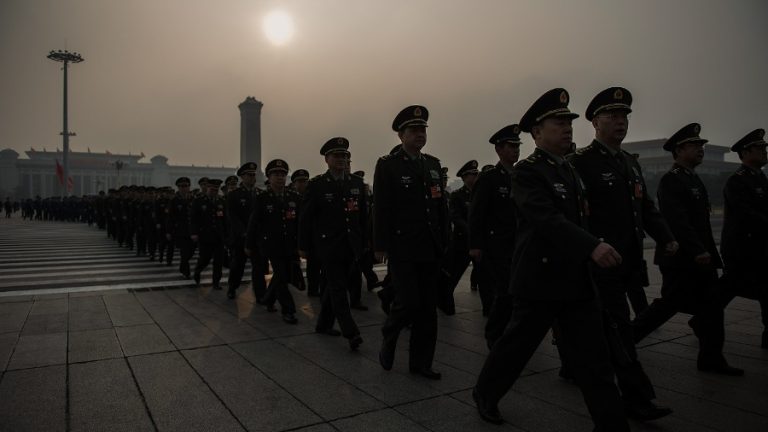
On June 25, state mouthpiece “People’s Daily” announced that a ceremony would be held at Tiananmen Square on Sept. 3 to commemorate the 80th anniversary of victory in the war against Japan. The event includes a troop review, and Xi is expected to deliver a major speech.

Notably, the announcement did not say Xi would personally inspect the troops — only that he would speak. Still, speculation has surged. Many believe Xi’s faction plans to use the military parade to reassert his fading authority. The moment recalls 1978, when Hua Guofeng tried to reinforce his image through a naval parade modeled after Mao’s “ruling through the military.” That move was blocked by Deng Xiaoping and Luo Ruiqing — and Hua’s standing crumbled.
But Zhang appears to have drawn a lesson from that failure. Recent reports suggest he has grown increasingly wary, accelerating his purge and placing state security apparatuses under military supervision.
Rifts among the elites
Overseas analyst Jiang Shenzhe notes that significant divisions have emerged between Zhang and other leading factions, including the Communist Youth League. The Youth League reportedly supports a “soft landing” for Xi — letting him retain his titles but stripping them of actual power, ensuring his and his family’s safety.
But Zhang sees this as a matter of survival. The longer Xi remains symbolically in place, the more dangerous he becomes. Zhang’s patience reportedly runs out in August. If the Youth League stalls, Zhang may move unilaterally by removing Xi from all three titles and holding him accountable to eliminate future threats.
To bolster support, Zhang has reportedly turned to the “Red Second Generation” — the descendants of founding revolutionaries in hopes of uniting the Party and charting a new path forward.