By Janet Huang, Vision Times
Chiang Kai-shek was one of the most influential figures in modern Chinese history. As a towering political and military leader of his era, his legacy continues to spark discussion and debate today. TIME Magazine — founded in 1923 and recognized as one of America’s three major current affairs weeklies — has long been known for its global perspective and coverage of defining international events.
When the Republic of China’s most prominent leader crossed paths with this iconic American publication, the result was a remarkable historical record. Not once or twice, but ten times, Chiang Kai-shek’s image graced TIME’s cover — each occasion marking a pivotal moment in Chinese and world history.
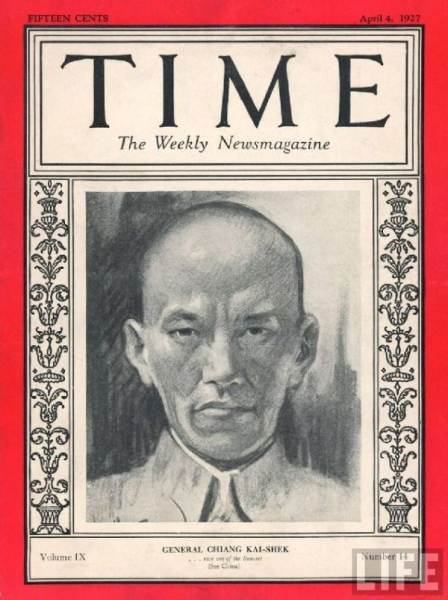
1. April 4, 1927 – Rising after the fall of Sun Yat-sen
In the wake of Sun Yat-sen’s death in March 1925, Chiang Kai-shek rapidly rose through the Kuomintang (KMT) ranks. By August that year, he was appointed commander of the First Army of the National Revolutionary Army. After defeating Guangdong warlord Xu Chongzhi, Chiang consolidated his control over the party’s military arm. The Northern Expedition, launched in 1926 under his leadership, brought early victories and renewed optimism.
In March 1927, a large-scale workers’ uprising in Shanghai — which also affected American sailors — drew sharp international attention. On April 4, 1927, TIME magazine featured Chiang on its cover for the first time. The story centered on the Shanghai unrest, but the cover image — clean-shaven, stern-eyed, and authoritative — made headlines. The title, “…rose out of the Sun-set,” alluded to his ascent after Sun Yat-sen’s death. The caption read simply: “General Chiang Kai-shek,” with the subheading, “The Conqueror.”
Success
You are now signed up for our newsletter
Success
Check your email to complete sign up
Only days later, Chiang launched the April 12 Purge, expelling Communist elements from the KMT, and by April 18 established a rival Nationalist government in Nanjing.
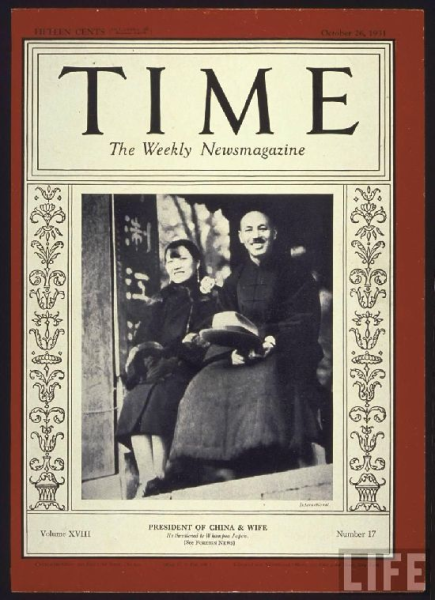
2. Oct. 26, 1931 – Chiang Kai-shek and Soong Mei-ling share the spotlight
By 1931, Chiang’s dominance in the KMT was secure. Following the Mukden Incident — Japan’s invasion of Manchuria — TIME again featured him, this time alongside his wife, Soong Mei-ling. The cover captioned them simply as “Chiang Kai-shek and his wife,” with the headline: “He Threatened Whampoa Japan.” The phrasing referenced his Whampoa Military Academy background and the looming threat from Japan.
Despite the growing external crisis, Chiang faced renewed internal dissent. On December 15, he announced his second resignation from all major posts, quietly withdrawing to his hometown of Fenghua shortly afterward.
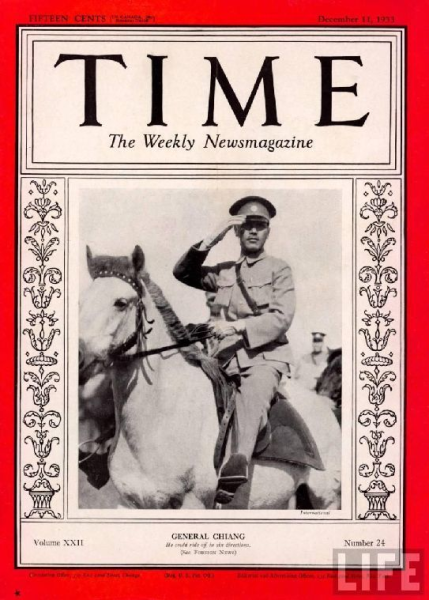
3. Dec. 11, 1933 – General Chiang Kai-shek, leader of China
By late 1933, Chiang was leading intense military campaigns against Communist bases in Jiangxi. That November, the Fujian Rebellion — led by the 19th Route Army — erupted, threatening Nationalist unity. TIME’s December 11 cover depicted Chiang on horseback under the headline: “He Could Ride Off Six Directions,” symbolizing his ambition to control multiple fronts.
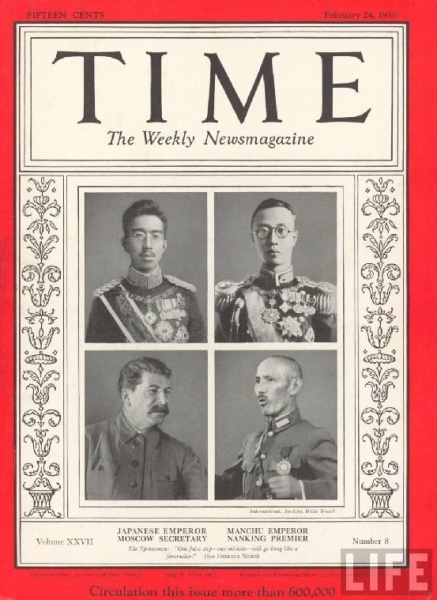
4. Feb. 24, 1936 – ‘One false step will go off like a firecracker‘
This cover featured four major geopolitical players: Emperor Hirohito, Puyi of Manchukuo, Joseph Stalin, and Chiang Kai-shek. The headline — “One false step—one mistake will go bang like a firecracker” — captured the tense dynamics among China, Japan, and the Soviet Union. By this time, Chiang was cautiously improving ties with Moscow in the face of increased Japanese expansion and coercion.
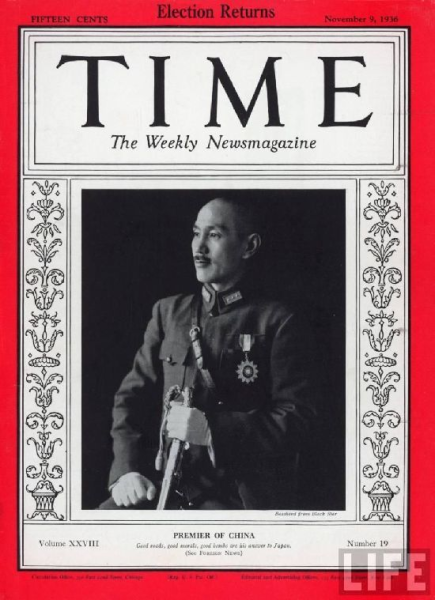
5. Nov. 9, 1936 – Good roads, good morals, good bombs
TIME’s headline declared: “Good roads, good morals, good bombs are his answer to Japan.” Barely a month later, the Xi’an Incident saw Chiang taken hostage by his own generals, forcing the KMT and CCP into the uneasy Second United Front against Japan.
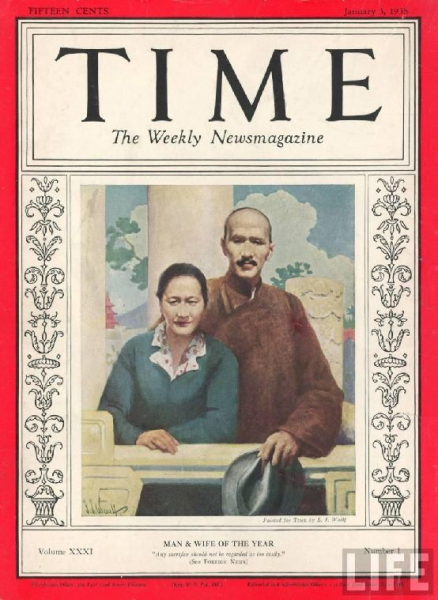
6. Jan. 3, 1938 – ‘No sacrifice too great in the war against Japan‘
In his sixth appearance — and second with Soong Mei-ling — Chiang was presented as the determined leader in a brutal war. TIME’s headline, “Any sacrifice should not be regarded as too costly,” reflected his resolve to resist Japan at any price, even as wartime strategies such as flooding the Yellow River exacted a devastating toll on civilians.
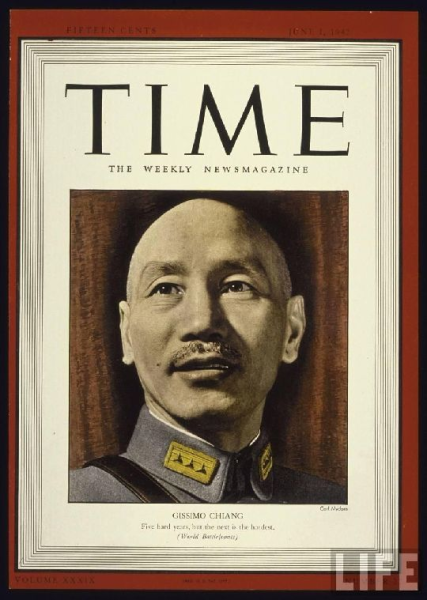
7. June 1, 1942 – 5 Tough years survived, the hardest still ahead
After Pearl Harbor brought the U.S. into WWII, Chiang forged closer ties with Washington and London. TIME’s headline, “Five hard years, but the next is the hardest,” conveyed both China’s endurance and the difficult battles still to come.
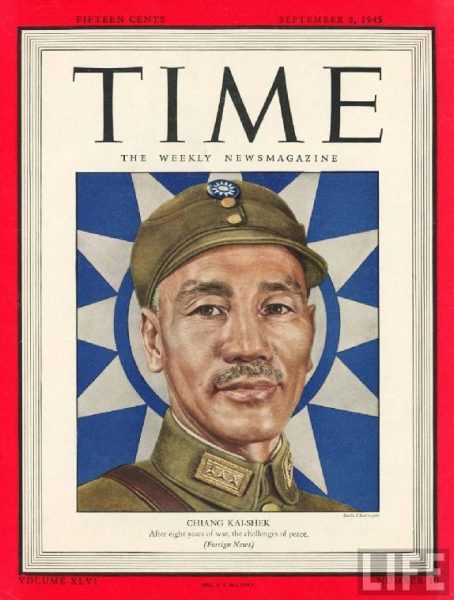
8. Sept. 3, 1945 – The challenges of peace
Following Japan’s surrender on August 15, 1945, TIME featured Chiang as China’s victorious leader. The headline read: “After eight years of war, the challenges of peace,” foreshadowing the coming civil conflict with the now-strengthened Chinese Communist Party.
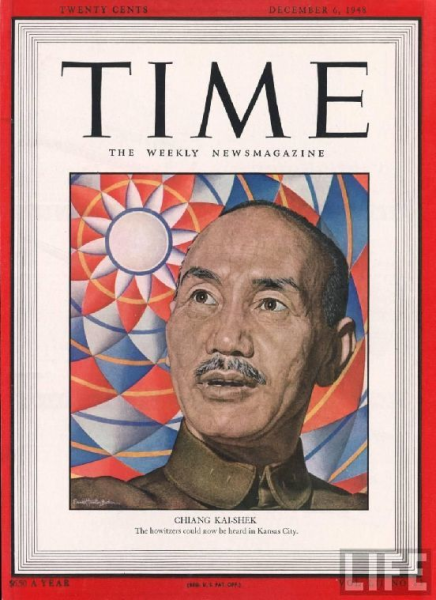
9. Dec. 6, 1948 – The Howitzers in Kansas City
By late 1948, the Nationalists were suffering repeated battlefield defeats. TIME’s headline — “The howitzers could now be heard in Kansas City” — underscored how the Chinese Civil War’s impact was felt even in the American heartland.
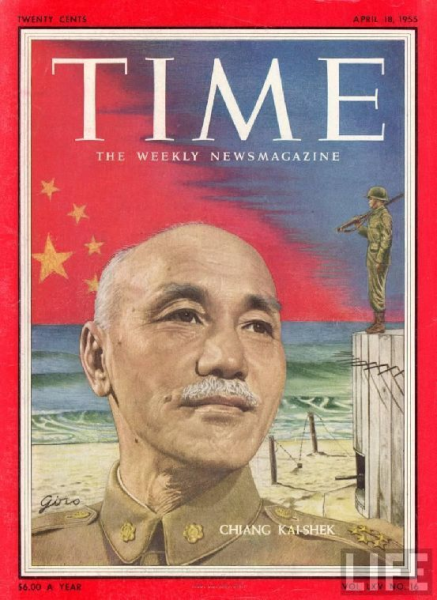
10. April 18, 1955 – Gazing or keeping watch?
From exile in Taiwan, Chiang’s final TIME cover depicted him against coastal defenses, staring across the Taiwan Strait toward the mainland. The imagery invited speculation — was he gazing in hope, or standing guard in vigilance? Either way, it symbolized the unbroken connection between Taiwan and the mainland.
Over nearly three decades, Chiang Kai-shek’s ten appearances on TIME’s cover chronicled his dramatic rise, wartime leadership, political crises, and enduring influence. More than portraits, they serve as a visual record of China’s turbulent modern history and one man’s central role in it.