On and around Aug. 15, countries in Asia and around the world commemorated the 80th anniversary of Japan’s capitulation in 1945, which ended World War II. The manner in which different governments and officials marked the occasion varied considerably, demonstrating the complex impact and legacy of the devastating war.
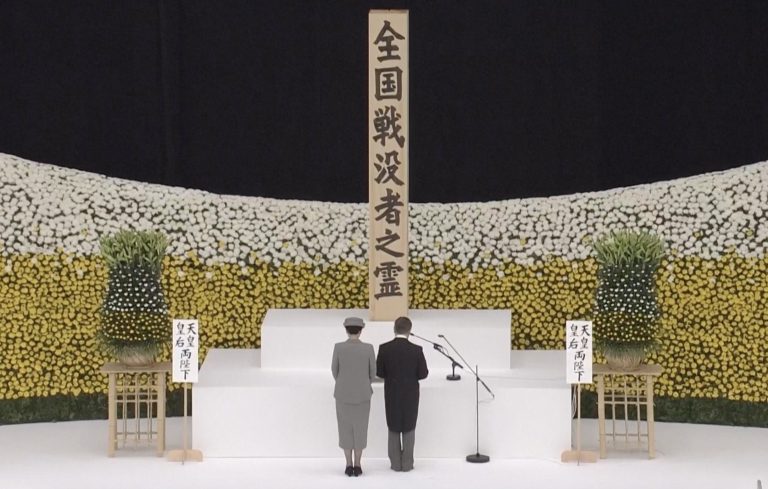
At a memorial event in Tokyo, Japan’s reigning emperor Naruhito and Prime Minister Shigeru Ishiba expressed apologies for the invasions begun in the 1930s by the militarist regime controlling the country at the time and, by the time of the Japanese surrender, had caused 20 to 30 million deaths across Asia.
Emperor Naruhito, who rules under the era name Reiwa, said, “Reflecting on our past and bearing in mind the feelings of deep remorse, I earnestly hope that the ravages of war will never again be repeated,” while emphasizing that Japan has been a peaceful nation for 80 years.
Ishiba said that the people of Japan must “take deeply into our hearts once again our remorse and also the lessons learned from that war,” noting that the vast majority of people alive today have no firsthand experience of the conflict.
“We must never again lose our way,” the prime minister added.
Success
You are now signed up for our newsletter
Success
Check your email to complete sign up
Under Japan’s postwar constintution, drafted with significant input from the United States, the country is not allowed to fight wars except in direct self-defense of Japanese territory, nor deploy weapons deemed to be intended for offensive, such as aircraft carriers or ballistic missiles.
As the Japanese sovereign and head of state issued their apologies, thousands of Japanese, including multiple lawmakers, paid homage to the country’s more than 2 million Japanese war dead who are honored at the Yasukuni Shrine in Tokyo.
The shrine, a privately run religious institution, has been seen as controversial because it includes around 1,000 Japanese war criminals.
Political narratives
The Japanese surrender on Aug. 15, 1945 came after more than a decade of aggressive campaigns against China, the Soviet Union, various Southeast Asian countries, and the United States, and several European powers.
Japan only gave up after the destruction of its powerful navy by the U.S. armed forces and a brutal strategic bombing campaign targeting the Japanese home islands, and the use of two nuclear bombs in early August 1945. Also impressing upon Japan the urgency of surrender was the entry of the Soviet Union into the war on Aug. 9, the day of the second U.S. nuclear attack.
World War II’s impact on Asia has been far-reaching and the effects continue to be felt, with modern governments often shaping memory and narratives about the war according to their political needs.
In China, where the Japanese invasion resulted in 10 to 20 million deaths, including many due to barbaric atrocities committed by the Imperial Japanese Army (IJA), the ruling Communist Party often uses Japan as an object of hatred in its propaganda.
However, during the actual war with Japan, the Chinese Communist Party (CCP) — then a rebel organization seeking to overthrow the Republic of China (ROC) government — seldom participated in the desperate battles to push back the IJA, instead taking the opportunity to expand its territory and influence behind the lines.
Four years later, in 1949, the communist armies, with help from the Soviet Union, defeated the ROC on mainland China, driving its government to the island of Taiwan.
The CCP, which claims democratic Taiwan is rightfully a part of its People’s Republic of China (PRC), has invited ROC veterans who fought against Japan to a victory parade to be held on Sept. 3 in Beijing and overseen by Chinese leader Xi Jinping.
Taiwanese officials have criticized the CCP for using the 80th anniversary of the war’s end to glorify itself, saying Beijing has falsely claimed it was the Communist Party that led the fighting against Japan rather than the ROC government.
Historical grievances
In the decades following its seizure of power over mainland China, the CCP downplayed World War II and the Japanese invasion, focusing instead on its struggle to “liberate” China from the Nationalist Party that led the ROC, and usher in a “New China” under the leadership of dictator Mao Zedong.
But towards the end of the 20th century, the CCP began to emphasize the war, particularly playing up the evils committed by the Japanese invaders and portraying the conflict as one in which the Chinese communists played a main role.
“The Chinese Communist regime has repeatedly distorted the facts in recent years, claiming that the war against Japan was led by the Communist Party, and has even fabricated the notion that Taiwan belongs to the People’s Republic of China,” said Chiu Chui-cheng, the ROC’s Mainland Affairs Council Minister.
He added that the PRC did not even exist during World War II.
Taiwan, originally belonging to the imperial Chinese Qing Dynasty, was annexed by Japan after defeating the Qing in the naval war of 1894–1895. It was returned to the ROC government in 1945.
The communist PRC has never governed Taiwan, though it vows the island will be politically “reunified” with the mainland.
The CCP’s hyping of the Sino-Japanese conflict has been criticized for demonizing the Japanese as a whole, rather than portraying the history of World War II in a balanced and rational way.
Multiple attacks on Japanese people in China have occurred in recent years, including on in 2024 that saw the fatal stabbing of a 10-year-old boy. Some Chinese tourists in Japan have engaged in disorderly behavior, such as a man who commited vandalism at the controversial Yasukuni shrine.
In Korea, which was annexed by Japan in 1910 and, like Taiwan, spent the entirety of World War II as a part of Tokyo’s empire, the conflict is generally remembered as a dark episode in which the nation was dominated and exploited.
At the end the war, Korea was divided between the Soviet Union and United States, which established the modern countries of North and South Korea.
North Korea, an isolated communist dictatorship, views Japan with hostility and often threatens it — as well as South Korea — with nuclear weapons.
In South Korea, the 35 years of Japanese colonization remains a painful point of controversy. Many believe that Japan has not done enough to own up to its crimes, particularly the enslavement of thousands of Korean women and girls to serve the Japanese army as “comfort women.”
South Korea’s president Lee Jae-myung, who assumed office this June, used the anniversary of the war’s end as an opportunity to reach out to North Korea to reduce tensions along the heavily militarized inter-Korean border.
However, the North Korean government has rebuffed Lee’s initial efforts, with Kim Yo Jong, sister of North Korean dictator Kim Jong Un and an influential official in the regime, calling South Korea a “faithful dog” of the United States.