The annual Balikatan military exercises between the United States and the Philippines expanded to an unprecedented scale in 2026, involving seven nations, 17,000 troops, and multiple observer countries. Analysts said the evolution of the drills reflects growing concerns over a potential Taiwan contingency and the broader Indo-Pacific security threat posed by the People’s Republic of China (PRC).
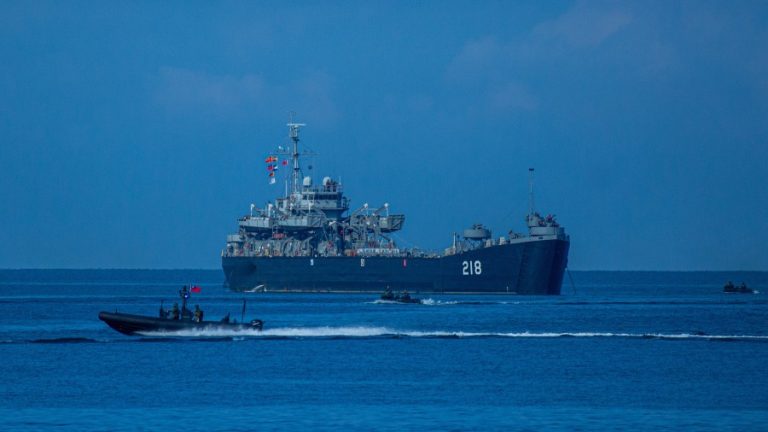
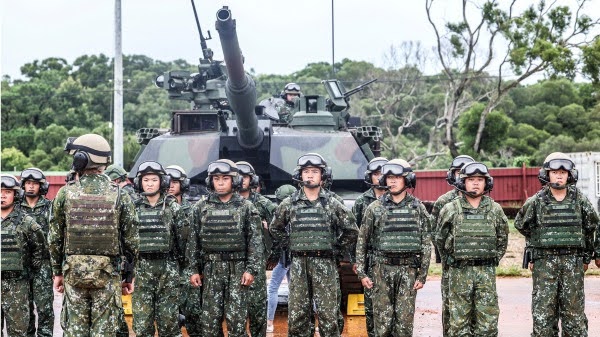
The 2026 Balikatan exercises took place across the Philippine archipelago and the South China Sea from April 20 to May 8, involving the United States, the Philippines, Japan, New Zealand, Canada, Australia, and France.
The drills marked the first time Japan deployed 1,400 combat troops outside its territory since World War II. On May 6, Japanese forces also fired a missile targeting a decommissioned Philippine ship approximately 75 kilometers away in the South China Sea.

The exercises highlighted growing Indo-Pacific deterrence capabilities, according to previous reporting by Vision Times. Analysts said the increasingly integrated security architecture in the South China Sea is closely tied to preparations for a possible conflict over Taiwan and efforts to counter the expanding presence of the Chinese People’s Liberation Army (PLA).
- Balikatan 2026 South China Sea Exercises Highlight Growing Indo-Pacific Integrated Deterrence
- How Taiwan Kept TSMC’s 3-Nanometer Chip Line at Home During Trump’s First Term
- China Builds Barricade at Scarborough Shoal, Raising South China Sea Tensions With Philippines
“If China attacks Taiwan, the US will be firing Typhon missiles from Filipino territory to defend Taiwan, along with many other integrated exercises the Americans will have to be doing with the Filipinos to defend Taiwan,” Sasha Bonafede Chhabra, a Taipei-based geopolitical analyst, told Vision Times, adding that the typhoon missiles used will be potentially made in the U.S. or Japan.
Success
You are now signed up for our newsletter
Success
Check your email to complete sign up
“So this is very, very important for Taiwan’s security.”
Retired Air Marshal Anil Khosla, former vice chief of the Indian Air Force, said the exercises’ focus on the First Island Chain underscores their connection to Taiwan.
“The maritime drills take place in northern Luzon, near the South China Sea (just over 100 miles from Taiwan). The focus on the First Island Chain signals a resolve to maintain freedom of navigation and deter unilateral changes to the status quo,” he said.
The First Island Chain refers to a series of islands in the Western Pacific Ocean running from Kyushu, Japan, to the Philippines. As all the islands — including Taiwan — are currently held by countries aligned with the U.S., they form a strategic barrier limiting the PLA’s access to the broader Pacific.
Taiwan is governed as the Republic of China (ROC), being the remnant territory of the state that once ruled all of China before its defeat on the mainland by communist rebels. The PRC claims Taiwan as a rightful part of its territory, to be “reunified” at all costs.
Missile and drone deployment
Khosla said the deployment of missile and drone systems at Enhanced Defense Cooperation Agreement (EDCA) sites in the Philippines reflects preparations for forward positioning and rapid-response operations.
During Balikatan 2026, the U.S. Army officially launched a Tomahawk Land Attack Missile from its Lockheed Martin Typhon missile system in the Philippines for the first time on May 5.
According to The Philippine Standard, the missile was launched from Tacloban Airport, a civilian facility, and struck a target approximately 600 kilometers away in Laur, Nueva Ecija, demonstrating long-range precision strike capabilities in the region.
Chhabra emphasized the strategic importance of the Typhon missile platform and its reach into the Taiwan Strait.
“So the Typhon missile [system] is a very, very important asymmetric type platform that’s being used that when launched from, anywhere in Luzon and like the main island in the Philippines, or, any of the Northern Filipino islands, it can strike into the Taiwan Strait,” Chhabra said.
According to the Taipei-based analyst, the Typhon system is highly mobile and concealable, capable of fitting inside shipping containers and being deployed from hidden locations.
“And it can very, very accurately strike targets in the Taiwan Strait,” he said, describing the system as a major deterrent against Beijing.
“Because in a first strike you will see China attacking air bases. All the large platforms, aircraft carriers, will be very, very vulnerable. But what will survive will be these dispersed locations where you have platforms like the Typhon missile and the new generation PrSM missile.”
Chhabra also pointed to Australia’s participation in Balikatan 2026 and the development of next-generation missile systems between the United States and Australia.
He said Canberra is increasingly focused on potential regional contingencies because a successful PRC move against Taiwan could alter the broader security balance across the Indo-Pacific.
“Obviously Australia is not immediately threatened by China’s presence like the East and South China Seas, or like Taiwan, Philippines. But if those areas fall, if China is able to take Taiwan and the South China Sea, it’s able to subdue the Philippines, then it’s able to project power towards Australia and threatens Australia’s security, which is heavily dependent on sea lanes that go through that region,” he said.
According to Chhabra, the next-generation missile systems being jointly developed by the United States and Australia offer greater precision and extended range, making exercises such as Balikatan increasingly important for operational testing.
“They will increase deterrence in the region,” he said.
Taiwan not directly involved
Despite the growing Taiwan-related focus of regional security planning, analysts noted that Taiwan does not formally participate in multinational exercises such as Balikatan.
Khosla said that while Taiwan remains highly relevant to the exercises, “the exercise is not explicitly focused on Taiwan. Its scenarios (counter-landing, maritime strikes, missile defence) directly relate to a potential contingency involving Taiwan.”

Chhabra described the drills as effectively rehearsing for a Taiwan-related crisis scenario.
“Of course, Taiwan is not able to be directly involved, for obvious reasons, but Taiwan is watching closely, and Taiwan will learn lessons from that,” he said.
He added that the United States, the Philippines, and Japan would all emerge better prepared for a Taiwan contingency because of the 2026 exercises.
According to Chhabra, Taiwan generally does not participate in formal multinational military drills due to diplomatic and political sensitivities.
“They do these sort of contact exercises where the Americans or the Japanese will pretend that they ran into the Taiwanese somewhere and just do some practice exercises so they won’t formally join like Balikatan,” he said.