On Sept. 16, congressional witnesses urged lawmakers to consider pushing for international prohibitions on experiments in solar geoengineering — injecting reflective particles into the atmosphere as a means of cooling the planet by reflecting sunlight away from Earth.
The testimony came before the House Oversight and Government Reform Subcommittee on Delivering Government Efficiency, where climate experts and policy analysts laid out competing views on whether the United States should lead an international non-use agreement.
Roger Pielke Jr., a senior fellow at the American Enterprise Institute, opened by urging the U.S. to take a lead role in banning solar geoengineering.
“We have one Earth, and experimenting on it carries considerable risks,” he said, adding that he has “likened geoengineering to risky gain-of-function research on viruses with uncertain benefits and catastrophic risks.”
Pielke and more than 500 scientists and academics have called for a formal international prohibition on outdoor deployment and for governments to monitor the atmosphere to enforce such a ban.
Success
You are now signed up for our newsletter
Success
Check your email to complete sign up
Christopher Martz, a meteorologist and policy analyst, echoed the call for prohibition. “Solar geoengineering should be prohibited, given the uncertainties about climate change itself, as well as the uncertainties that geoengineering could have on both the environment and life on Earth,” Martz said.
He argued that unanswered scientific questions about the climate and natural variability must be resolved in peer-reviewed literature before any nation contemplates altering the planet’s radiation balance.
Not all witnesses urged a ban. Michael MacCracken, who has long advised climate programs, argued that nature has already performed a kind of experiment: volcanic eruptions that loft sulfur into the stratosphere have produced measurable, if temporary, cooling.
“Volcanic eruptions put sulfur dioxide in the atmosphere,” he said. “It turns to sulfate. It reflects maybe 1 percent of solar radiation… That’s not something that science really has to go back and do. What we have to do is see if the tailoring and the optimizing … will work.” MacCracken urged deliberate research to assess whether tailored interventions could be beneficial or harmful.
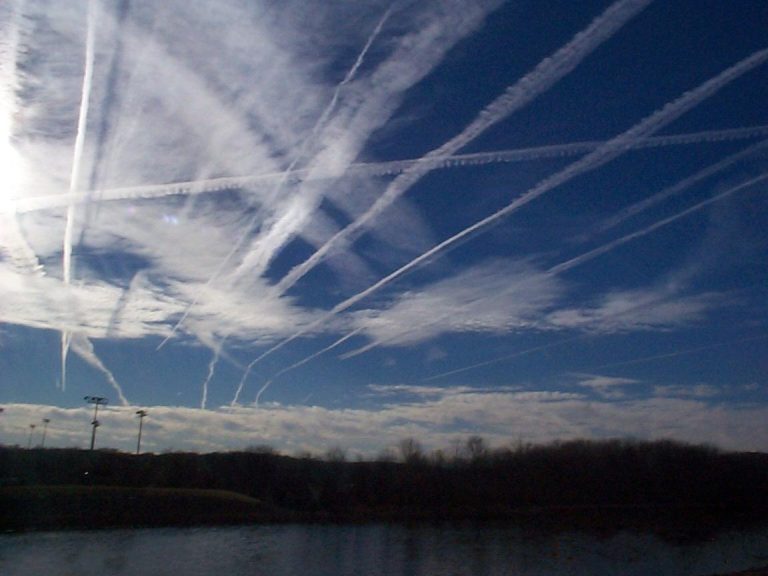
The hearing took place amid heightened public concern about atmospheric modification and an unusual spike in online conspiracy theories after a summer of severe floods — leading to many deaths in Texas — and widely shared accusations that weather-modification activities were to blame.
In response to public questions, the Environmental Protection Agency on July 10 released new online resources intended to explain what is known about contrails, cloud seeding, and solar geoengineering.
“Americans have legitimate questions about contrails and geoengineering, and they deserve straight answers,” EPA Administrator Lee Zeldin said as the agency posted the materials. “We’re publishing everything EPA knows about these topics on these websites.”
The EPA’s pages summarize the limited state of scientific understanding and note potential risks such as ozone depletion, altered precipitation patterns, crop impacts, and human-health effects.
The exchange in the hearing room also turned political. Subcommittee Chairwoman Rep. Marjorie Taylor Greene singled out a private California company, Make Sunsets, which has announced plans to release reflective particles from high-altitude balloons; observers criticized the company’s unilateral approach and reiterated the need for regulation.
Meanwhile, Democratic lawmakers at the hearing rebuked the Trump administration’s prior cuts to federal climate science investments and to underline the EPA’s role in studying environmental interventions.