By the Global Service Center for Quitting the CCP
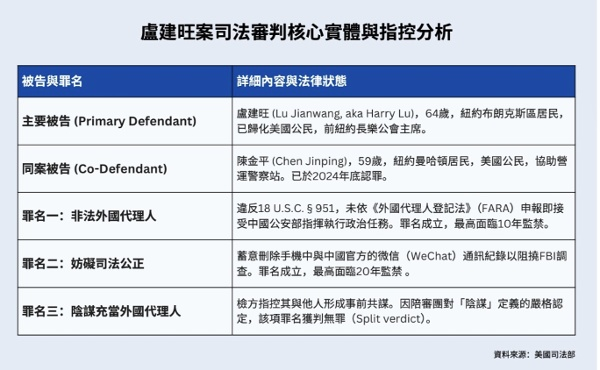
What began with a blue banner hanging inside a Manhattan office has ended with a landmark federal conviction that prosecutors say exposed a hidden arm of Beijing’s influence network operating on American soil. On May 13, a federal jury in Brooklyn convicted 64-year-old U.S. citizen Lu Jianwang on charges of acting as an unregistered agent of the Chinese government and obstruction of justice.
The case marks the first criminal conviction linked to a so-called “Chinese overseas police station” operating on American soil. Federal prosecutors argued that Lu helped establish and operate a secret outpost tied to China’s Public Security Bureau in Manhattan’s Chinatown, carrying out tasks on behalf of Chinese authorities while concealing the relationship from the U.S. government.
Analysts say the verdict is viewed as a significant milestone in efforts by Western governments to confront what officials describe as China’s growing campaign of transnational repression.
RELATED: Taiwan Promotes ‘2P1R’ Strategy to Strengthen Democratic Defenses Against Transnational Repression
From community leader to defendant
Success
You are now signed up for our newsletter
Success
Check your email to complete sign up
For decades, Lu was a familiar figure within New York’s Chinese-American community. A longtime leader of the America Changle Association, he cultivated extensive ties among immigrants from China’s Fujian Province and was widely known for community involvement. According to prosecutors, however, those connections also made him valuable to Chinese authorities.
During the trial, experts testified that Beijing has increasingly relied on local community organizations and influential diaspora figures to expand its reach overseas. Rather than dispatching intelligence officers directly, authorities allegedly leverage existing networks to gather information and exert influence while maintaining plausible deniability.
Court records showed that Lu maintained contact with numerous Chinese public security officials, including personnel connected to law enforcement agencies in Fujian Province.
An overseas police station
The investigation centered on an office located at 107 East Broadway in Manhattan. Publicly, the facility was presented as a service center assisting overseas Chinese citizens with administrative matters such as driver’s license renewals and document processing.
Such services became particularly useful during the COVID-19 pandemic when travel restrictions made it difficult for many Chinese nationals to return home.
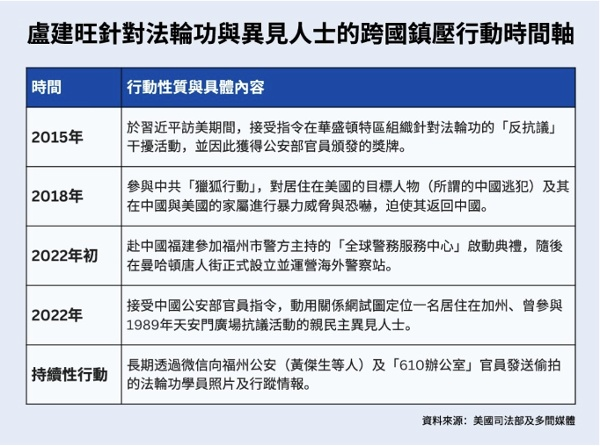
Federal investigators, however, argued that the office served a larger purpose. When FBI agents executed a search warrant in 2022, they recovered evidence linking the site to Chinese public security authorities. Among the most notable items was a banner identifying the office as a “Fuzhou Police Overseas Service Station.”
Prosecutors said the evidence demonstrated that the location was not simply a community service center but part of a network connected to Chinese law enforcement operations overseas.
Surveillance of dissidents
One of the most significant aspects of the case involved allegations that Lu helped monitor individuals targeted by the Chinese government. Prosecutors presented evidence that Lu received requests from Chinese officials concerning individuals living in the United States, including democracy activists and Falun Gong practitioners.
Falun Gong, also known as Falun Dafa, is an ancient spiritual discipline rooted on the principles of Truthfulness, Compassion, and Forbearance. The practice has faced persecution in China since 1999. Since then, thousands have perished at the hands of Chinese police, with many still undergoing routine monitoring, arbitrary travel bans, and arrests. Human rights organizations have also documented extensive efforts by Chinese authorities to suppress the practice both inside China and abroad.
According to court testimony, Lu helped gather information on individuals viewed as politically sensitive by Beijing and transmitted information back to contacts in China. Prosecutors also argued that he attempted to locate a California-based democracy advocate who had participated in the 1989 Tiananmen Square protests.
When questioned by federal investigators, authorities said Lu denied involvement and later deleted communications with Chinese officials, actions that formed the basis for the obstruction charge.
Part of a larger global network
The New York case emerged amid growing international scrutiny of China’s overseas police station network. In 2022, the Spain-based human rights organization Safeguard Defenders published a report claiming that Chinese authorities had established overseas police service stations in dozens of countries across North America, Europe, Asia, and Latin America.
The report triggered investigations in multiple democratic nations, including Canada, the United Kingdom, Germany, and the Netherlands.
Chinese officials have consistently denied that the facilities function as police stations, describing them instead as voluntary service centers that assist overseas Chinese citizens with routine administrative matters. U.S. prosecutors, however, argued that the Manhattan operation crossed a legal line by functioning on behalf of a foreign government without disclosure to American authorities.
A warning to foreign influence operations
The conviction comes as U.S. officials intensify efforts to combat foreign influence campaigns and transnational repression. Federal prosecutors emphasized that the case was not about providing community services. Rather, they argued, it concerned whether an individual was carrying out activities directed by a foreign government while operating secretly inside the United States.
For advocates who have long warned about overseas intimidation campaigns targeting dissidents, the verdict represents a rare instance in which such allegations resulted in a criminal conviction.
The case also sends a broader message, according to legal observers: Democratic societies are increasingly willing to use existing laws to confront foreign influence operations that operate beyond traditional espionage. As sentencing approaches, Lu faces the possibility of years in federal prison for his role in the scheme.