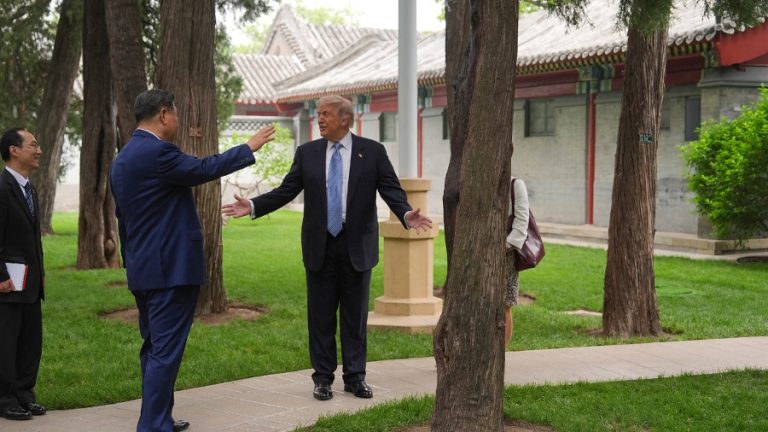
In mid-May, Xi Jinping hosted US President Donald Trump and Russian President Vladimir Putin in Beijing within the same week, each receiving two days of lavish state treatment. Trump’s visit produced trade optics; Putin’s visit produced strategic coordination on Ukraine.
Taiwan is a distraction — the real conflict with China runs deeper
Miles Yu, who served as the chief China policy adviser at the US State Department and is now a senior fellow at the Hudson Institute, wrote in the Washington Post that Taiwan is frequently misidentified as the core issue dividing Washington and Beijing. The actual conflict is the irreconcilable tension between the CCP’s authoritarian ideology and the democratic principles of the free world. Taiwan amplifies that contradiction, but it did not create it, and resolving Taiwan would leave the deeper antagonism entirely intact.
The framing of Taiwan as the central issue suits the CCP because it crowds out discussion of the Party’s domestic repression, redirects Western attention toward a territorial dispute with procedural complexities, and buys time.
Xi’s description of US-China relations at the summit, which he called a “constructive, strategically stable relationship,” should be read in that light. The CCP’s talent for wrapping predatory ambitions in anodyne diplomatic vocabulary has a long institutional history, from the Korean War to the militarization of the South China Sea to the ongoing campaign of intimidation against Taiwan. Each of those episodes was accompanied by its own vocabulary of reassurance.
The real business in Beijing was Russia, and it was conducted behind closed doors
The Trump visit generated the photographs, the state banquets, the garden tea ceremony, and the headlines. It produced no joint communiqué, no press conference, and, on the Taiwan question, nothing of substance. Trump departed satisfied, apparently charmed by the imperial pageantry Xi had arranged for him.
Success
You are now signed up for our newsletter
Success
Check your email to complete sign up
Putin arrived next, and the atmosphere changed entirely. The two leaders have now met more than 40 times, with formal talks on at least 25 occasions. The density of that relationship has no equivalent in either man’s diplomatic calendar. Their May meeting in Beijing was described by the Kremlin as covering “the most important and sensitive questions” in “candid and confidential” terms. Observers were admitted; a joint statement was issued; and then Putin left early for the airport before the banquet ended.
Xi’s public framing of the China-Russia relationship at the summit was extraordinary in its candor about what the two governments actually share. He outlined four principles governing their partnership: unconditional mutual support on “core and major issues”; deepening bilateral trade integration, aligning China’s next five-year plan with Russia’s economic targets through 2030; expanding people-to-people ties, including academic exchanges and research platforms; and joint efforts to “improve global governance,” oppose “unilateralism and hegemonism,” and resist what Xi described as attempts to rehabilitate fascism and militarism.
The first principle commits China to backing Russia’s war in Ukraine on the most fundamental political level. The fourth, with its invocations of anti-fascism, recycles the propaganda framework Putin has used since 2022 to justify the invasion, in which Ukraine is grotesquely portrayed as a Nazi state despite having elected a Jewish president. Xi endorsed that framing with a straight face. He called Putin his “best and closest friend.” Russian Foreign Minister Sergei Lavrov went further, describing the China-Russia relationship as “deeper and more powerful than a traditional military-political alliance.”
China has been supplying Russia’s war machine, and the evidence is no longer circumstantial
Reuters reported in 2025 that 200 Russian soldiers received training on Chinese soil in drone operation techniques. Chinese military personnel traveled to Russia for reciprocal training. Both governments kept the arrangement secret.
The economic dimension is larger still. Xi’s government has functioned as the primary external stabilizer of Russia’s war economy since the invasion began in 2022. Western sanctions severed Russia from European energy markets, financial systems, and technology supply chains. China absorbed the surplus, expanded bilateral trade, and provided the technological inputs that kept Russian industry functioning at wartime tempo. The war, now in its fourth year, has cost an estimated 300,000 to 500,000 lives on both sides, with Ukrainian military and civilian deaths exceeding 150,000. It continues in large part because Moscow has a patron with the economic weight to sustain it.
China’s formal position is neutrality. At the United Nations General Assembly, where 141 countries voted to condemn Russia’s invasion, Beijing abstained. The Party’s official line holds that “China does not take sides, does not add fuel to the fire, and provides the rarest certainty in an unstable world.” Beijing abstains at the UN while endorsing Russia’s war aims in bilateral summits. It professes neutrality while training Russian soldiers. It describes itself as a peacemaker while ensuring the aggressor has the resources to keep fighting.
Lam Wo-lap, a research fellow who has spent decades studying CCP strategy, observed after the summit that China’s wolf-warrior diplomatic posture has been moderated under US pressure, but the underlying strategic orientation, rooted in Mao Zedong’s formulation of “the East rising, the West declining,” has not shifted. The “community of shared human destiny” Beijing promotes is in practice a community defined by opposition to the United States and its allies.
Why Putin came to Beijing, and what it revealed about Xi Jinping’s ambitions
The timing of Putin’s visit was not accidental. Trump’s arrival in Beijing generated more international attention than Xi had anticipated. With the world’s cameras already in the Chinese capital, Xi summoned Putin to create a three-way tableau: America’s president, Russia’s president, and China’s top leader, all in Beijing within the same week, with Xi as the convening host. Xi positioned himself at the center of the international order, equidistant from Washington and Moscow, indispensable to both, subordinate to neither. It was a calculated exaggeration. Xi’s government has made a strategic choice to back Russia’s war; it is not a neutral arbiter.
The “front and back foot” sequencing, as one Chinese analyst described it, with Trump arriving first and Putin following, revealed the hierarchy of what Beijing actually values. The Trump visit produced trade optics. The Putin visit produced strategic coordination.
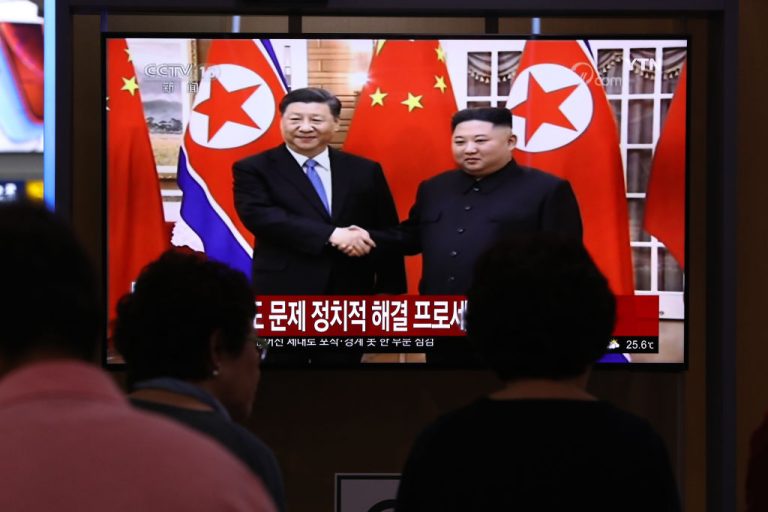
On Sept. 3 last year, Beijing staged a massive military parade marking the 80th anniversary of the end of World War II, at which Xi stood alongside Putin, North Korean leader Kim Jong-un, and the Iranian president. Several commentators noted at the time that an anti-fascist commemoration had become a gathering of the leaders most plausibly described as comprising a new axis of authoritarian states. Putin, backed by that axis, has calculated that he can outlast Western support for Ukraine. He may be right.
Xi has committed an unforgivable strategic error: backing Russia’s war in the belief that the gains outweigh the diplomatic isolation it entails. Mao Zedong, in his final years, turned against the Soviet Union and launched the Cultural Revolution partly as an expression of that rupture, a self-destructive lurch that contributed to China’s decades of immiseration. Xi, in reverse, has fused China’s strategic interests to a war of aggression whose ultimate failure will exact a price Beijing has not fully reckoned with.
Xi’s third term and the Mao comparison that haunts Beijing
2026 marks the 60th anniversary of the Cultural Revolution, the decade of political terror Mao launched in 1966 that killed hundreds of thousands and traumatized an entire civilization. Xi Jinping, who grew up in that period and whose family suffered under Mao’s purges before he rose through the Party, is now positioned for a third consecutive term as general secretary. He is 72. Putin is 73.
Mao died in 1976, aged 82. Both men may well hold power for another decade. Mao’s China at 82 was a country exhausted by purges, isolated from its neighbors, and requiring the emergency diplomacy of Nixon’s 1972 visit to end its international quarantine.
Jin Zhong is the founder of Open (開放) magazine, a Hong Kong-based Chinese dissident publication.