The mysterious death of Chinese actor Yu Menglong continues to draw global attention, with rumors spreading rapidly across social media. New revelations suggest that powerful figures bribed police to smear Yu’s reputation, while whistleblowers allege that the killers’ plot was secretly monitored and recorded by military intelligence. Analysts now say the unraveling of Yu’s case may reflect a deeper power struggle between Xi Jinping’s family and the Chinese military.
Was Yu Menglong’s case part of a Xi–PLA power game?
An unusual volume of videos and audio recordings from the crime scene—many captured with telephoto lenses and directional microphones—have surfaced online, suggesting that a professional surveillance team was tracking the events. This has added a chilling twist to the narrative.
Anti-CCP blogger “Lao Deng” claimed that Yu Menglong had obtained confidential materials from actress Yang Lanlan and, fearing for his safety, stored them as leverage. According to the account, Xi Yuanping (Xi Jinping’s brother) tasked Chen Wenqing, China’s top security official, with silencing Yu. Chen allegedly mobilized his associates and encouraged film producer Xin Qi to orchestrate the attack. Xin reportedly recruited thugs with financial incentives and even arranged passports for them to escape abroad.
But the killers may not have realized that military intelligence was shadowing their moves. Sources claim that the entire plot to murder Yu was captured by professional surveillance equipment. “The gradual exposure of the Yu Menglong case,” Lao Deng argued, “is really the unfolding of a contest between Xi’s family and the PLA.”
Independent commentator Cai Shenkun echoed the view that the case touches elite political circles. Writing on X, he identified Xin Qi—a producer with ties to the entertainment industry—as a distant relative of the Xi family, well-known in film and media circles for his “red” background.
Success
You are now signed up for our newsletter
Success
Check your email to complete sign up
Author lists 14 key doubts
Yu Menglong fell to his death on Sept. 11. Police were quick to declare there was “no criminal suspicion,” and Yu’s studio confirmed the tragic news later that evening. But many online believe his death was not accidental.
Mainland novelist “Luban,” who boasts a million followers, outlined 14 major doubts:
- Why would a young, successful actor suddenly jump to his death without warning?
- Why at a friend’s apartment?
- Why from the fifth floor, a height that doesn’t guarantee death?
- Witnesses said he landed headfirst—was he pushed rather than jumped?
- Why was the surveillance camera “out of power” that day?
- Why did he schedule a commercial performance the day after his supposed suicide?
- Why had he shown no suicidal tendencies before?
- Why were there claw marks on the window?
- Why had the protective wire netting been cut in advance?
- Why leave no farewell message for his widowed mother?
- Why were two Rolex watches belonging to a friend in his pocket?
- Why wasn’t his phone examined?
- Why weren’t the drinking companions from that night investigated?
- Why did police conclude suicide so quickly—and why did the story vanish from trending searches so fast?
Luban concluded bluntly: “All signs point to homicide.”
Cai Qi reportedly issues secret oral order to silence discussion of Yu Menglong’s death
The mysterious death of Yu has now drawn more than 20 billion views worldwide, an outpouring of attention that has reportedly rattled Beijing’s leadership. Sources claim that Cai Qi, the Chinese Communist Party (CCP) Politburo Standing Committee member in charge of propaganda, has delivered an oral “gag order” to suppress all discussion of the case.
According to the alleged directive, relayed verbally from central to local levels, no one is allowed to discuss topics that could negatively affect “social stability.” In particular, the order reportedly singled out “the recent death of a male figure in the entertainment industry,” prohibiting all commentary in any setting. Officials were instructed to convey the message orally to their subordinates and to closely monitor internal discussions.
The directive further ordered cadres to ensure that those under their jurisdiction “do not participate, do not discuss, and do not go online to watch the commotion.” Any incidents must be reported immediately. Those who violate the order would face disciplinary or legal consequences, with “serious cases to be handled swiftly and severely.”
Whether Cai Qi truly issued such instructions cannot be independently verified. However, reports have circulated that individuals who posted content about Yu have faced threats.
Netizens report death threats
Commentator Li Muyang revealed that one netizen wrote an open letter to Yu’s supporters and ordinary sympathizers, describing how he received a death threat via the Chinese video platform Bilibili (“Po Station”) in the early hours of Sept. 24.
The netizen explained that years earlier, he had uploaded two fan videos—one featuring a montage of Yu’s role as Bai Zhen, and another using footage of Yu as Xu Xian in The Legend of White Snake. Both were previously taken down by the platform. Recently, he decided to re-upload the videos so fans could revisit Yu’s work.
Soon after posting, he received a private message traced to an IP address in Guangdong. The anonymous sender warned: “If you don’t want your family destroyed, delete it immediately. The internet is not beyond the law.”
Commentator Li Muyang noted that the death threat message received by a netizen contained phrasing commonly used by CCP officials, suggesting that the sender may have been a government operative or someone involved in the case.
Leaked hush money list, Tian Hairong allegedly bribes police
Reports also allege that the so-called “female big shot” behind the Yu Menglong incident, Tian Hairong, paid 50 million yuan in hush money to dozens of residents in the Sunshine Upper East residential complex. According to Mainland real estate website Fang.com, shortly after the incident, as many as 93 second-hand units in the complex were listed for sale, priced between 11.5 million and 16.5 million yuan, fueling speculation that residents were eager to sell their properties. Real estate agents aggressively advertised the listings on social media, causing a stir online.
Netizens believe that many residents may have been aware of “inside information” and feared for their safety, prompting a rush to sell their homes. “Everyone is hurrying to sell their apartments, probably out of fear of being silenced,” one comment read.
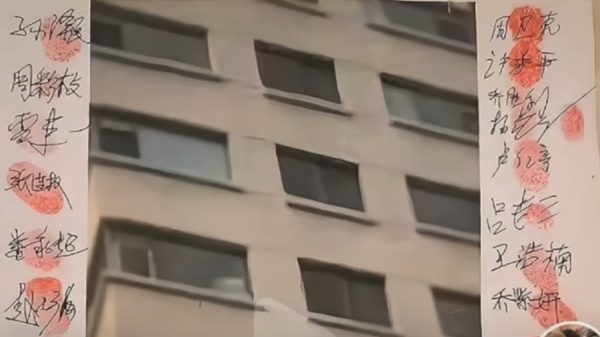
Li Muyang also revealed that he received a tip about a red-handprint list on Xiaohongshu showing Sunshine Upper East residents who allegedly accepted hush payments. The list appears to confirm efforts to silence those involved. Furthermore, capital may have bribed local police: the Chaoyang Public Security Sub-bureau issued a “police notification” the day after the incident, which Tian Hairong then shared publicly. Observant netizens immediately pointed out that Tian’s version was unwatermarked, raising suspicions of manipulation.
Another netizen noted that if Tian Hairong had used the blue-background post from Beijing Chaoyang Weibo, it would have displayed the “Ping An Beijing Chaoyang” watermark. The more times a post is forwarded, the more the watermark layers appear. However, Tian shared the police notification at 12:47 p.m. on September 22, and the image had no such watermark. Some netizens interpret this as evidence that Tian obtained the image before the official police release, suggesting possible collusion with local authorities, and raising suspicion that the Chaoyang police may have been bribed.
Commentator Li Muyang added that there are reports claiming the “villains” planned to release false information to smear Yu Menglong. “These are fabricated, even absurd,” he said, “and they colluded with the police to pin false charges on Yu.”
The earlier the leak, the closer to the truth
Hong Kong writer Feng Xigan recently posted on Facebook that since the incident, the internet has been flooded with rumors: some claim Yu allegedly signaled for help with a “540” hand gesture during a livestream, or left acrostic messages hinting “Today will be my death.” Others examined singer Jiao Maiqi’s sunglasses in photos, claiming reflections reveal glimpses of the alleged assault. Feng emphasized: “The earlier the information emerges, the closer it is to the truth.”
Feng stressed that Yu Menglong’s death is no longer just an entertainment story. “Many Chinese are realizing: if an actor with 20 million fans can die mysteriously, what hope does an ordinary person have?” A mainland netizen similarly noted, “The Yu Menglong incident is not just entertainment gossip—it is a brutal social event where an ordinary, kind-hearted youth without connections was exploited and killed by the powerful.”
Feng cautioned against taking all online claims at face value. “I don’t believe the official account of ‘drunken accidental fall,’ but that doesn’t mean we should blindly accept every alleged video, guest list, or conspiracy theory circulating online,” he said. “Spreading baseless rumors does not deliver justice for the deceased; it can indirectly help vested interests manipulate public opinion and let the truly responsible parties escape accountability.”
By Li Jingyao, Janet Huang