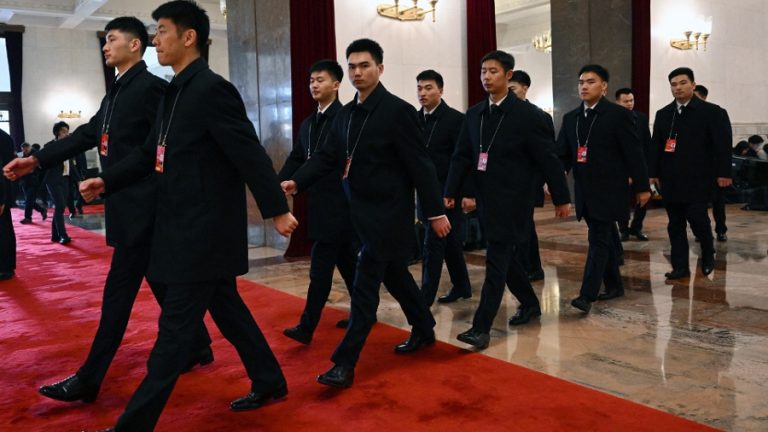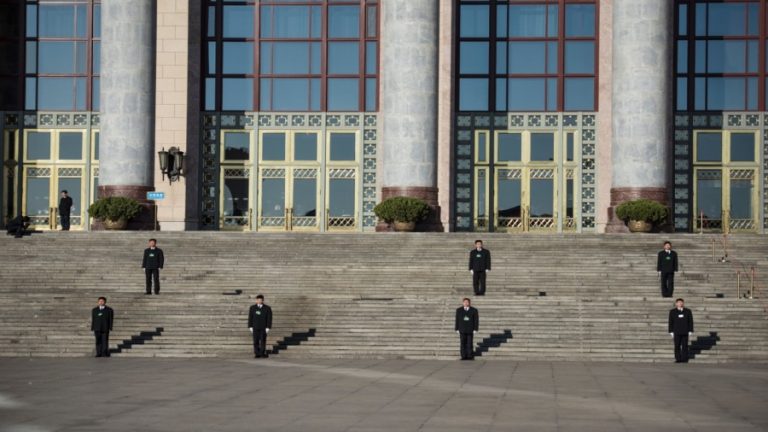
From Oct. 20 to 23, the Chinese Communist Party (CCP) is set to hold the Fourth Plenary Session of the 20th Central Committee. Analysts say internal infighting may result in unusually high absenteeism among committee members, as the number of officials “in trouble” already exceeds that during President Xi Jinping’s first anti-corruption campaign peak. Observers suggest the plenum could include unexpected political maneuvers.
The Fourth Plenary Session is a stage for power struggles
While officially billed as a meeting to “study proposals for the 15th Five-Year Plan for National Economic and Social Development,” the session is widely seen as a showcase for power struggles within the party.
The 20th Central Committee, elected at the 2022 Party Congress, initially included 205 full members and 171 alternate members. Following personnel adjustments through the Third Plenum in 2024, the committee currently comprises 203 full members and 165 alternates.
Most members were portrayed by state media as personally vetted by Xi, part of his so-called “Xi faction.” However, since mid-2023, this personnel system has reportedly begun to collapse. Rough counts indicate that 46 Central Committee members are now “in trouble,” though only 19 have been officially removed or disciplined.
36 full members affected
1 death: Yu Jianhua, head of China Customs, reportedly died in December 2024. Official reports cited “sudden illness,” but sources suggest he committed suicide following disciplinary questioning; a news article about Yu was abruptly removed, fueling speculation.
Success
You are now signed up for our newsletter
Success
Check your email to complete sign up
13 confirmed removals: Former officials include ex-Defense Minister Li Shangfu, former Rocket Force Commander Li Yuchao, former Agriculture Minister Tang Renjian, former Foreign Minister Qin Gang, former Political Work Department Director Miao Hua, Shanxi Governor Jin Xiangjun, Guangxi Chairwoman Lan Tianli, Inner Mongolia Chairwoman Wang Lixia, and former Securities Regulatory Commission Chairman Yi Huiman.
Observers note that the Fourth Plenum, like previous plenary sessions, serves less as a policy forum and more as a stage for consolidating power, signaling potential shifts within the CCP hierarchy.
Ministerial removals: Jin Zhuanglong, Minister of Industry and Information Technology, was reportedly dismissed after a period of disappearance. On September 12, both Wang Chunning, Commander of the People’s Armed Police, and Zhang Lin, Minister of the Central Military Commission’s Logistics Support Department, were stripped of their positions as National People’s Congress deputies.
Foreign affairs shake-up: Liu Jianchao, Minister of the United Front Work Department, has been missing for over two months amid reports of investigation; he was reportedly replaced in late September by former National Security Commission deputy Liu Haixing.
Military leadership under scrutiny
Eleven senior military officials have reportedly been missing or under investigation for extended periods, including:
- Vice Chairman of the Central Military Commission He Weidong
- Political Commissar of the People’s Armed Police Zhang Hongbing
- Former Southern Theater Command Commander Wang Xiubin
- Rocket Force Commander Wang Houbin
- Western Theater Command Commander Wang Haijiang
- Secretary of the Central Military Commission Political and Legal Affairs Commission Wang Renhua
- Eastern Theater Command Commander Lin Xiangyang
- Executive Deputy Director of the Central Military-Civil Fusion Committee Lei Fanpei
- Executive Deputy Director of the Political Work Department of the CMC He Hongjun (allegedly committed suicide while in military disciplinary custody)
- Former Army Political Commissar Qin Shutong
- Navy Political Commissar Yuan Huazhi
Additionally, six other Central Committee members in the military remain unaccounted for. Notably, Navy Commander Hu Zhongming was absent from the July 31 “August 1” military reception; he had reportedly been dismissed in June.
Analysts say these high-level disappearances and dismissals reflect intensified internal power struggles and may foreshadow significant shifts in the CCP and PLA hierarchy.
Central Theater Command Commander Wang Qiang and Political Commissar Xu Deqing were also absent from the “August 1” military reception. At the September 3rd military parade, the usual role of parade commander was temporarily downgraded to Lieutenant General Han Shengyan, commander of the Central Theater Air Force.
Army Commander Li Qiaoming and Political Commissar of the Information Support Forces Li Wei were also absent from the “August 1” reception for unknown reasons.
When Xi Jinping met military officers of colonel rank and above stationed in Lhasa on the afternoon of August 20, Tibet Military District Commander Wang Kai was absent, and his whereabouts are unknown.
Two officials were unusually dismissed: former Rocket Force Political Commissar Xu Zhongbo and former Strategic Support Force Commander Ju Gansheng.
Three others were reassigned or stripped of real authority: former Xinjiang Party Secretary Ma Xingrui, former Director of the CMC General Office Zhong Shaojun, and former Jilin Party Secretary Jing Junhai.
Zhong Shaojun, a close aide of Xi in the military, was reported in April 2024 to have been reassigned from Director of the CMC General Office to Political Commissar of the National Defense University; the CCP never officially announced this.
On August 19, 2025, the Singapore Ministry of Defense posted photos on Facebook showing a delegation meeting with Zhong Shaojun, but the CCP censored any domestic reports of his appearance. Recent reports indicate Zhong Shaojun may have been dismissed from his post at the National Defense University and retired from active service, though this cannot be confirmed.
Six alternates have been officially announced as under investigation, including Shanghai Party Standing Committee member Zhu Zhisong, Rocket Force Chief of Staff Sun Jinming, Yunnan Party Standing Committee member Li Shisong, Qinghai Party Standing Committee member Yang Fasen, National Railway Bureau Director Fei Dongbin, and former Guizhou Party Standing Committee member/Wu Shenghua, Party Secretary of Bijie City.
Ten alternate central committee members ‘in trouble’
Four others have been dismissed with whereabouts unknown: China Aerospace Science & Industry Corporation Chairman Yuan Jie, China Shipbuilding Group Chairman Wen Gang, Rocket Force Deputy Political Commissar Ding Xingnong, and CMC General Office Director Fang Yongxiang.
Fang Yongxiang was reportedly dismissed in March and reassigned as deputy political commissar of the Academy of Military Sciences; some reports suggest he is under investigation. When Xi met military representatives in Tibet in August and in Xinjiang in September, Fang Yongxiang was absent.
In total, more than 46 Central Committee members are reportedly “in trouble,” though only 19 have been officially confirmed. At the upcoming Fourth Plenary Session, more than 19 members are expected to be absent. Depending on the severity of the issues and factional negotiations, some under review may still attend, such as Ma Xingrui. Long-missing officials may have been secretly dealt with and cannot attend, such as He Weidong, Lei Fanpei, Yuan Jie, and Wen Gang.
Whether absent members will be announced before or after the plenum, and in what numbers, is difficult to estimate. Some of the dozens of “troubled” officials may never reappear publicly.
Not all officials “in trouble” will necessarily miss the plenum; some absences may be due to health reasons rather than disciplinary issues.
Xi Jinping’s political setbacks
During Xi’s first five years after taking power, the anti-corruption campaign saw 43 Central Committee and alternate members investigated, mostly Jiang faction and Communist Youth League affiliates. The previous 19th Central Committee had 12 officials investigated and 6 with undisclosed outcomes.
Since the 20th Central Committee took office, halfway through their five-year term, 46 officials are reportedly in trouble, many of whom were personally promoted by Xi, highlighting the political risk for his administration.
Former Foreign Minister Qin Gang was unusually fast-tracked by Xi from deputy minister to vice national-level rank in just over three months before suddenly disappearing and being removed in July 2023, making him the shortest-serving foreign minister in PRC history.
Liu Jianchao, head of the United Front Work Department, was also reportedly “missing” in July 2025 and removed from office by the end of September. Sources allege he was implicated in leaks, factional disputes, and a sex scandal.
Defense Minister Li Shangfu, who had been personally supported by Xi and sanctioned by the U.S., was removed just over five months after taking office, becoming the shortest-serving defense minister in PRC history. His predecessor Wei Fenghe was also expelled from the party and military and stripped of his general rank. Both men had received their promotions directly from Xi.
CMC member Miao Hua, another close aide of Xi, was accused of selling military positions while Xi reportedly remained aware. Similarly, He Weidong, who had been unusually promoted to CMC vice chairman despite not previously serving in key party positions, became involved in factional infighting, ultimately leading to his sudden disappearance in March 2025.
Other Xi-promoted officials have similarly fallen, undermining the so-called “Xi faction” that had risen after the 20th Party Congress. Analysts suggest these removals reflect both corruption and political disloyalty and weaken Xi’s authority.
Observers note that some argue Xi himself is removing his allies under pressure from rival factions, creating a public political embarrassment for the president.
Potential surprises at the Fourth Plenum?
Observers are closely watching whether the upcoming Fourth Plenary Session will produce any unexpected developments.
In recent years, major CCP events have occasionally been marked by shocking incidents. For example, at the closing day of the 19th Fourth Plenum, alternate Central Committee member and Chongqing deputy party secretary Ren Xuefeng reportedly jumped to his death at the Jingxi Hotel, though official reports cited “illness.” At the 20th Party Congress closing, former CCP General Secretary Hu Jintao was forcibly removed from the ceremony, drawing international attention. Earlier this year, during the September 3 Beijing military parade, state broadcaster CCTV accidentally aired a private conversation between Xi Jinping and Vladimir Putin about organ transplants and “living to 150,” sparking global controversy.
The Fourth Plenum is a secretive meeting, making it difficult for outsiders to witness events similar to Hu Jintao’s removal. However, reports such as Ren Xuefeng’s death show that the CCP’s inner workings are not entirely opaque, and some insider information may emerge during the session.
Xi Jinping’s autocratic rule, chaotic governance, and ongoing party purges have generated strong backlash both inside and outside the party. While Xi has long cultivated a “one-man rule,” the party charter formally grants plenums as the highest authority of the CCP, where all opinions can be expressed and major decisions discussed. If members feel sufficiently supported, they may dare to protest openly, reminiscent of the heated debates at Mao-era plenums such as the Lushan Conference.
Historical examples highlight the boldness of some officials: under Hu Jintao, Maoming Party Secretary Luo Yingguo was investigated for embezzling 1.6 billion RMB and maintaining over 100 mistresses. During questioning, Luo reportedly challenged investigators, saying, “If I am corrupt, then the entire system is corrupt. Why single me out?” He added, “If you want to catch all corrupt officials, start from village chiefs all the way up to the top. Who is truly innocent?” These statements were later confirmed by state media.
Similarly, under Xi’s leadership, officials like former Zhuhai Party Secretary Li Jia openly criticized systemic corruption during investigations, challenging the integrity of past provincial leaders.
By CCP convention, some officials under internal investigation can still attend plenums. For instance, on October 29, 2024, military commission member Miao Hua appeared at a provincial-level cadre seminar despite being under review; about a month later, he was officially placed on “suspension for inspection.”
The current political climate is different: Xi is seen as less dominant than before, and some disgruntled officials may feel emboldened to openly protest at the Fourth Plenum. They could publicly confront Xi, saying, for example, “I was promoted by you and did all your dirty work—why am I discarded now?” While risky, such acts could expose internal dissent, highlighting the president’s weakened control, though Xi is reportedly compelled to remove these officials regardless.
Xi Jinping digging a hole for himself
In principle, all Central Committee members are recommended by Xi Jinping’s close aide Chen Xi, approved by Xi, or directly appointed by Xi himself. The military system operates independently, with generals recommended by Xi’s military personnel chief Miao Hua and then approved by Xi. However, only Xi could promote them in such an extraordinary manner, leaving no one else to blame.
As former Maoming Party Secretary Luo Yingguo remarked, the CCP promotes corrupt officials with corrupt officials. Xi himself has said, “Corrupt governance is the greatest corruption.” As the CCP claims to be the world’s largest party, Xi could be considered the most corrupt in the country.
On Aug. 29, 2016, the CCP General Office issued the “Opinions on Preventing Cadres from Being ‘Promoted While Sick,’” which states that if such promotions cause serious harm or occur on a large scale, the party committee responsible must be held accountable. Typical cases should be publicly reported, and this includes the Central Committee itself.
Those who make the rules may one day be punished by them—when Xi faces a power crisis, opportunists could use these regulations against him. By issuing these rules, Xi is effectively digging a hole for himself.
Moreover, throughout Xi’s governance, actions such as pseudo-anti-corruption campaigns, promoting red ideological indoctrination, and mismanaging the economy have all generated widespread public anger—further creating pitfalls for himself.
(This article is exclusively authorized by The Upstream to Vision Times. Do not reproduce or plagiarize. Original link provided.)
The views and opinions expressed in this article are those of the author and do not necessarily reflect the official policy or position of Vision Times.