By Yang Tianxuan, Vision Times
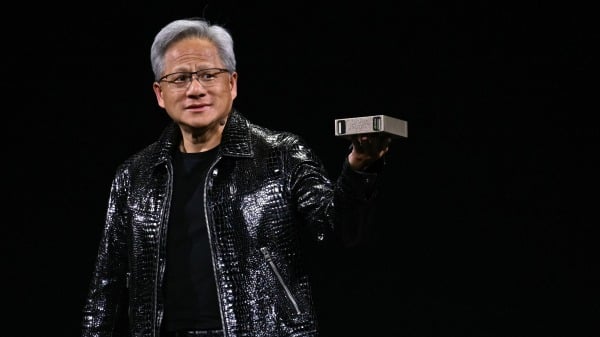
Nvidia CEO Jensen Huang sent shockwaves through the tech world when he warned that China’s chip development is “only a few nanoseconds behind” the U.S. What seemed like a passing comment instantly reignited the debate over who will lead the next era of artificial intelligence (AI). Huang’s statement underscored the shrinking technological divide between the U.S. and China in the global race for AI supremacy.
Simply put, Nvidia remains the global benchmark for AI computing power, but the Chinese Communist Party (CCP) is pouring immense state capital and political will into catching up across hardware, software, and industrial applications. Its ambition is not just to compete with the West, but to construct what he calls a “parallel AI ecosystem.”
RELATED: Google Alleges Censorship Under Biden, Pledges to Reinstate YouTube Accounts
Huang’s “few nanoseconds” remark serves as both a warning and a reluctant acknowledgment. While China still trails in single-chip performance, software maturity, and stability under high-frequency workloads, it has made rapid gains in system engineering, algorithmic efficiency, and real-world iteration — enough to challenge U.S. dominance.
Success
You are now signed up for our newsletter
Success
Check your email to complete sign up
For decades, America has led tech innovation on the world stage. But Beijing now seems determined to alter that reality, investing billions in AI, robotics, and, most critically, advanced chip manufacturing — the very core of modern technological power.
The DeepSeek phenomenon
In 2024, a little-known Chinese startup, DeepSeek, shocked the global AI community by unveiling a ChatGPT rival that could be trained at a fraction of the cost of leading Western models — a disruption many dubbed a “cost-curve event.”
DeepSeek’s breakthrough proved three key points:
- Algorithms can offset hardware gaps: Through innovations such as sparsification, Mixture-of-Experts (MoE), mixed-precision computation, memory optimization, and communication compression, DeepSeek showed that even less powerful chips could be stacked to produce competitive AI models.
- Efficiency can hedge against hardware embargoes: When high-end GPUs are restricted, architectures like DeepSeek’s become “leverage multipliers,” enabling China to expand limited computing capacity through smarter engineering — a “software-over-hardware” strategy that mitigates Western export controls.
- Market narratives are shifting: Investors increasingly realize that AI competitiveness isn’t only about chip quantity — it’s about efficiency, software synergy, and cost control. Across China’s tech sector, firms are now using domestic accelerators for inference tasks while reserving scarce high-end GPUs for training.
For the first time, Nvidia’s end-to-end dominance over the AI value chain faces a serious challenge.
Beijing’s full-stack offensive
A BBC report on Oct. 6 detailed how Chinese firms are advancing simultaneously across multiple layers of chip architecture — from AI accelerators (Huawei Ascend, Cambricon) to data center CPUs (Huawei Kunpeng) and dedicated inference NPUs. Companies like Alibaba claim its newest chip matches Nvidia’s China-only H20 GPU in performance while consuming less energy.
Despite lacking the world’s most advanced EUV lithography tools, China has turned to multi-patterned DUV and advanced packaging to bridge the gap — leveraging 2.5D and 3D integration to enhance bandwidth and interconnect density.
In networking, Chinese companies are developing ecosystems around RoCE (RDMA over Converged Ethernet) and high-density Ethernet to counter Nvidia’s NVLink/Infiniband interconnect advantage through sheer scale and optimized throughput.
On the software front, China is building a native AI development stack around Huawei’s CANN, Baidu’s MindSpore, and Alibaba’s PaddlePaddle to reduce reliance on Nvidia’s CUDA ecosystem. Huawei has even pledged to open its design and code base fully to accelerate domestic adoption.
Meanwhile, cloud and storage giants — Alibaba Cloud, Tencent Cloud, Baidu, and Huawei Cloud — are integrating hardware, models, and applications into unified delivery systems, turning Chinese-made chips into viable commercial products. This dual engine of state policy and market demand is rapidly narrowing China’s software gap, notes Huang.
Nvidia’s fortress and China’s limits
China’s progress is undeniable, but Nvidia’s entrenched advantages remain formidable. Its CUDA platform, refined over more than a decade, offers vast operator libraries, compilers, optimization tools, open-source support, and a massive developer ecosystem. This creates a powerful “path dependency” — switching costs are enormous, and replication is slow.
China still faces critical bottlenecks in its supply chain: high-bandwidth memory (HBM) remains dominated by U.S. and Korean firms, advanced packaging and testing capacity is limited, and EDA tools are controlled by Western vendors.
While Chinese chips are approaching parity in inference and predictive tasks, they continue to lag in complex analytics, long-sequence stability, and extreme-condition reliability. The absence of unified public benchmarks further limits global credibility. As computer scientist Javad Haj-Yahya noted, “China’s chips are catching up fast — but I don’t believe they can fully close the gap in the short term.”
Beyond tech: A battlefield of AI policy
The U.S.–China AI chip rivalry is no longer just technological — it has become a contest of industrial policy and national strategy.
Washington’s export bans on advanced GPUs and lithography tools strike directly at Beijing’s weakest links, while Beijing retaliates with antitrust probes against Nvidia and expanded local procurement mandates — creating a regulatory–market–capital feedback loop.
Huang continues to advocate “free trade,” while Beijing signals it can now produce chips that “match the H20.” Both sides are maneuvering for leverage — the U.S. trading time for technological dominance, and China trading market scale for autonomy.
The CCP’s goal
Beijing’s ambitions have evolved beyond catching up. The CCP aims to construct a complete, sovereign AI infrastructure — one capable of functioning independently of the West. Its blueprint includes:
- Full-stack independence: From IP and EDA tools to packaging, drivers, compilers, and cloud services — a closed, self-sustaining ecosystem.
- National computing grid: Expanding the “East Data, West Computing” initiative to treat AI computing as a public utility.
- Global software standards: Pushing domestic frameworks into international forums to gain “parallel standard” recognition alongside CUDA.
- Civil-military integration: Embedding AI across defense, telecom, energy, and finance as a force multiplier.
- Data centralization: Leveraging vast domestic data pools as a perpetual training engine.
A pragmatic approach
Rather than directly confronting Nvidia in top-tier chip performance, Beijing is pursuing a “good-enough-at-scale” strategy:
- Decoupling training and inference: Training may use limited high-end or overseas resources, while inference runs entirely on domestic hardware.
- Algorithmic amplification: MoE, sparsity, distillation, and KV-cache optimization improve throughput per watt.
- Advanced packaging and chiplets: Modular designs offset process lag and accelerate iteration.
- Software stack refinement: Continuous upgrades to domestic compilers and operators enhance reliability and ease of use.
- Network engineering: Competitive RoCE and 800G Ethernet infrastructure reduce performance gaps.
- Ecosystem leverage: State-owned and big-tech “super users” set standards and strengthen the domestic supply chain.
A 5-year race
12–18 months: Domestic chips will gain share in inference-heavy sectors such as search, advertising, customer service, and industrial vision. Nvidia will stay dominant in top-tier training but may lose market share due to policy and supply constraints.
2–3 years: China may establish one or two stable AI hardware–software platforms with mature ecosystems and practical training capability.
3–5 years: A self-sustaining AI infrastructure could emerge within China, cutting costs and boosting efficiency. Even if export barriers persist, China could secure footholds in “Global South” markets.
Semiconductor engineer Ragavendra Anjanappa predicts that “China isn’t far behind — perhaps just five years away from full independence.”
Risks and unknowns
Despite its momentum, major risks persist:
- Supply chain bottlenecks: HBM, EDA tools, and lithography remain critical vulnerabilities.
- Software inertia: Convincing developers to abandon CUDA will take years.
- Policy volatility: Export bans or geopolitical shocks could upend progress overnight.
- Overinvestment and redundancy: Excess capital could lead to wasteful duplication.
- Innovation vs. control: Heavy state direction may stifle the creative experimentation vital for breakthroughs.
In the end, Huang’s “few nanoseconds” remark captures more than a fleeting performance comparison — it symbolizes a historic struggle over who can turn computing power into a sustainable, sovereign ecosystem.
This is no longer just a race for faster chips. It is a geopolitical contest over the very architecture of intelligence itself, warns Huang.