On the eve of the Fourth Plenary Session of the Chinese Communist Party’s (CCP) 20th Central Committee, tensions between factions loyal to Xi Jinping and those opposed to him are reportedly reaching a boiling point. Unverified online accounts claim that Xi personally led a delegation to visit former President Hu Jintao, only to be turned away. According to the same reports, Hu entrusted former Premier Wang Yang to convey eight pointed messages to Xi — each said to strike like a “blow to the head,” leaving Xi visibly unsettled before hastily departing.
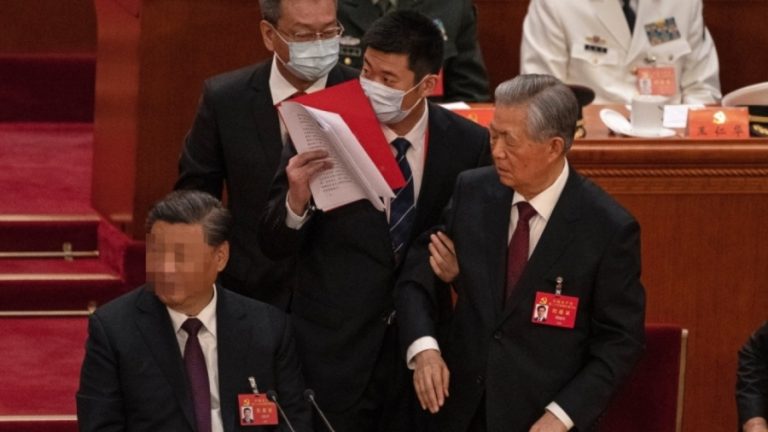
Hu Jintao was forcibly escorted out of the closing session of the CCP’s 20th National Congress, an incident that symbolized the purge of the Communist Youth League faction and the consolidation of Xi’s absolute power through constitutional revision. Since last year’s Third Plenum, rumors have circulated that Xi suffered a minor stroke, leading to shifts within the Party’s upper echelons. Reports suggest that Hu and his allies have quietly regained influence, while Xi’s control — especially over the military — is said to be waning.
With the Fourth Plenum just two weeks away, political maneuvering in Beijing has reportedly intensified. A commentator known as Shandong He claimed he received insider information from members of the “Huaxia Freedom Party” stating that Hu Jintao instructed Wang Yang to deliver eight “critical” remarks to Xi.
According to the alleged account, Xi arrived at Hu’s residence accompanied by First Lady Peng Liyuan and six members of the Politburo Standing Committee, intending to smooth tensions with Party elders ahead of the key meeting. However, Hu — citing ill health — declined to meet in person and instead sent Wang Yang to receive the delegation and convey his words.
The atmosphere was described as tense. Speaking on Hu’s behalf, Wang Yang said the former leader was unwell but had prepared several remarks for Xi to consider seriously.
Success
You are now signed up for our newsletter
Success
Check your email to complete sign up
The first four reported messages
The first message read:
“I, Hu Jintao, have already done my utmost for you. I refuse to meet before the Fourth Plenum because I am soft-hearted and fear making another mistake.”
Insiders interpreted this as Hu’s acknowledgment that he had long tolerated Xi’s rule, choosing silence at crucial moments. But with another critical Party meeting approaching, Hu reportedly decided to distance himself from factional conflict to avoid being drawn into further political turmoil.
The second message stated:
“The outcome you face is not a personal grievance between you and me — it is the collective voice of the Party, the military, and the 1.4 billion people.”
The statement, sources said, implied that discontent toward Xi within the Party, the military, and even among the public had reached a rare consensus. Although Xi’s sweeping anti-corruption campaign initially cowed the bureaucracy, it also fueled resentment among some senior officials, who began questioning his personnel choices and governing style.
The third message read:
“The only reason you wish to see me is to preserve your power — perhaps even to pursue lifelong rule or to govern from behind the scenes. This must never be allowed. I advise you to abandon such ambitions.”
According to insiders, Hu’s blunt remark exposed what he believed to be Xi’s true motive for the visit, drawing a direct line between Xi’s political maneuvering and his alleged desire for indefinite control. The tone was unmistakably admonitory, they said.
Witnesses claimed that upon hearing these words, Xi furrowed his brows and appeared visibly displeased.
The fourth message stated:
“You are already over seventy. It is time to consider your legacy. You have a vast family and empire — you cannot think only of yourself. You must also think of those who will come after you.”
This message, observers suggest, was an implicit reminder for Xi to plan for succession and avoid plunging the Party — and his own family — into uncertainty through his insistence on personal rule.
According to analysts familiar with the matter, Hu Jintao’s reminder about Xi Jinping’s age and “place in history” carried multiple layers of meaning. At over seventy himself, Hu’s words were both paternal and political — a subtle warning wrapped in elder statesman decorum. The mention of Xi’s “large family and vast fortune,” one insider noted, hinted at growing scrutiny over the financial and political interests surrounding Xi’s relatives. “It was not just personal advice,” the source said. “It was a warning — a reminder that in today’s climate of anti-corruption and internal purges, even those closest to the top are not immune.”
Hu hints at Li Keqiang’s death
The fifth message read:
“Reflect on your principles of choosing officials. Many senior military and local leaders, recently purged, rose to power through flattery and sycophancy. Your way of governing has done great harm to the country.”
According to insiders, this statement struck directly at one of the most sensitive criticisms of Xi’s rule — that his promotion system rewards loyalty over competence. The room reportedly fell silent after these words, with even the six Politburo Standing Committee members accompanying Xi showing “uneasy and shifting expressions.”
The sixth message said:
“Li Keqiang was a good comrade. His passing still pains me. He was merely a scholar, never a threat.”
Observers noted that this line, while framed as a lament, carried a sharp undertone. Li Keqiang’s sudden death in 2023 had sparked widespread speculation at home and abroad. Hu’s words, sources said, “barely veiled an accusation” — suggesting that Li’s demise may have been tied to internal power struggles.
The seventh message read:
“Your father, Xi Zhongxun, was a revolutionary I deeply respected. You should follow his spirit, not stray further down an extreme leftist path.”
Analysts said Hu’s remark was a pointed rebuke of Xi’s ideological hardening and tightening of control, contrasting it with the pragmatic and reform-minded legacy of Xi Zhongxun. “It was as much a political criticism as it was a moral one,” one source commented.
The eighth and final message delivered the heaviest blow:
“You should seriously reflect on what Chairman Mao truly meant by ‘serving the people.’”
According to witnesses, the room grew tense as Xi’s face darkened further. Insiders described the atmosphere as “frozen.” The closing remark, they said, was not just a moral reproach but a direct challenge to Xi’s legitimacy — reminding him that the Party’s power, at its core, must rest on the will of the people.
According to sources, after Wang Yang relayed eight statements from Hu Jintao, Xi Jinping offered no immediate response. He merely exchanged brief pleasantries with Wang before swiftly departing with Peng Liyuan and six members of the Politburo Standing Committee.
‘Like the sky before a storm’
Sources described Xi’s expression as dark and foreboding, “like the sky before a storm,” suggesting he was deeply shaken by Hu’s words. Peng Liyuan reportedly remained silent throughout, quietly accompanying him.
Insiders revealed that following his departure, Xi quickly convened trusted aides to discuss strategies for managing internal party pressures. Meanwhile, Hu’s eight statements began circulating in small circles, with some retired senior officials reportedly expressing agreement.
The authenticity of these reports cannot be independently verified, but they reflect Xi’s apparent struggle for survival and the heightened vigilance of anti-Xi factions within the party.
“Youth League Fraction” Makes a Comeback: Hu Chunhua and Hu Haifeng Appear in the Spotlight
Since July of last year, unusual developments have emerged within China’s political landscape. Phrases typically associated with Hu Jintao have begun reappearing in state media, signaling a high-profile return of the “Tuanpai (Youth League)” faction. Hu Chunhua, regarded as Hu Jintao’s designated successor for a generational leadership transition, and Hu Jintao’s son, Hu Haifeng, have been making increasingly prominent appearances.
‘Scientific, democratic, and law-based decision-making’
In May, Chinese state media reported Xi Jinping’s directives on “the next five-year planning requirements,” emphasizing adherence to “scientific, democratic, and law-based decision-making.” These slogans were once staples of Hu Jintao’s rhetoric and largely disappeared after Xi assumed power. Their reemergence has surprised observers.
On Aug. 22, Hu Chunhua inspected the downstream hydropower project of the Yarlung Tsangpo River in Nyingchi, Tibet. Political commentator Tang Jingyuan noted that visits by senior Chinese leaders to major projects often carry symbolic political meaning. Hu Chunhua has no historical connection to the Yarlung Tsangpo project, suggesting his visit signals a rise in his standing within the party.
On Aug. 27, Hu attended the opening ceremony of the 15th Northeast Asia Expo, delivering a speech. Analyst Zhou Xiaohui observed that Hu, who previously attended the Expo as a Politburo member and Vice Premier, now appeared in the role of Vice Chairman of the Chinese People’s Political Consultative Conference—a change that is politically significant. Meanwhile, Hu Jintao’s son, Hu Haifeng, has also been attracting attention for his recent high-profile appearances.
On June 18, 2025, the Lujiazui Forum opened in Shanghai, where Hu Haifeng, along with other high-ranking officials, unveiled the Chinese Capital Market Society. Analysts interpreted Hu Haifeng’s prominence at the event as highly unusual, reflecting the resurgence of the Tuanpai faction.
On Sept. 23, the same day Xi Jinping visited Xinjiang, the Turkish Ambassador to China posted photos of a meeting with Vice Minister of Civil Affairs Hu Haifeng. The Turkish Embassy’s official accounts on Weibo, X, and Facebook reported that Ambassador Selçuk Ünal paid a courtesy visit to Hu, exchanging views on bilateral cooperation. The post included images of the ambassador visiting Hu’s office and presenting gifts.
Tang Jingyuan highlighted that the visit was highly unusual. Hu Haifeng, as the fourth-ranked Vice Minister of Civil Affairs, oversees social organization management, social assistance, child welfare, and elderly services, with no connection to foreign affairs. Tang suggested the visit was aimed at Hu Haifeng because of his status as Hu Jintao’s son. “Frankly, it’s a message directed at Hu Jintao,” he said.
By Li Jingyao, Janet Huang