Self‑media author Edward Wenming has made startling public claims: that Yu Menglong’s death was not accidental, but part of a ritualistic sacrifice.
Here is what he claims:
“Hello everyone, I am Edward Wenming. It’s been over twenty days since Yu Menglong’s death, yet the public remains riveted. To be honest, I didn’t focus much on it at first—cases of murder, trafficking, and forced organ harvesting are disturbingly common in the CCP’s China, and one becomes numb.
Recently, a self‑media insider known as ‘Youliao’ leaked an explosive allegation: Yu’s death was a sacrifice. Youliao claims to be a retired senior CCP official who once had access to Politburo proceedings. He asserts that Yu was ritualistically chosen because he shares the birthdate June 15 with Xi Jinping—thus becoming a “substitute victim.”
Youliao goes further, revealing what he calls the CCP’s deepest secret: each year, the regime allegedly sacrifices 300 children in the Kunlun Mountains. In times of crisis, he claims, hundreds are selected and transported for occult ceremonies—locals have even discovered piles of human bones in remote areas. He argues this help explain why so many disappeared children remain untraceable, even under heavy surveillance.
Success
You are now signed up for our newsletter
Success
Check your email to complete sign up
The U.S. journal Foreign Policy recently weighed in on the controversy, referring to a folk belief: that when a ruler’s lifespan wanes, one born on the same day—sharing a life “pattern”—is chosen as a sacrificial substitute.
At first, I dismissed these as conspiracy noise. But after watching a program by feng shui master Ma Xian, my skepticism faltered. He cross‑examined texts on “life‑extension” occult arts, and many details lined up eerily with the Yu case—strange injuries, date coincidences, ritual indicators. Previously I suspected foul play; I never suspected ritual sacrifice tied to CCP elites. After Ma’s exposition, my worldview shifted.
Xi Jinping is said to believe deeply in the supernatural—and he is not alone. Many CCP leaders are rumored to seek more than political power: temples, remote mountains, Tibetan rites—they allegedly pursue dark rituals not to heal but to prolong life via human sacrifice.
Ancient secrets and modern echoes
In classical texts rooted in Daoist tradition, life‑extension techniques are recorded. In Romance of the Three Kingdoms, Zhuge Liang is said to use such arts during the Wuzhangyuan Campaign—though his method is portrayed as symbolic, not destructive. But occult arts that harm others have long lurked in the shadows.
Ma Xian cites ancient works like Sea Eye, One Grain Valley, Land Eye that document imperial rituals and secret life‑extension methods—strictly forbidden knowledge in antiquity. Yet he finds too many “coincidences” between them and the modern Yu case: entire networks of ritual logic, spatial alignments, and uncanny patterns he cannot ignore. He shares them now, begging someone to explain how so many parallels could arise.
Consider the date coincidence: ancient emperors often initiated rituals 49 days before a major rite. Yu died on Sept. 11; 49 days later is Oct. 20—the day Beijing hosts the CCP’s 4th Plenum.
Ma also revisits the case of Qiao Renliang, who died Sept. 12, 2016. Though media declared suicide, rumors claim Qiao was sacrificed to absorb karmic burden tied to Xi’s father, Xi Zhongxun. Both share a birthday—October 15—and in classical astrology, Qiao’s “day pillar” is said to generate Xi’s element, making him an ideal proxy in occult lore.
Ritual details and striking coincidences in Yu Menglong’s death
Feng shui expert Ma Xian claims that ancient rituals of life extension originally employed mummies—but later evolved to use living humans, effectively creating “living mummies.” He insists that sacrificial rites must involve bloodshed, the opening of the skull to produce a “regenerative brain,” and mutilation to genital and anal areas. Rumors swirl online that Yu’s body bore such signs, though none are verifiable.
He also invokes a ritual known as “soul procession” (开生路 / 持魂巡游). According to witnesses, just before his death, Yu was captured on camera, barely conscious, being carried along a residential hallway corridor.
If these claims are valid, they mirror the soul procession motif—but is it mere coincidence? In occult lore, when living humans are used as sacrifice, anomalous weather often precedes or follows their passing. Ma cites the “blood moon” of Sept. 7–8, strong winds, lightning without thunder—all present. On the night of Yu’s death (around midnight Sept.10), lightning flickered for twenty minutes behind heavy clouds—yet there was no thunder, no rain, no audible disturbance. Just light.
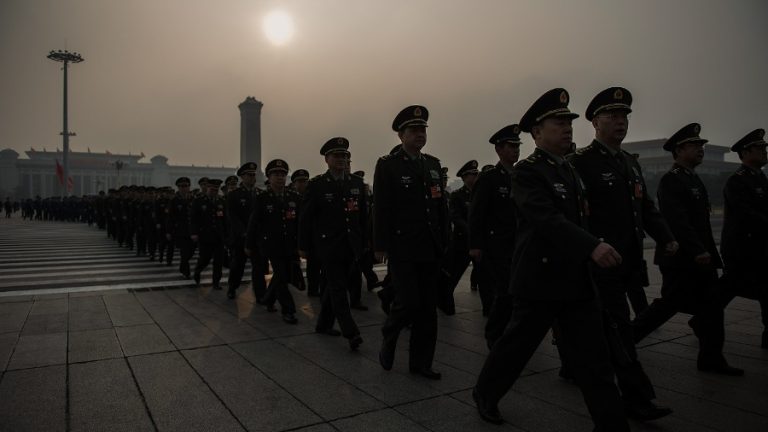
Another ritual requirement: pre‑rites tradition holds that “flags and drums” must herald sacrifice ceremonies, often days before. On September 3, Beijing held a grand military parade—exactly seven days before Yu’s death—aligning with a seven‑day preparatory ritual period (Sept. 3 to Sept. 11). Ma argues true human sacrifice only begins after the full preparatory week.
Occult ritual must occur in one’s benming (zodiac) year. Xi Jinping’s current year is the snake year—his zodiac year—marked in ritual tradition as requiring spiritual sustenance. Ma points to Yu’s two limited‑edition Rolex watches, whose dials bear concentric circles—paralleling the ritual’s requirement for paired concentric “soul stones.”
Ma further describes the doctrine of three souls and seven po (魄). At death, one soul ascends, one remains, one descends. The seven po must be guided by seven individuals, with ten assistants—totaling 17. Remarkably, the gathering before Yu’s death included 17 people, Ma notes.
These seven po bear names: Shigou, Fushi, Queyin, Tunzei, Feidu, Chuhui, Choufèi. Each assigned one po in proper sequence—and the first bearer is to shout “Good to eat” during procession.
Shortly postmortem, Cheng Qingsong posted two Chinese characters on Weibo. Many interpreted them as “好吃” (“Good to eat”). Subsequent shouts allegedly followed: “good to wear,” “good lust,” “good gamble,” “good goods,” “good greed,” and “good miscellaneous affairs.” After the ritual, they collected fingernails, concentric‑patterned items, and a local “dragon whisker water” allegedly found near his apartment building—hence their lack of hesitation at that site.
Ma describes further macabre rites: rituals performed in 256 bone joints, bone crevices—Yu’s body purportedly dissected for occult power. The staged corpse beneath, dismemberment pre‑staged. Qiao Renliang, too, is rumored to have died fragmented.
Traditional sacrifice demands innocent boys and girls. From the entertainment company Tianyu, four individuals died—Qiao Renliang, Benxi, Ren Jiao, and Yu Menglong (two men, two women). Two fell from heights; two allegedly committed suicide. Coincidence?
Artists, ‘corpse raising,’ and the role of the agent
Recent reports indicate that Cheng Qingsong has fallen ill and been hospitalized, with claims of disorientation and mental distress. According to ancient ritual texts, anyone who conducts a sacrificial rite without pure virtue—or bungles the ritual—faces retaliation from vengeful spirits within 49 days, possibly even fatal. Observers now suggest that signs of such spiritual retribution may be manifesting.
Why select artists? In occult numerology, artists are believed to embody both masculine and feminine qualities—they may straddle both genders in energetic form. Such duality is considered ideal for ritual use, making artists uniquely suitable. These individuals are reportedly identified years in advance, entering a period of preparation called “corpse raising” (养尸).
In the months before sacrifice, the subject is often restricted to a vegetarian diet. Formerly, Yu Menglong mentioned that he went days eating little but vegetables. Actor Qiao Renliang, who tragically died in 2016, is said to have adopted vegetarianism before his death—a detail some interpret as part of ritual buildup. Thus, some claim Yu may have known his fate long before his final moment and was monitored discreetly.
One name draws scrutiny: Du Qiang, alleged as Yu’s agent, is said to specialize in these ritual undertakings. In 2015—one year before Qiao’s death—he posted a macabre video involving ceremonial cake cutting. That video, and cryptic text he posted alongside (“The whole can become pieces, but pieces can never rebuild the whole”), is viewed by some as rehearsing occult methods.
Perhaps Yu’s selection began when Du assumed his representation. Du may have had influence over Yu’s schedule, entourage, and daily movements—potentially without Yu’s full awareness of his role as a ritual candidate. Leaked reports suggest Yu was drawn into secret group chats where ominous plans were made; he came to suspect these were orchestrated against him. Viewed this way, theories about U‑disk smuggling or laundering evidence may be distractions—not the true motive.
Ma Xian points to a striking coincidence: during the Sept. 3 large military parade, Xi reportedly told Putin and Kim Jong Un, “At 70, I’m still a child; I expect to live to 150.” That bold claim seems to echo ritual ambition. Could this lie at the heart of the occult power structure?
Occult ritual mechanics and divine retribution
Feng shui master Ma Xian describes the occult logic behind ritual sacrifice: to prevent the spirit from ascending to heaven and lodging complaints, the skull must be violently opened—this ritual “brain cracking” blocks the soul’s celestial path. In occult belief, the soul (hun) resides in the liver and connects to the brain; once that link is severed, the victim cannot appeal to heaven, and their suffering escapes cosmic record.
But mortal deceptions cannot hide from divine oversight. He asserts that celestial beings are dispatched to investigate aggrieved souls—especially those meant for heaven or those born from heavenly origin.
To fully sever the soul’s route, practitioners must also extract the seven po, dismembering them through the body’s lower channels. In ritual doctrine, po dwell in the lungs and descend via the “valley path”—the body’s undercarriage. After the soul departs, ritual assistants must retrieve the po in a process known in antiquity as the yin corpse soul‑gathering ritual, a method alleged to fabricate fate and grant unnatural longevity, even up to 150 years.
Ma warns that these dark arts do not fear the underworld—they fear the heavens. Believing they can trap souls and silence them, perpetrators err: the soul, even in the nether realms, can still petition for justice. Illicit life creation defies cosmic order, incurring the rage of deities. Within 100 days, ritual actors provoke spiritual contagion that spawns disaster omens.
In this worldview, every layer of ritual—from the sacrificers at ground level to the elites seeking extended life—must ultimately face retribution from both heaven and the nether courts. Their craft, Ma cautions, yields violence not only in execution, but in cosmic reckoning.