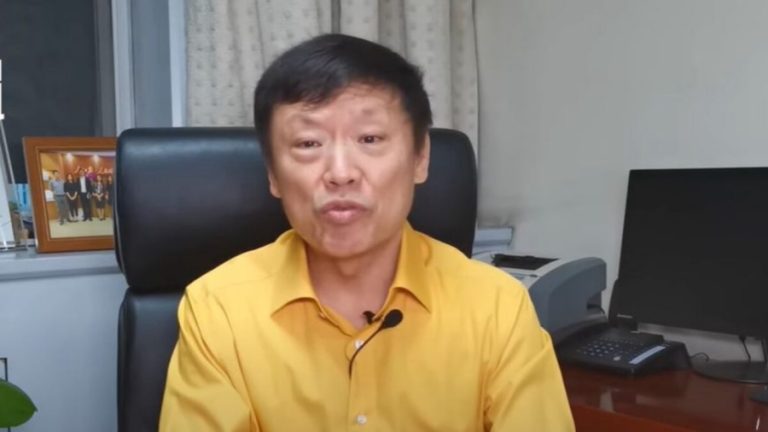
Former Global Times editor-in-chief Hu Xijin, long regarded as one of the Chinese Communist Party’s most loyal media figures, has sparked unusual discussion after lamenting that public voices in China’s social media space are “falling silent.” His remarks, posted on Weibo on Oct. 13, were read by many as a subtle critique of Xi Jinping’s tightening control — and, by some, even as a hint that the time has come for change at the top.
In his Weibo post, Hu wrote that more and more Chinese citizens — from celebrities to professors to private entrepreneurs — now speak “increasingly cautiously,” or not at all, on social media.
“In the past, celebrities used to chat about daily life. Now their feeds are filled only with official announcements,” he wrote. “People within the system post nothing personal. Even university lecturers, now considered a ‘sensitive group,’ rarely express opinions. Their pages are as clean as fields after the autumn harvest.”
Hu went on to describe an atmosphere of fear and conformity: institutions avoid controversy, private firms dismiss employees over online remarks, and “the risk of speaking publicly has become much higher.”
Still, the veteran propagandist stopped short of blaming censorship. Instead, he argued that “the real reason is that society’s tolerance has declined,” and urged that “within the constitutional order under the Party’s leadership, we should still be as relaxed as possible.”
Success
You are now signed up for our newsletter
Success
Check your email to complete sign up
An unlikely outburst — and a political signal
Hu’s unexpected post drew wide attention precisely because he has long been known for his caution. Under Xi’s leadership, China’s online speech has been subject to the harshest restrictions in four decades, observers say.
U.S.-based entrepreneur Hu Liren commented on X (formerly Twitter):
“Xi Jinping’s digital surveillance system now builds a ‘political file’ on every citizen. The control is far stricter than Mao’s time. When even Hu Xijin dares to complain, it signals cracks within the system.”
Political commentator Chen Pokong noted that Hu’s post may serve as a “political weather vane.”
“Hu Xijin is usually timid — during his time at Global Times he often hid in his office after publishing risky pieces,” Chen said in a YouTube commentary. “For him to speak out now suggests that someone powerful is backing him — a ‘higher hand’ sending a message ahead of the Fourth Plenum.”
Chen further suggested that Hu’s remarks could also allude to the Yu Menglong or Yang Lanlan controversies — two stories that, according to Chinese social-media users, authorities have aggressively censored online.
“In one of those cases,” Chen explained, “a 23-year-old Chinese woman living in Australia was said to possess enormous wealth, drive luxury cars, and initially avoid appearing in court. Rumors claimed that Chinese interests offered about 2 billion yuan as a hush payment, calling it an ‘investment’ in Australian mining. When she was later forced to appear in court, Beijing reportedly retaliated by halting imports of Australian iron ore.”
“By saying that an ‘open society should not fall silent,’ Hu was indirectly pointing to such politically sensitive stories,” Chen added. “He knows these scandals expose the system’s decay — and that is precisely what Xi’s hardliners fear most.”
Criticism hidden between the lines
While Hu attributed the “silence” to social intolerance, Chen believes it was a veiled jab at Xi’s leadership style.
“Hu’s sentence lacks a subject — ‘tolerance has declined.’ Declined because of what, or whom? He knows the answer but avoids naming it,” Chen said. “This is his way of testing boundaries.”
Analysts noted that by describing China’s public sphere as “no longer that of an open society,” Hu was implicitly rejecting the ideological tightening under Xi. “The subtext,” said Chen, “is clear: he wants the Fourth Plenum to mark an end to the hardline, ultra-left course.”
Several commentators speculated that Hu would not have spoken so boldly without protection.
“In China, when someone as cautious as Hu Xijin starts releasing signals, it usually means he’s acting under instruction from higher up,” Chen said. “It’s part of the information warfare inside the Party — a way to test public reaction before internal decisions.”
Political analyst Li Linyi echoed that view, saying Hu belongs to an older propaganda faction linked to Wang Huning rather than current top ideologue Cai Qi. “The timing is sensitive,” Li said. “Even a mild statement about ‘tolerance’ can carry hidden meaning when the Party’s elite are locked in factional struggle.”
Netizens: ‘Drawing out the snakes’
Hu’s post quickly drew a wave of sarcastic reactions online. Many users accused him of playing his familiar role as the Party’s “snake charmer.”
“Old Hu is at it again — helping the Party draw snakes out of their holes,” one comment read. “If the snakes don’t come out, how will the censors do their job? With online police sitting idle and paid commentators desperate to complete their ‘tasks,’ they’ve started over-policing ordinary users. That’s exactly the ‘phenomenon’ Hu describes. Isn’t that what you wanted? You get what you asked for. Once the Communist Party steps down, without its ‘leadership,’ we’ll finally hear real voices and truth. The real question is: you can only choose one — the Party’s leadership or free speech.”
Others were blunter:
“A typical two-faced man.”
“Hu thinks things are too strict — I think they’re still too loose. Otherwise this fence-sitter would’ve been banned from all platforms long ago.”
“Keeping quiet is his biggest contribution to society.”
“Where was his ‘caution’ when he called for shooting down Pelosi’s plane?”
“Where was his restraint when he hinted online about taking out America’s No. 3 leader for clicks?”
To many observers, Hu’s remarks were less about courage than calibration — a signal carefully timed before the Party’s upcoming Fourth Plenum, amid reports of deepening factional rifts.
Whether he was voicing genuine concern over China’s shrinking space for speech or simply performing his old role as a loyal “weather vane,” one thing seems clear: even the Party’s most trusted propagandists now sense that the political winds may be shifting.