After more than a decade of unrivaled dominance, Chinese leader Xi Jinping is facing a moment of rare vulnerability.
Unverified reports suggest that Xi may have suffered a stroke, sparking speculation about his health and the future of China’s centralized power structure.
In the opaque world of Chinese Communist Party (CCP) politics, health is never just a private matter—it is a measure of legitimacy.
When the leader weakens, the entire system begins to tremble.
As one Beijing-based observer put it, “When the body of the emperor falters, the empire shakes.”
Success
You are now signed up for our newsletter
Success
Check your email to complete sign up
On Oct. 14, Chinese state television aired footage of Xi Jinping meeting with Ghana’s President in Beijing.
What caught viewers’ attention was not the meeting itself, but Xi’s appearance. In the video, his complexion looked pale and lifeless, his lips drained of color, and his face appeared slightly swollen.
His eyes seemed vacant, his expression tense, and his overall demeanor unusually fatigued.
The images reignited rumors about Xi’s health that had circulated earlier in the week. Several overseas Chinese commentators claimed that Xi had recently been hospitalized for a stroke, citing sources inside the Party.
While none of these claims have been independently verified, analysts noted that the tightly edited state broadcast—showing Xi sitting stiffly and speaking little—suggested an attempt to control public perception.
Delegating diplomacy—or avoiding exposure?
At almost the same time, Premier Li Qiang traveled to Pyongyang for a high-profile meeting with North Korean leader Kim Jong-un—a role typically reserved for Xi himself.
The visit was formally described as a routine diplomatic engagement, but analysts interpreted it differently.
“For a leader who has centralized all power, letting someone else represent China on the world stage is remarkable,” said a Hong Kong-based political analyst.
“It suggests either illness, or extreme caution about showing weakness abroad.”
Li’s meeting was cordial and ceremonial. Yet the mere fact that Xi stayed home fed speculation that China’s top leadership may be quietly adjusting to his limited capacity.
The timing could not be more sensitive.The CCP’s 20th Central Committee Fourth Plenary Session—a major political gathering that sets long-term direction—is expected within weeks.
Rumors that Xi may be incapacitated have coincided with reports of intensified factional maneuvering inside the Party.
Overseas commentators noted that for several days, Xi’s name was absent from the front page of People’s Daily, a rare omission since his rise to power in 2012.
“The Party is pretending all is normal,” one former insider said, “but behind closed doors, everyone is watching for the next sign.”
History’s recurring pattern
If true, Xi’s situation would echo a familiar pattern among Communist strongmen.
From Lenin to Stalin, many authoritarian rulers saw their health collapse near the end of their reigns.
Lenin suffered a series of debilitating strokes that left him unable to speak, while Stalin’s massive stroke in 1953 brought his rule—and an entire era—to an end.
Analysts say the same dynamic persists today: when all power is concentrated in one person, the leader’s body becomes the body of the state itself.
“The CCP can control everything except mortality,” said an independent scholar in Taiwan.
“When the leader’s health becomes a secret, it means the system has no plan for his absence.”
In one-man systems, illness becomes both metaphor and warning—a reminder that even absolute power cannot command time.
Beyond politics, some Chinese commentators frame Xi’s rumored illness through the lens of traditional superstition.
A popular online theory links recent events to the legend of “dragon veins” (龙脉)—a geomantic belief that mountain ranges and rivers channel a nation’s life force.
According to this narrative, large-scale construction near the Qinling Mountains—a site long associated with China’s imperial lineage—has “severed the dragon vein,” symbolically cutting off the regime’s fortune.
While state media dismiss such claims as nonsense, their persistence reveals how deeply superstition still shapes public perception.
In online forums, users described Xi’s rumored stroke as “heaven’s warning,” suggesting that excessive control and corruption have disturbed the natural order.
“People may not believe in democracy,” one Chinese commentator wrote, “but they still believe in karma.”
A system built on one man’s health
Since abolishing presidential term limits in 2018, Xi has dismantled collective leadership in favor of personal rule.
That centralization has given him enormous control—but also made the system dangerously brittle.
“If Xi is incapacitated, there’s no clear mechanism for succession,” noted a political scientist in Singapore. “He spent a decade eliminating rivals and alternative power centers. Now there’s no one left to share the burden.”
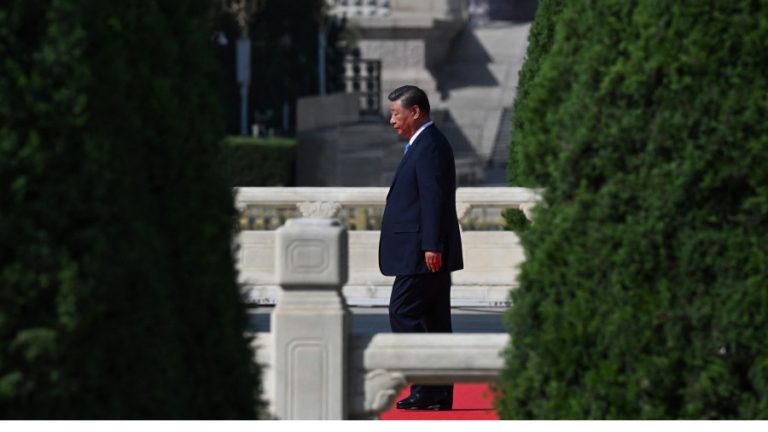
For that reason, every public image of Xi—every handshake, every edited broadcast—carries symbolic weight.
His vitality is treated as proof of the Party’s stability; any hint of frailty becomes a national question.
Whether Xi has truly suffered a stroke remains unverified. But the frenzy surrounding his health underscores a broader reality: in a system built on secrecy, rumor becomes its own form of truth. Each whisper of illness or “dragon vein curse” reflects a growing anxiety inside the Party and among ordinary citizens—that power without transparency is power without safety.
For now, Xi continues to appear in state media, his movements slow but deliberate.
Yet beneath the silence, an unspoken question lingers: Can a system built around one man survive when that man falters?
Editorial Note:
This article draws from Chinese-language commentary, video footage, and analysis by independent scholars and overseas media.
All health-related claims regarding Xi Jinping remain unverified.
They are presented here solely to illustrate the intersection of secrecy, symbolism, and political power in contemporary China.