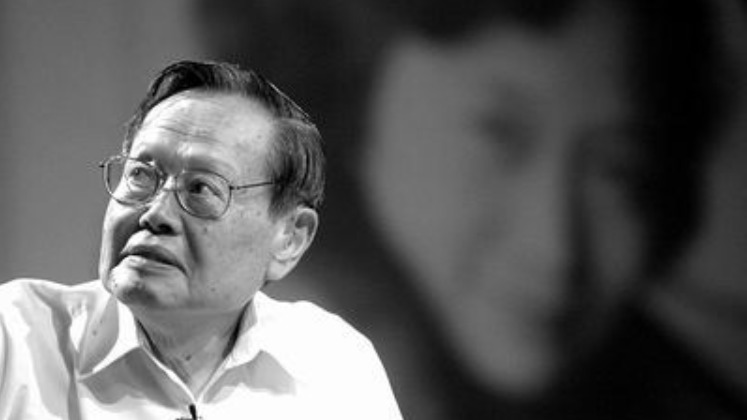
Renowned physicist Yang Zhenning (Chen-Ning Yang), a Nobel laureate and academician of the Chinese Academy of Sciences, passed away in Beijing on Oct.18, 2025, according to Chinese state media. He had just celebrated his 103rd birthday on October 1.
China Central Television (CCTV) reported that Yang, who served as a professor at Tsinghua
University and honorary director of its Institute for Advanced Study, died of illness in Beijing.
Born on Oct. 1, 1922, in Hefei, Anhui Province, Yang studied at the National Southwestern Associated University during World War II, earning his bachelor’s and master’s degrees in physics.
In 1945, he traveled to the United States on a government scholarship and earned his Ph.D. from the University of Chicago in 1948.
Success
You are now signed up for our newsletter
Success
Check your email to complete sign up
Yang, together with physicist Tsung-Dao Lee, proposed the theory of parity violation, a groundbreaking concept that challenged fundamental assumptions of particle physics. The discovery earned them the 1957 Nobel Prize in Physics, making Yang one of the first Chinese scientists to receive the honor.
In 1954, Yang and Robert Mills developed the non-Abelian gauge field theory, later known as the Yang–Mills theory, which became a cornerstone of modern quantum field theory.
After decades in the United States, Yang returned to China in the early 2000s and took a professorship at Tsinghua University.
In 2015, he renounced his U.S. citizenship and formally became a Chinese citizen.
In 2022, he was named one of the “People Who Moved China” for 2021 by state broadcaster CCTV, reflecting Beijing’s continued recognition of his contributions.
Personal life and public attention
In recent years, public interest in Yang focused less on his scientific legacy and more on his personal life.
In December 2004, a year after the death of his first wife Du Zhili, Yang, then 82, married 28-year-old Weng Fan, a graduate student at the Guangdong University of Foreign Studies — a union that drew worldwide attention due to their 54-year age gap.
Yang often referred to Weng as “a sweet angel” and “God’s final gift.” In a television interview, he remarked, “When I leave this world, I want Weng Fan to know she can remarry.”
According to Hong Kong’s 01 News, Du Zhili — the daughter of Republic of China Army General Du Yuming — married Yang in 1950 in Princeton, New Jersey. The couple had two sons and a daughter and were married for 53 years until Du’s passing in 2003.
Reports have long suggested that Yang’s status in China afforded him considerable protection and privilege. In his early career, he was personally received by Premier Zhou Enlai, and after his return to China, he remained closely connected to senior Communist Party officials.
Some observers speculated that his later years — including his marriage to Weng — were accompanied by political facilitation and official oversight, though such claims remain unverified. The couple’s continued media presence and institutional support, however, underscored the extent of Yang’s influence and the state’s symbolic investment in his legacy.
A life that bridged two worlds
Yang Zhenning’s century-long life embodied the trajectory of 20th-century Chinese science — from wartime scholarship to global recognition and eventual return to a transformed homeland.
For many, he represented China’s early generation of scientists who brought Western scientific rigor to a country in search of modern identity.
Even amid debate over his political choices, Yang’s contributions to modern physics remain monumental, his theories continuing to shape the scientific landscape decades after their conception.