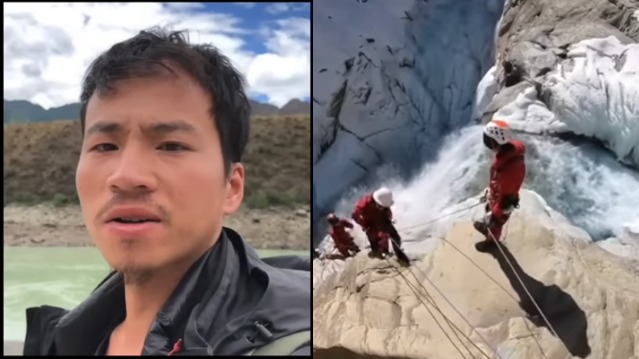
Over seven years, Wang Xiangjun trekked to more than 70 glaciers, capturing footage that drew global attention to climate change.
In 2019, he attended the UN Climate Change Conference (COP25) in Madrid, where he presented his photography to scientists and journalists.
His work earned him the nickname “Glacier Brother,” and millions followed his social-media accounts for breathtaking images from Tibet’s frozen peaks.
According to the Public Security Bureau of Jiali County, Wang fell into a river on Dec. 20, 2020, during an expedition in northern Tibet.
Search teams conducted seven operations but initially failed to locate him. A Feb. 22, 2021 police bulletin concluded that witness testimony, video evidence, and forensic results supported an accidental drowning, dismissing online rumors.
Success
You are now signed up for our newsletter
Success
Check your email to complete sign up
A follow-up notice on Mar. 14 confirmed that his body had been recovered and authorities ruled out homicide.
Public doubt and unanswered questions
Despite the official findings, skepticism persisted.
Social media users claimed that audio from Wang’s final video — after digital noise reduction — contained phrases such as “He’s still bleeding” and “Don’t talk — he’s dead.”
Authorities never addressed the recording’s authenticity.
Wang’s younger brother later denied allegations of foul play, explaining that the video had been filmed earlier and was uploaded automatically.
He acknowledged, however, that the footage’s background did not match the location where Wang went missing.
In recent months, a commentator known as “Caijing Lengyan” revived the discussion, calling Wang’s death “highly suspicious.”
According to unverified online claims, Wang had filmed helicopters marked “International Medical” flying repeatedly over Tibet.
Netizens traced similar aircraft to hospital helipads in Xi’an and Luoyang and speculated — without evidence — that they were used for organ transport.
Other online narratives alleged that Wang had mentioned missing travelers in Tibet’s glacier zones and referred to the area as a “large organ bank.”
He reportedly spoke of underground tunnels linking China and Nepal and filmed luxury villas in secluded valleys where public figures allegedly appeared — none of which can be independently verified.
Disturbing imagery and reactions
Clips posted online also showed partially burned ID cards said to belong to female students, triggering alarm and speculation.
Wang allegedly warned followers not to visit Motuo County, claiming that “black shops” there poisoned travelers and that “thousands have gone into the mountains and never returned.”
Viewers of Wang’s last livestream described him as fearful and disoriented, claiming he blinked in response to messages asking if he had been kidnapped — again, no evidence supports these accounts.
Online commentators compared Wang’s case with other high-profile Chinese deaths — including actors Yu Menglong and Qiao Renliang — suggesting a pattern of official denial and family coercion.
No investigation has confirmed any such links. Still, the theories resonated with many Chinese netizens.
“My God, China is terrifying,” one user wrote. “So many people disappear, and no one ever finds out why.”
Others expressed admiration for Wang’s courage to explore Tibet’s most remote and politically sensitive regions.
“He filmed what others feared to see,” one comment read. “Maybe that’s why he never came back.”
Five years after his death, Wang Xiangjun remains a polarizing figure — honored by environmentalists as a pioneer and remembered by others as a victim of secrecy.
Official records describe an accident, yet the persistence of online speculation reflects deep public mistrust toward the Chinese regime’s handling of unexplained deaths and censorship of sensitive cases.
For many, Wang’s death has become a symbol of modern China’s contradictions — a country eager to promote environmental achievements abroad while concealing uncomfortable truths at home.
“Whether he drowned or was silenced,” one overseas blogger wrote, “Wang Xiangjun revealed more about China than any video could show.”
By Siyun Cai