To watch the full episode, please click on the FinalWar’s official YouTube channel here.
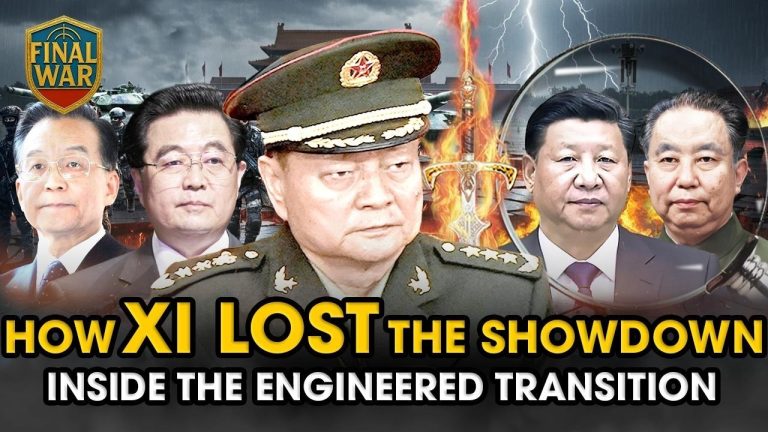
Chinese leader Xi Jinping’s covert security unit has been exposed — and that, insiders say, was “the last straw — the moment Beijing decided he had to go.” In the latest FinalWar episode, host Katherine Hu reveals how China’s ruler “has entered the ‘Hua Guofeng mode.’ But behind Beijing’s sealed doors, how can we tell if he’s truly out — or just wearing the mask of power?”
What follows is the story of how Xi’s exit was engineered, concealed, and modeled on the Party’s own history of quiet removals.
RELATED: 13 Xi-Appointed Generals Fall in Rocket Force Scandal as CCP Infighting Escalates
An engineered transition
“In our last episode,” Hu explains, “we exposed what Beijing has tried hardest to conceal. Inside the Fourth Plenary Session, Xi was forced to make a self-criticism, submitted his resignation, and handed over both the Party and the military. In essence, he is no longer the director of the system—he has become the actor left on stage.”
Success
You are now signed up for our newsletter
Success
Check your email to complete sign up
The real figure now directing Party affairs, Hu notes, is Wang Yang, the reformist leader whose rise began at that same session.
Hu continues: “Of course, this story runs completely against the official narrative, and that’s why reactions have been split—some believe it, others don’t. That’s normal.” Her report describes how “insider information always comes early,” and the program will keep tracking signs “to answer one question: Does Xi still hold real power?”
Xi’s ‘private army’
Just as the Fourth Plenary Session ended, former Party School professor Cai Xia dropped a revelation that “stunned even Beijing’s inner circle.” According to Cai, Xi’s two most powerful generals — He Weidong and Miao Hua — “had secretly formed a private force under his command to carry out covert military operations.”
RELATED: Xi Jinping’s ‘Private Army’ Exposes Deep Fractures Within the CCP’s Top Ranks
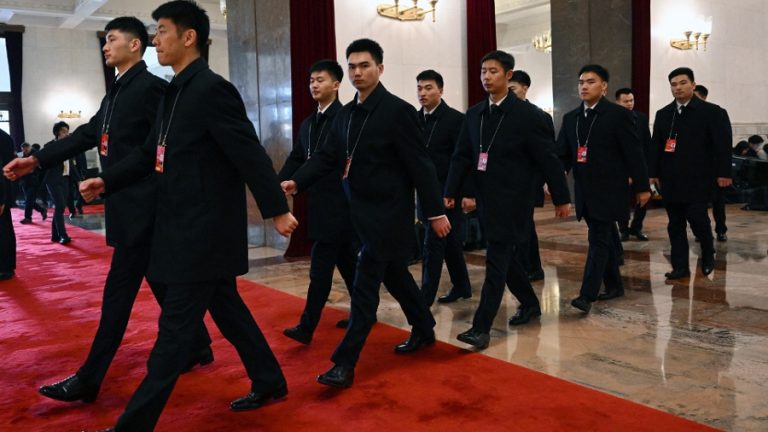
Cai said the unit, based in Langfang City less than an hour from Zhongnanhai, was “completely independent from all existing theater commands and the regular military structure.” It answered only to Miao and He, “and refused directives from any other military institution.” This force, Hu notes, was designed as a “shadow layer of defense beyond Beijing’s official security perimeter — an extra ring of personal protection and political leverage designed exclusively for Xi.”
Cai later told audiences that she had known of the unit through contacts among “military second-generation reds” but waited until after the Fourth Plenary Session to speak. Her conclusion was unequivocal: “The purpose of the unit was unmistakable. It was a personal security force custom-built for Xi by Miao Hua and He Weidong, essentially Xi’s own secret force.”
Former naval officer Yao Cheng later confirmed “similar intelligence,” calling the group a potential “covert security force rebellion.” By then, many of Xi’s hand-picked generals had been purged, and Beijing had entered what Hu calls “the great power seizure case.”
The great power seizure
After the nine top generals were purged, the “Liberation Army Daily” published an extraordinary editorial accusing them of “losing loyalty and integrity,” “seriously undermining the principle that the Party commands the gun,” and “seriously damaging the CMC Chairman responsibility system.” Hu explains: “In the language of CCP politics, every word in that editorial carried the weight of a hammer.”
These charges did not refer to ordinary corruption but to “an organized attempt to seize control of the Party and the army.” Faced with the exposure of his secret force and evidence linking him to the death of former Premier Li Keqiang, Hu reports, “Xi had no choice but to submit his resignation at the Party’s highest-level meeting.”
Yet “what followed was not justice; it was compromise.” Under the banner of “saving the Party,” the elders staged a gradual fade-out: “Xi’s powers would be stripped in phases to create the illusion of stability. Only a few hundred insiders were informed, and everything was sealed in absolute secrecy.”
Hu adds: “On paper, Xi still holds all three of his titles. In reality, every one of them has already been taken away.”
The ‘Hua Guofeng model’
To explain how such a transition works, Hu draws a parallel to 1976. “When Mao Zedong died, Hua Guofeng inherited Mao’s title but not his authority.” Within two years, Deng Xiaoping had quietly dismantled Hua’s network. Hu notes that by 1981 Hua had resigned from all positions and “for months afterward, Hua still held the ceremonial title of Party Leader and continued meeting foreign delegations, just to maintain the illusion of continuity.”
“That’s the model now being applied to Xi,” Hu says. “Hu Jintao is following Deng Xiaoping’s old script almost line by line.” Xi’s stroke in July 2024 triggered the sequence: his loyal generals were detained, his military power eroded, and by October 2025 the Fourth Plenary Session formally completed his removal in all but name.
Behind closed doors, “Xi had surrendered both Party and military authority. His position as ‘State Chairman’ would remain only as a symbol — a ceremonial mascot to preserve the illusion of continuity.”
The final straw
Hu tells viewers that to verify Xi’s true status, “the answer lies in four directions: diplomacy, the military, the economy, and politics.”
On the foreign front, “the negotiations must succeed — just as China’s WTO accession did in 2000. The United States is China’s largest single trading partner and the world’s biggest economy. A successful deal will break the deadlock in China’s diplomacy and, once achieved, Europe’s issues will resolve themselves.” This quote from Wang Yang is a clear marker of the reformist return.
Hu argues that Beijing’s new cooperative tone “wasn’t negotiation; it was surrender.” The shift away from Xi’s “wolf-warrior” diplomacy and the market rallies that followed are, she says, “the first clear sign of a power shift.”
In her closing analysis, Hu cautions that “Xi has certain advantages Hua never had.” His political doctrine is written into the Party Constitution, making his removal legally complex. Moreover, “Xi is far more ruthless, unpredictable, and duplicitous than Hua ever was.”
She warns that “even without formal power, Xi’s 13-year network still holds influence, especially inside the propaganda system.” That control of narrative, she adds, “gives him leverage for a comeback.”
Hu ends on a somber note: “If Beijing’s reformers continue to soft-pedal and hide the truth, they should be ready for what comes next — a push-back from the remnants of Xi’s camp. As long as the system survives, the crisis continues. This is not reform; it is survival disguised as change. History is moving again in Beijing, and we will be here to witness it.”
To watch the full episode, please click on the FinalWar’s official YouTube channel here.