By Chen Jing, Vision Times
The purge within China’s Rocket Force, once hailed as the crown jewel of leader Xi Jinping’s military reforms, has reached unprecedented depths.
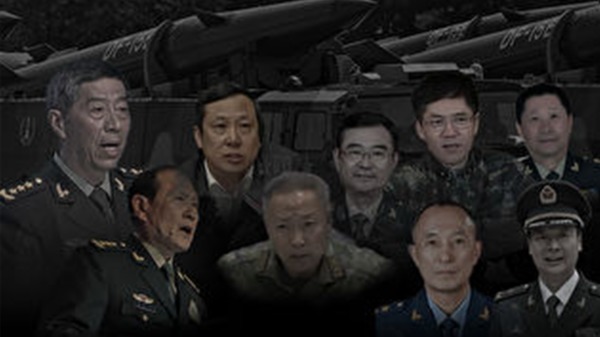
Following the conclusion of the Chinese Communist Party’s (CCP) Fourth Plenum on Oct. 24, yet another senior general — Zhang Fengzhong, former Director of the Rocket Force Political Work Department and an alternate member of the 20th Central Committee — has been expelled from the Party. Zhang is now the 13th general to fall since the massive Rocket Force corruption scandal erupted, signaling a political earthquake that continues to shake the foundations of the People’s Liberation Army (PLA).
Xi’s ‘core team’ in collapse
The Rocket Force scandal, which surfaced less than six months after the CCP’s 20th National Congress, has now claimed at least 13 generals, including four full generals (上将), seven lieutenant generals (中将), and two major generals (少将) — many of them directly appointed and promoted by Xi himself. Other generals currently being investigated or detained include:
- First Commander Wei Fenghe (上将)
- Second Commander Zhou Yaning (上将)
- Third Commander Li Yuchao (上将)
- Fourth Commander Wang Houbin (上将)
- Deputy Commanders Li Chuangang, Zhang Zhenzhong, and Liu Guangbin
- Chief of Staff Sun Jinming
- Discipline Secretary Wang Zhibin
- Political Work Department Directors Sun Fengzhong and Zhang Fengzhong
- Equipment Department heads Lv Hong and Li Tongjian
Success
You are now signed up for our newsletter
Success
Check your email to complete sign up
Hong Kong media reported that Liu Guangbin, detained in April 2023, has since “disappeared” from public record. Meanwhile, retired Deputy Commander Wu Guohua reportedly committed suicide by hanging himself at age 66 after three years of retirement.
Truth #1: Xi’s personnel failures
The Rocket Force, established in 2015 as Xi’s signature military reform, was meant to serve as China’s “core strategic deterrent” — capable of launching nuclear-armed ballistic missiles from land, sea, and air. Xi once called it “the cornerstone of national security and the strategic support of China’s great power status.”

Given its critical role, the appointment of Rocket Force commanders has always been personally approved by Xi Jinping in his capacity as Chairman of the Central Military Commission (CMC). Yet, every single commander personally promoted by Xi has fallen for corruption.
After three failed appointments — Wei Fenghe, Zhou Yaning, and Li Yuchao — Xi’s fourth handpicked commander, Wang Houbin, also turned out to be corrupt. “Xi once said, ‘The corruption of governance is the greatest corruption.’ After four Rocket Force commanders fell, does this not prove exactly that?”
Observers note that Xi’s entire personnel system has imploded, raising questions about his judgment and leadership. “If he personally approved each appointment,” one analyst asked, “then who bears the ultimate responsibility?”
Truth #2: The PLA’s corruption
Since Xi launched his anti-corruption campaign in 2012, more than 160 generals have been investigated — more than the total number of generals who died in all wars and political purges since 1927. High-profile figures such as Xu Caihou, Guo Boxiong, Zhang Yang, and Fang Fenghui — all members of the CMC — were among the first to fall. In 2018, the Party declared that its “fight against corruption had achieved overwhelming victory.”
Yet, just months after Xi’s third term was confirmed at the 20th Party Congress, the Rocket Force purge exploded — followed by waves of arrests across the Equipment Development Department, Joint Staff Department, Political Work Department, and even the Armed Police Force.
“Even those who were personally, exceptionally, and rapidly promoted by Xi — like Vice Chairman He Weidong — have now fallen,” analysts noted. “The fact that anti-corruption officials and political commissars within the Rocket Force were themselves corrupt shows the system has completely collapsed.”

The purge has laid bare a grim reality: Xi’s anti-corruption drive has failed, and the PLA’s rot has reached the highest echelons of power.
Truth #3: Xi’s path from centralization to dictatorship
Xi’s rise to absolute power began through the anti-corruption campaign, which he used to eliminate rivals and consolidate authority. Over his three terms, he has become the first leader since Mao Zedong to control the Party, the state, and the military simultaneously — what Chinese state media glorified as “the Party leads everything.”
However, that absolute control has led to absolute isolation. The same generals Xi called “his most trusted loyalists” — such as He Weidong and Miao Hua — have now been accused of “collapsing in faith and betraying loyalty.”
In CCP disciplinary language, “collapse of faith” means rejection of Party ideology, while “betrayal of loyalty” suggests acts of disobedience or even political defection. The charges leveled against top generals — “seriously violating the Party’s control of the gun” — imply that some were accused of plotting to seize power or acting as “political conspirators.”
“Absolute power leads to absolute corruption,” noted an overseas commentator. “Xi dismantled Deng Xiaoping’s system of divided authority and reintroduced Mao-style autocracy — but his reward has been betrayal from within his own army.” As Xi’s inner circle shrinks, analysts say he now faces a crisis of trust so severe that “he can trust no one, and no one can trust him.”
Xi’s endgame?
The collapse of Xi’s Rocket Force is not just a military scandal — it represents the failure of his governance model. Despite proclaiming victory over corruption and establishing himself as the “core” of the Party, Xi’s handpicked loyalists have turned out to be the very embodiment of systemic rot.
“Four mistakes can no longer be forgiven,” one commentator wrote. “If a leader repeatedly appoints corrupt generals to command China’s nuclear force, how can anyone still ‘pledge loyalty’ or ‘defend’ him?”
Even so, state media continues to push slogans like “Loyalty to the Core” and “Defend the Leader.” But beneath the propaganda lies growing internal panic — a Party facing the inevitable paradox of total control and now, total collapse.