Reports have surfaced that roughly 40 percent of the active-duty generals absent from the Chinese Communist Party’s (CCP) Fourth Plenary Session are currently under investigation by the Party’s military disciplinary body. Most are expected to face trial in military courts, suggesting that the latest wave of purges within the People’s Liberation Army (PLA) has reached an unprecedented, deep-level phase. Analysts say the campaign is less about corruption and more about enforcing political loyalty to Xi Jinping amid growing internal fractures.
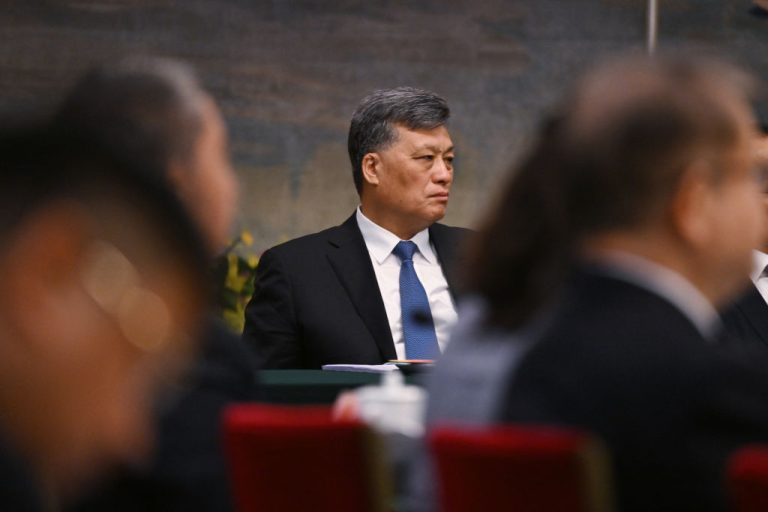
According to state-run Xinhua News Agency, the Standing Committee of the 14th National People’s Congress concluded its 18th meeting in Beijing on Oct. 28, 2025, confirming the appointment of Zhang Shengmin as Vice Chairman of the State Central Military Commission (CMC) and the dismissal of his predecessor, He Weidong.
China’s military operates under a dual structure known as “two titles, one body”—the Party CMC under the CCP Central Committee and the State CMC under the National People’s Congress. Zhang, who also serves as head of the CMC Discipline Inspection Commission, had already been promoted to Vice Chairman of the Party CMC during the Fourth Plenum earlier this month, effectively replacing He Weidong in both roles.
Sources familiar with internal deliberations told overseas Chinese media that Zhang’s promotion was viewed as a temporary compromise between Xi Jinping and veteran General Zhang Youxia, reflecting a fragile power balance rather than genuine consensus within the military hierarchy. “The factional equilibrium is only superficial,” one insider said. “The deeper conflicts remain unresolved.”
Dozens of generals expelled or missing
The infighting surrounding the plenum was already evident. On Oct. 17, Vice Chairman He Weidong, former Political Work Department Director Miao Hua, former Executive Deputy Director He Hongjun, and six other generals were expelled from both the Party and the military.
Success
You are now signed up for our newsletter
Success
Check your email to complete sign up
When the Fourth Plenum concluded on Oct. 23, observers noted that several key military figures—such as Rocket Force Deputy Commander Wang Liyan and three other lieutenant generals—were excluded from Central Committee replacements, widely interpreted as signs they had been purged.
Out of the 42 military members of the CCP’s 20th Central Committee, 27 were absent from the plenum—an unprecedented 63 percent absence rate, including 22 full generals. Of these, only eight expulsions have been officially confirmed, while 14 others have quietly disappeared from public view.
Also missing was Wang Renhua, head of the CMC’s Political and Legal Affairs Commission and a member of the Central Political and Legal Affairs Commission, fueling speculation that he, too, had been detained.
Veteran journalist Gao Yu noted on X (formerly Twitter) that the Fourth Plenum’s attendance rate was “the lowest in CCP history.” She pointed out that while the session expelled 14 Party Central Committee members and appointed 11 civilian replacements, it did not fill any military vacancies, indicating a freeze on personnel movements within the armed forces.
“This reflects deep turmoil inside the PLA,” Gao wrote, suggesting that the power struggle over military control remains intense, with “multiple theater commanders and political commissars” from the five major war zones already fallen.
Insiders: Four in ten active generals under investigation
Multiple individuals with ties to the PLA told overseas media that about 40 percent of the active generals who failed to attend the plenum are currently under investigation by the CMC Discipline Inspection Commission, led by Zhang Shengmin. Most are expected to be transferred to military courts for prosecution, confirming that the purge has entered a judicial phase.
One source familiar with military judicial procedures said that some of those under scrutiny have already been formally charged, while others remain under “review without clearance.”
“Even those who pass the review,” the source said, “are often removed from command positions or forced into early retirement.”
According to internal communications circulating within the PLA, this campaign represents a comprehensive restructuring of the military’s ‘loyalty and discipline.’ Analysts note that the focus is not on financial corruption or professional misconduct but on political allegiance.
“Corruption among senior officers is a known constant,” one military commentator observed. “Those records existed before their promotions—it was tolerated until their loyalty came into question. Now, political reliability has become the only metric that matters.”
Mass removal of military representatives
Preliminary data show that at least 22 military delegates have been stripped of their seats in the current National People’s Congress.
A military insider told Vision Times that “the removal of a delegate’s parliamentary status usually means his military post was already revoked and his case transferred to the court system.”
The latest meeting of the NPC Standing Committee also dismissed Sun Bin, deputy auditor of the CMC Audit Office, and Yuan Huazhi, former Navy political commissar, from their posts as national legislators—strong indicators that both have been caught up in the purge.
Sun Bin had served concurrently as a member of the PLA Election Committee, which is now reportedly down to just four active members out of twelve: Vice Chairmen Zhang Youxia and Zhang Shengmin, Chief of Staff Liu Zhenli, and Political Work Department Deputy Director Wang Chengnan.
Meanwhile, CMC Political and Legal Affairs chief Wang Renhua’s profile has been quietly deleted from the Central Political and Legal Affairs Commission’s official website—another likely sign of his removal.
Even Fang Yongxiang, director of the CMC General Office and considered one of Xi Jinping’s closest military aides, has vanished from public appearances for weeks and is widely believed to be in custody.
Separately, Zhong Shaojun, political commissar of the National Defense University and another longtime Xi confidant, has reportedly been dismissed. Having been reassigned from the CMC General Office to the university in 2024, his removal now signals that his career is effectively over.
Analysis: A purge that exposes Xi’s fragile control
Observers say the sweeping crackdown reveals both the depth of disloyalty within the PLA and the limits of Xi Jinping’s command authority.
“The scale is staggering—nearly two-thirds of the generals are gone, sidelined, or under review,” one Beijing-based analyst told Vision Times. “This is no longer routine discipline; it’s political surgery.”
While Xi continues to emphasize “absolute Party control over the military,” the simultaneous disappearance of so many officers—including those once viewed as loyal—suggests that his grip on the armed forces may be weaker than ever.
As the military purge advances into its judicial stage, the CCP faces a paradox: each arrest consolidates Xi’s personal authority in the short term, yet the fear and distrust it generates may ultimately erode the very loyalty he seeks to enforce.