Since July 20, 1999, when Jiang Zemin launched the persecution of Falun Gong, countless practitioners have died as a result of efforts to force them to renounce their belief in “Truthfulness, Compassion, and Forbearance.” At the helm of this campaign was a faction led by Jiang Zemin and Zeng Qinghong, often referred to as the CCP’s “Blood Debt Clique.”
Over the past 26 years, many members of this faction have faced retribution in various forms. Beginning on Oct. 2, 2025, a series of reports will detail cases of CCP “Blood Debt Clique” members meeting with karmic consequences, serving as a warning to those still participating in the persecution of Falun Gong.
Xu Caihou was one of the prominent members of this faction under Jiang and Zeng.
Following the launch of the anti-Falun Gong campaign, Xu Caihou steadily rose through the ranks with Jiang’s backing:
- July 1999: Following the persecution’s initiation, Xu was promoted repeatedly by Jiang.
- September 1999: At the 4th Plenary Session of the 15th Central Committee, Xu was added as a member of the Central Military Commission and promoted to the rank of general.
- November 2002: At the 16th Party Congress, Xu was elevated to Secretary of the Central Secretariat, member of the Central Military Commission, and Director of the General Political Department, achieving vice-national-level status and entering the ranks of “Party and State leaders.”
- September 2004: At the 4th Plenary Session of the 16th Central Committee, Xu was promoted to Vice Chairman of the Central Military Commission.
- October 2007: At the 17th Party Congress, during Jiang’s “Taishang Huang” phase, Xu was appointed Politburo member of the 17th CCP Central Committee and retained his position as Vice Chairman of the Central Military Commission.
Xu’s career illustrates how Jiang Zemin strategically placed loyalists in the military to consolidate power and enforce factional priorities, including the persecution of Falun Gong.
Success
You are now signed up for our newsletter
Success
Check your email to complete sign up
Top ‘Military Tiger’ dies before trial
On March 15, 2014, Xu Caihou, former CCP Politburo member and Vice Chairman of the Central Military Commission, was hospitalized at Beijing’s 301 Hospital when he was suddenly called by a senior Central Military Commission official. On that day, Xu was placed under “isolated review” by the military’s disciplinary authorities.
On June 30, 2014, the CCP’s Central Commission for Discipline Inspection (CCDI) announced that Xu had been expelled from the Party for serious violations of discipline and law. Evidence related to his suspected bribery and other criminal activities was transferred to the Supreme People’s Procuratorate for prosecution by the military procuratorate. On July 30, Xu was stripped of his military rank of general and expelled from the armed forces.
On Oct. 27, 2014, the military procuratorate filed charges against Xu at a military court. The indictment alleged that Xu exploited his official position to secure promotions for others and accepted bribes personally and through family members, with sums described as “especially huge.” He was also accused of using his influence to benefit others for profit, again involving significant amounts of bribery.
According to Chinese state media, Xu Caihou died on March 15, 2015, from end-stage bladder cancer with multiple metastases and multi-organ failure. Medical treatment proved ineffective. Because Xu died before trial, legal proceedings were terminated, though his illicit gains from bribery were still subject to lawful disposition.
Xu’s death before trial cemented his image as a top “military tiger” who faced accountability posthumously, highlighting both the extent of corruption within the PLA and the CCP’s struggle to prosecute senior military figures while alive.
The PLA’s super corrupt official: Xu Caihou’s hidden fortune
According to the cover story of Phoenix Weekly (Issue 32, 2014) titled “The Inside Story of the National Traitor Xu Caihou’s Seizure”, on the night of March 15, authorities conducted a raid on Xu Caihou’s luxurious residence on Fucheng Road in Beijing. A source close to the top echelons of the military revealed that investigators were stunned by the findings. They had assumed that, given the rumors of Xu’s corruption circulating for years and the fact that over two years had passed since Gu Junshan’s case, any illicit wealth Xu might have accumulated would have long been moved—leaving little of value at his home.
However, when they opened the 2,000-square-meter basement, they were shocked. Cash in multiple currencies—U.S. dollars, euros, and RMB—was piled everywhere. There was so much that investigators could not immediately count it, resorting to weighing it instead before sealing it. The total cash reportedly exceeded one ton, some still in unopened bundles.
The mansion also contained an astonishing array of valuables: gold, silver, jewelry, over 100–200 kilograms of high-quality Hetian jade, rare hardwoods, and exquisite jadeite items. Many pieces of jade remained in their original state, while some had only a thin outer layer removed. Investigators noted that the jade and cash were kept separately. Additionally, there were antique artifacts and calligraphy from the Tang, Song, Yuan, and Ming dynasties.
The sheer volume of Xu’s assets required a dozen military trucks just to remove them from the property. This was only one of Xu’s homes; the combined value of the cash and treasures was estimated to far exceed hundreds of millions of yuan.
Exactly how much Xu Caihou embezzled remains undisclosed by the CCP—likely because the figure is so staggering that releasing it publicly could incite outrage or unrest among both military personnel and civilians.
This case exposed the unprecedented scale of corruption at the top levels of the PLA, earning Xu the label of the “super corrupt military official.”
‘Buying and selling of positions’: Xu Caihou
Xu Caihou, while serving as Executive Deputy Director and later Director of the PLA General Political Department, as well as Vice Chairman of the Central Military Commission overseeing the department, became a key figure in the promotion and appointment of senior military officers across the People’s Liberation Army.
During the CCP’s “Two Sessions” in March 2015, Major General Yang Chunchang of the Chinese Academy of Military Sciences told reporters: “After Xu Caihou’s downfall, people around him said his power was immense. One commander of a major military region gave him 10 million yuan, another gave 20 million. He would not settle for just 10 million.”
Investigators reported that on his deathbed, Xu admitted that nearly all top-ranking officers of major military regions had offered him bribes. This included:
- Deputy Chiefs of the General Staff and senior officers of the Central Military Commission
- Deputy Directors of the General Political Department
- Secretaries of the CMC Discipline Inspection Commission
- Heads of the General Logistics Department and General Armaments Department
- Commanders of the Army, Navy, Air Force, and Second Artillery Corps
- Military and political heads of all major military regions
- Officers in the People’s Armed Police with general ranks
- Heads of the Academy of Military Sciences and National Defense University
- Essentially, Xu presided over a near-systemic network of bribery and corruption in the PLA, where virtually every senior military leader felt compelled—or chose—to provide financial gifts to secure promotions and favorable positions. His role made him one of the main sources of the military’s entrenched system of buying and selling offices.
Owing a trail of blood: The forced organ harvesting of Falun Gong practitioners
On June 20, 2022, Japanese economic commentator Sugawara revealed to overseas media a shocking truth: the Beijing Armed Police General Hospital was involved in the forced organ harvesting of Falun Gong practitioners.
In 2007, a friend of Sugawara’s had a brother suffering from severe liver disease. Facing long waiting times for liver transplants in the United States or France, he chose to undergo surgery in China at the Armed Police General Hospital. The hospital promised a donor would be available soon, quoting a cost of 30 million yen.
Before the surgery, it was discovered that the hospital-provided albumin was fake. Sugawara purchased the albumin in Japan and delivered it to Beijing. Upon arrival, a doctor showed him the donor: a 21-year-old young man restrained with bandages. The doctor told Sugawara that the donor was “a bad person, sentenced to death,” and casually identified him as a Falun Gong practitioner.
The doctor also admitted that the young man’s tendons had been cut the previous day—to prevent escape and ensure organ quality. The liver was forcibly harvested, and the practitioner died. Tragically, the Japanese patient also died during the transplant. Sugawara later described the incident as “extremely cruel,” resulting in the loss of two lives and a huge financial cost.
At the time, Xu Caihou was a member of the CCP Politburo and Vice Chairman of the Central Military Commission, overseeing the General Logistics Department, under which the Armed Police General Hospital fell. Thus, a clear chain of responsibility existed: from Xu Caihou, to the General Logistics Department, its Health Department, the Armed Police General Hospital, and the doctors performing the organ harvesting.
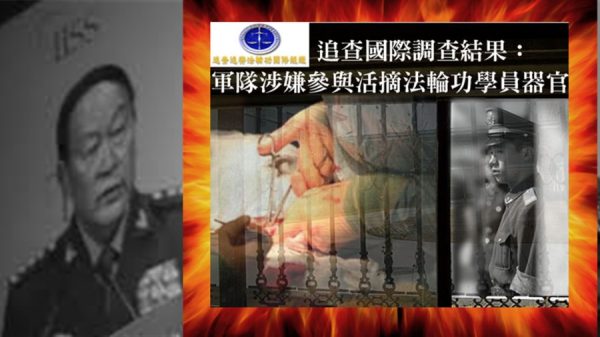
Investigations by the New York-based Epoch International (追查国际) confirmed that Bai Shuzhong, Minister of the Health Department of the General Logistics Department from 1998–2004, admitted that Jiang Zemin ordered the forced harvesting of Falun Gong practitioners’ organs. Xu Caihou, promoted by Jiang in 2004 as Vice Chairman of the Central Military Commission, acted as one of Jiang’s key agents in the military.
The Liver Transplant Center at the Armed Police General Hospital, established in 2001, became Beijing’s largest liver transplant facility. Zang Yunjin, appointed deputy director in 2005, conducted over 1,570 liver transplants and 22 combined liver-kidney transplants by 2014. He reportedly committed suicide by jumping from a building in 2021, at age 57, with foreign reports linking his death to his involvement in forced organ harvesting.
Since 2006, Epoch International has investigated military hospital transplant doctors extensively. Many doctors have admitted that donors came from Falun Gong practitioners, whose deaths were systematically concealed.
As Vice Chairman of the Central Military Commission overseeing the General Logistics Department, Xu Caihou bears direct and inescapable leadership and legal responsibility for the atrocities committed under his command, including the forced organ harvesting of Falun Gong practitioners.
This case illustrates a chilling network of institutionalized abuse, linking top military leadership to crimes against humanity for personal and political gain.
On Jan. 13, 2015, then-Commander of the Nanjing Military Region, Cai Yingtin, remarked during a teleconference: “Reflecting on the case of Xu Caihou, it becomes evident that his actions bear a striking resemblance to the ‘Ten Infamous Ministers’ in Chinese history—Qing Fu, Bo Pi, Zhao Gao, Dong Zhuo, Li Linfu, Cai Jing, Qin Hui, Yan Song, Wei Zhongxian, and Heshen. He was ‘treacherous,’ lacking virtue and integrity, committing great betrayals under the guise of loyalty; ‘greedy,’ insatiable and corrupt; ‘tyrannical,’ lawless and overbearing; ‘deceptive,’ two-faced and duplicitous; and ‘self-serving,’ forming factions and cliques for personal gain.”
Xu Caihou, a thoroughly corrupt “grand treacherous minister,” naturally rose to become a key member of the CCP’s so-called “Blood Debt Gang” led by Jiang Zemin and Zeng Qinghong.
But blood debts must be repaid.
Xu Caihou’s violent death can be seen as one manifestation of this karmic reckoning. Following his death, it is believed he has been consigned to hell to continue paying for his accumulated blood debts.