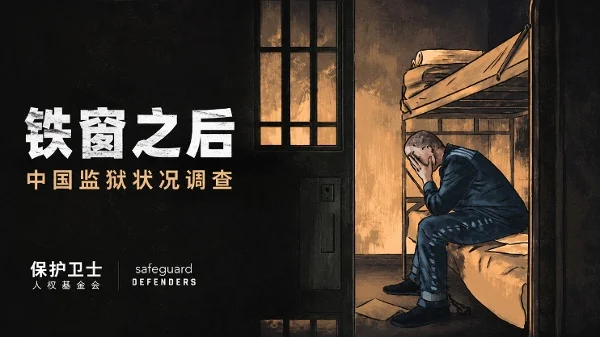
A new report released by European human rights organization Safeguard Defenders has found disturbing accounts of forced labor, political indoctrination, physical abuse, and inadequate medical care remain pervasive throughout China’s prison system, raising new concerns over the treatment of inmates and the lack of independent oversight within the country.
Released on July 16, the report, titled: “Behind Bars: A Survey on Prison Condition in China”, draws on questionnaires completed by 59 former prisoners, including both Chinese citizens and foreign nationals. Respondents had been incarcerated in at least 36 prisons across 16 provinces, municipalities, and autonomous regions, leading researchers to conclude that the reported abuses reflect broader systemic practices rather than isolated cases.
In addition to the survey, the report includes an in-depth interview with former Australian prisoner Matthew Radal, a comparative legal analysis of Chinese and international standards, and a case study examining Hunan Province’s Chishan Prison, which has previously faced international scrutiny over allegations of forced labor and rampant abuse.
RELATED: UN-Recognized Refugee Detained in Thailand Minutes Before Boarding Flight
Accounts of abuse and coercion
The findings point to a pattern of disturbing human rights violations. Among respondents, 54 percent said they experienced violence at the hands of prison guards or fellow inmates, while an equal proportion reported the presence of inmate enforcers who maintained control over other prisoners through intimidation or violence.
Success
You are now signed up for our newsletter
Success
Check your email to complete sign up
More than half (54 percent) said they received no compensation for prison labor, while 58 percent reported being denied adequate medical treatment when ill. Nearly one-third (29 percent) said they were given no outdoor exercise time, and 81 percent said they were required to write ideological “thought reports” as part of the prison’s political education program. According to respondents, refusing to complete such reports often resulted in punishment.
The report also documents allegations of beatings, the use of electric batons and pepper spray, prolonged stress positions while restrained, shackling, and solitary confinement.
Researchers expressed particular concern over the reported use of prolonged solitary confinement, noting that some prisoners said they were held far beyond the 15-day maximum recognized under international standards, after which prolonged isolation may constitute psychological torture. According to the report, solitary confinement was sometimes used to punish inmates who refused prison labor or failed to meet production demands.
One respondent wrote that while imprisoned, he was “not treated as a human being at all.” Former Australian prisoner Matthew Radal also alleged that during solitary confinement he was shocked with electric batons almost daily and spent 194 consecutive days with his legs chained.
Forced labor at the center of findings
The report devotes significant attention to what it characterizes as exploitative prison labor. More than half of respondents said they received no wages for their work. Those who were paid generally reported earning less than 100 yuan (about USD$15) per month.
A case study of Chishan Prison in Hunan Province describes prisoners working shifts of up to 12 hours per day under hazardous conditions. Respondents reported prolonged exposure to airborne fibers that allegedly caused respiratory illnesses, as well as repetitive work with few breaks. Several linked chronic back pain, significant weight loss, and other long-term health problems to prison labor.
One former prisoner summarized the system by saying, “The reality is that this prison is not a prison with a factory, it is a factory with a prison.” The same respondent added that prisoners in China, regardless of guilt or innocence, were “treated like animals and deprived of even the most basic rights.”
Lack of accountability
The report argues that China’s prison system places heavy emphasis on political conformity alongside incarceration. According to respondents, inmates were routinely required to write confessions, repentance statements, and essays expressing support for the ruling Chinese Communist Party (CCP). More than three-quarters said they had been ordered to complete such assignments.
Failure to comply, or submitting writing deemed politically insufficient, could reportedly result in disciplinary measures, including denial of sentence reductions, reduced purchasing privileges, shortened family visits, corporal punishment, or solitary confinement. One respondent said that after refusing to write a confession, he was denied medical treatment and told by authorities, “If you do not repent, you will remain in solitary confinement.”
Researchers argue that weak oversight has allowed such abuses to persist. While Chinese law assigns supervisory responsibilities to prosecutors, the report contends that meaningful independent oversight is difficult under China’s one-party political system. Several respondents said complaints filed with prosecutors produced little response and, in some cases, allegedly resulted in retaliation that made sentence reductions more difficult.
One former prisoner said fear prevented him from filing complaints altogether. Another recalled: “Not only did they take no action, they took action against me.”
Report calls for global oversight
Safeguard Defenders estimates that China operates more than 680 prisons, with approximately 850,000 new admissions annually and an estimated prison population of 2.34 million, making it one of the world’s largest prison systems. Beyond ordinary criminal offenders, China’s prison system has also been used to detain political dissidents, independent journalists, rights advocates, religious practitioners, and members of ethnic minorities, contributing to broader efforts to suppress freedom of expression and political dissent.
The organization said the report builds upon its earlier study examining conditions in China’s detention centers and warned that increasingly sophisticated surveillance and censorship have made documenting prison conditions more difficult.
The group urged governments negotiating security cooperation or extradition agreements with Beijing to carefully consider the potential human rights implications, arguing that independent documentation of prison conditions has become increasingly important as public information inside China grows more restricted.