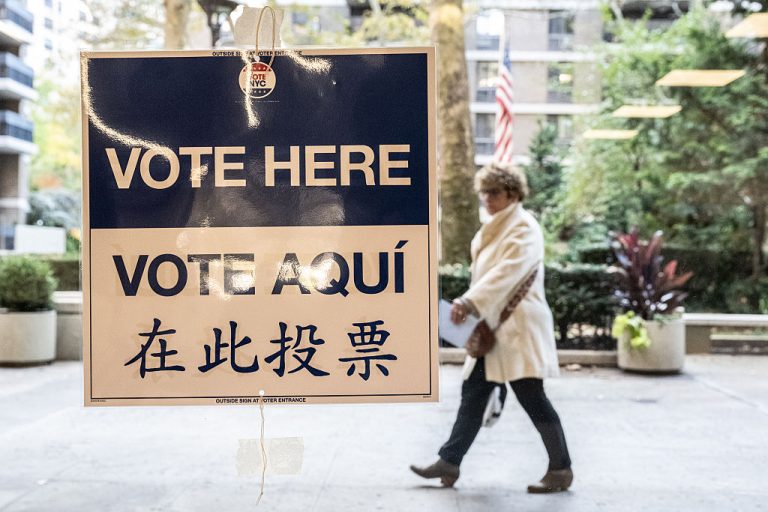
Today, Nov. 4, New York City is holding its highly anticipated municipal election. Voters are casting ballots not only for the hotly contested mayoral race but also for comptroller, public advocate, city council members, several district attorneys, and six key proposals on the back of the ballot.
However, this year’s focus is on the three-way mayoral race, seen as a repeat of the “1969 three-way showdown.”
State Assemblyman Zohran Mamdani, a socialist newcomer, has gained momentum and shaken both the Democratic establishment and broader political circles.
Andrew Cuomo, who spent years building influence within the Democratic Party but lost to Mamdani in the June primary, is now running as an independent, attempting to win back support.
Meanwhile, Republican Curtis Sliwa has refused to drop out despite pressure from the White House, which hoped he’d withdraw to prevent a “socialist takeover” of the New York City government.
Success
You are now signed up for our newsletter
Success
Check your email to complete sign up
Recent polls vary dramatically — one shows Cuomo trailing Mamdani by only 4 points, while another shows Mamdani leading by 26, underscoring the race’s volatility. Analysts expect Sliwa will finish third.
Preliminary vote counts are expected to appear within minutes after polls close, though clearer results may not emerge until after 10 p.m.
The last intense three-way mayoral race in New York was in 1969, when John Lindsay of the Liberal Party narrowly defeated Democrat Mario Procaccino (42.4 percent to 34.8 percent), with Republican John Marchi taking 22.7 percent. Voter turnout hit 81 percent — one of the highest in modern city history.
This year, more than 730,000 people voted early over nine days, nearly double the turnout of June’s Democratic primary. Observers predict total turnout could surpass 2 million ballots, possibly reviving the high participation levels of past mayoral elections.
The back of the ballot: Six key proposals
This year’s ballot included six proposals — one statewide amendment and five New York City charter changes dealing with housing, land use, digital mapping, and election timing.
The city proposals are seen as part of a broader power struggle between the City Council and Mayor Eric Adams over control of land and housing policy.
Opponents called them “misleading,” while supporters said they were necessary to speed up housing construction.
1. State constitutional amendment: Legalizing Olympic facilities
This statewide proposal would officially legalize the long-existing Lake Placid Winter Olympic facilities, which technically sit on protected forest land and have operated for over 45 years.
If approved, the Olympic Regional Development Authority could continue using and improving the site.
The measure would also require the state to add 2,500 acres of new protected forest and allow expansion of ski trails in upstate New York.
2. Speeding up affordable housing construction
Currently, New York’s Uniform Land Use Review Procedure (ULURP) takes about seven months, giving the City Council final authority.
The proposal would bypass ULURP and create two new approval processes — one through the Board of Standards and Appeals (BSA) and another through local community review followed by the City Planning Commission (CPC) for the 12 districts with the least affordable housing.
Supporters say this would accelerate housing projects; critics warn it weakens the City Council’s power.
3. Simplified review for small projects
This would establish a “Fast-Track Land Use Review” (ELURP) for small-scale housing and infrastructure projects.
Most would no longer need City Council review — instead, approval would come from community boards, borough presidents, and the CPC in a shorter timeframe.
It would also raise building height limits in some low-density zones to about 45 feet, and allow 30 percent more units in medium- and high-density areas.
4. Creation of an affordable housing appeals board
Under current law, the City Council has final say on ULURP decisions (the mayor can veto, but the council can override).
This proposal would create a new Affordable Housing Appeals Board, made up of the City Council Speaker, the borough president, and the mayor — any two of whom could overturn a council decision, effectively giving the mayor’s office another layer of control.
5. A unified digital city map
New York currently lacks a single official map — the city relies on about 8,000 paper maps pieced together.
This proposal requires the Department of City Planning to create a unified city map by January 2028 and launch a digital version by January 2029, making boundaries for streets, parks, and neighborhoods clearer and improving planning and public services.
6. Aligning local elections with presidential elections
This aims to tackle New York’s chronically low turnout in local elections. In 2021, local election turnout was only 23 percent, while over 60 percent voted in the 2024 presidential election. The proposal would move city elections to coincide with presidential election years, hoping national attention boosts local turnout. The City Council has not yet taken a stance on this measure.