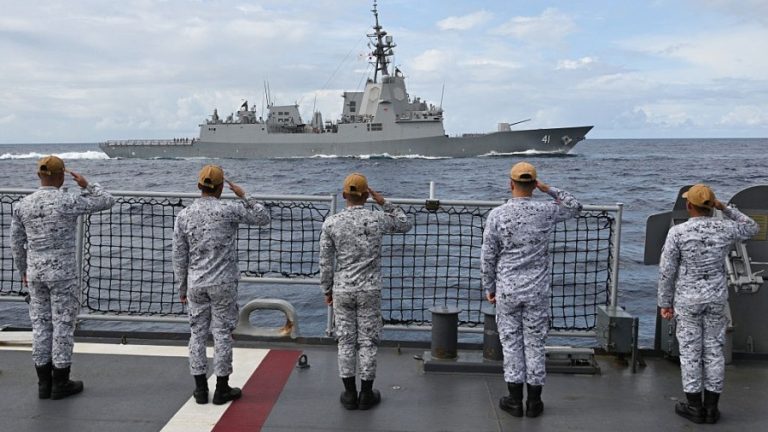
According to a U.S. Naval Institute News (USNI News) report on Nov. 5, the Philippines has launched its annual ‘Air-Sea-Land Anti-Invasion Military Exercise’ in the South China Sea and northern Luzon. This move comes in response to China’s increasingly assertive behavior in the South China Sea and the potential threat of conflict in the Taiwan Strait.
The core phase of this year’s exercise is being conducted in northern Luzon, a location chosen for its strategic value and its proximity to Taiwan. The shift underscores Manila’s deep concern about a possible spillover of conflict across the Taiwan Strait. The exercise is both a demonstration of the Philippine Armed Forces’ growing defense capability and a strategic adjustment to evolving regional security conditions, aimed at strengthening the country’s ability to respond to future complex risks.
Geopolitical context and China’s expanding influence
The Indo-Pacific region is undergoing profound geopolitical change, driven in large part by China’s growing military power and assertiveness. In the South China Sea, China has expanded artificial islands, built military installations, and regularly deployed coast guard and maritime militia vessels, claiming sovereignty over nearly the entire area within its so-called “nine-dash line.”
These actions have infringed upon the rights of other claimant states — including the Philippines — and pose a direct challenge to international law and freedom of navigation. Filipino fishermen and coast guard ships have repeatedly clashed with Chinese vessels, heightening regional tensions.
Beyond the South China Sea, the escalating situation in the Taiwan Strait poses a direct security concern for the Philippines. The strait is considered one of the world’s most likely flashpoints. Should armed conflict break out between China and Taiwan, its effects would extend well beyond Taiwan’s borders.
Success
You are now signed up for our newsletter
Success
Check your email to complete sign up
The Luzon Strait, which connects the South China Sea to the Pacific Ocean, lies between the Philippines and Taiwan, and is a strategically vital corridor. In any Taiwan conflict scenario, the Philippines could find itself in the path of military operations or even drawn into the conflict. With China’s expanding military reach and ambiguous intentions, Manila is compelled to rethink its defense posture to prevent any spillover of hostilities and safeguard national sovereignty.
Strategic significance of the annual air-sea-land exercise
The annual anti-invasion drill serves as the Philippines’ main platform for testing and improving joint operational readiness. This year’s exercise involves around 2,000 military personnel, along with elements from the national police and coast guard, simulating realistic multi-domain threats and ensuring inter-agency coordination under combat-like conditions.
The exercise’s objectives go beyond conventional warfare. They include protecting critical infrastructure, humanitarian assistance, and disaster response — reflecting a broad-based approach to national defense.
Unlike previous years, this year’s main operations fall under the Northern Luzon Command (NOLCOM), responsible for defending the country’s northernmost provinces facing Taiwan and the Luzon Strait. The shift of focus from the South China Sea to northern Luzon signals Manila’s growing vigilance toward the potential expansion of Taiwan Strait tensions — a clear evolution in the Philippines’ national defense strategy from defending isolated islands to addressing broader regional instability.
Northern Luzon’s strategic role and training details
The Luzon Strait is a vital maritime chokepoint connecting the Pacific Ocean and the South China Sea — a busy route for international shipping and submarine operations. If conflict erupts in the Taiwan Strait, this corridor could become either a pathway for the Chinese navy to access the Pacific or a strategic blockade zone around Taiwan.
The Batanes Islands, just over 100 km from Taiwan, are of immense strategic value and could become a key battleground — whether as a supply post, surveillance base, or staging area.
Of the nine field training exercises (FTX) planned, three focus on anti-invasion operations near the Luzon Strait — including anti-amphibious landing drills and retaking critical infrastructure such as ports and airports.
These drills are designed to simulate repelling seaborne or airborne invasions and protecting vital transport hubs. Given the Philippines’ archipelagic geography, defending coastal and island territories is essential. Securing airports and ports ensures logistical flow during wartime and post-conflict recovery — underscoring the nation’s readiness to face potential threats like enemy attempts to seize northern islands or disrupt major supply routes.
Despite the northern focus, the Philippines is not neglecting the South China Sea. The military will still conduct territorial defense training on Thitu Island (Pag-asa Island) — its largest occupied feature in the Spratly Islands. This shows that while Manila is preparing for northern contingencies, it remains resolute in defending its South China Sea claims.
Evolving defense posture and regional implications
This exercise marks not just an enhancement of military readiness but a major transformation in Philippine defense and foreign policy strategy. In the past, the country’s defense focus was largely on internal security and low-intensity South China Sea disputes.
However, China’s continued expansion and rising Taiwan tensions have forced Manila to broaden its defense horizon. By shifting its strategic focus northward, the Philippines is preparing for higher-level, regional conflicts and signaling its determination to protect national interests amid regional uncertainty.
This shift may also deepen defense cooperation with allies, especially the United States, even though the report does not explicitly mention foreign participation. The exercise’s scale and strategic focus are likely to attract allied attention and pave the way for future joint drills and expanded defense partnerships.
Ultimately, the Philippines’ 2025 ‘Air-Sea-Land Anti-Invasion Exercise’ — centered in northern Luzon and supplemented by operations in the South China Sea — is a strategic response to China’s assertiveness and the growing risk of conflict in the Taiwan Strait. It sends a clear message: the Philippines is actively strengthening its defenses to ensure national sovereignty and regional stability in an increasingly volatile Indo-Pacific environment.
By Yang Tianzi