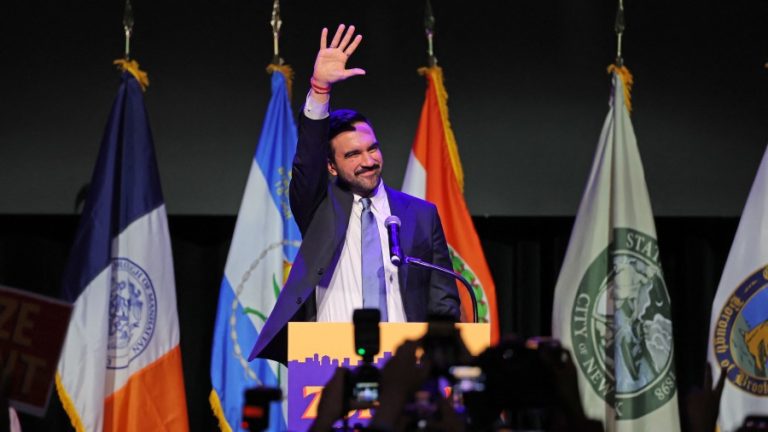
On the evening of Nov. 4, 2025, a young man named Zohran Mamdani was elected Mayor of New York City. He is only 34 years old, a Muslim, and the son of immigrants from Uganda. A boy who grew up in a rented apartment somehow earned the applause and trust of one of the most complex cities in the world.
At that moment, an indescribable emotion surged within me. Every ballot cast seemed to illuminate the dark, oppressive country that still lives in my memory. Here, a young person can be elevated for their ideas; over there, a young person might be taken away for simply speaking.
I kept looking at that news photo — Mamdani smiling in the crowd, a banner behind him reading “Power to the People.”
Five simple words that left me restless for a long time.
In America, that phrase means “sovereignty belongs to the people.”
Success
You are now signed up for our newsletter
Success
Check your email to complete sign up
But in China, if those same words appeared on a poster, they would be condemned as “inciting subversion.”
From childhood, we were taught to “love our motherland” and “support the Party,” but no one ever asked us — do we truly love our country, or the political party that claims to stand above it?
Mamdani’s victory is not just a personal triumph; it’s a triumph of the system.
He came from an ordinary background — no connections, no powerful backers. He won through ideas, debate, and the trust of citizens.
I can’t help but wonder: if he had been born in China, what would his life look like?
Perhaps he would be under “special surveillance.” Perhaps he would never even have the chance to publicly express his beliefs.
I once lived in a country without real ballots. There were ballot boxes, red banners, and smiling officials — but everything had already been decided.
I remember the first time I heard the phrase “real election” — it was after I came to America.
Here, the ballot is a weapon of the people, not a prop. The media can question the mayor. Journalists can mock the president. Citizens can protest openly.
But in China, an ordinary person who merely questions the government — even with a single Weibo post — might be “invited for tea.”
I often ask myself: Why is power in China never afraid of losing? Why are the people, in their own country, never treated as the owners?
Mamdani won because voters believe that politics can change lives.
In China, most people have only learned to escape — escape abroad, escape into silence, escape into the corners of their minds.
Mamdani is Muslim, South Asian, and a left-wing progressive.
He dares to advocate “free public transit,” “taxing the rich,” “freezing rents.”
Maybe his proposals are radical, but he has the right to express them — and the space to be heard.
In China, young people can only talk about “civil service exams,” “involution,” or “running away.”
Their imagination has been hollowed out by the system, and fear has clipped their wings.
I know many overseas Chinese who still miss their homeland, yet they also know — that land no longer allows real diversity.
A society that loses the clash of ideas is like a body that has lost its breath.
I am not praising America — I am reflecting.
What makes one society embrace difference, while another can only echo a single voice?
Sometimes I feel that China’s problem is not just the lack of democracy — it’s the loss of shame.
When power can lie freely, suppress truth, and trample on human rights without guilt, it means the moral compass of the entire society has gone numb.
In New York, the mayor must answer to the citizens. In Beijing, the citizens must bow to the officials.
In a democracy, power is a position of service. In an autocracy, power is a privilege of plunder.
I am no political scientist, but I understand one simple truth:
Power without oversight will always corrupt.A system that cannot be criticized is doomed to collapse.
Now I live in America.
I often walk the streets and see people of different races and faiths walking side by side. They debate, disagree, and protest — but they can speak.
I know that freedom of speech does not mean perfection, but it means this: I will not disappear for telling the truth.
And I still remember the names of those who did disappear — Zhang Zhan, Xu Zhiyong, Ding Jiaxi, Guo Feixiong…
They were buried in prison darkness simply for telling forbidden truths.
Sometimes I wonder — if they lived in New York, could they too stand in the sunlight and speak their beliefs with a smile, like Mamdani?
In a free society, a boy from a rented apartment can change his destiny through conviction. In a repressive society, a citizen who tells the truth may lose his future for it.
When will China see a real citizen election?
When will people no longer fear expressing dissent?
When will the next generation finally live without lies and fear?
That day may still be far away, but I believe it will come.
Because history never sides with oppressors forever.
Power can control the media — but not awakening minds.
It can imprison people — but never their convictions.
In New York, people change reality with their votes.
In China, countless others still resist oblivion — with their conscience.
This article represents the author’s personal views and do not necessarily reflect the views of Vision Times.