A new commentary in the People’s Daily (PLA) official newspaper has intensified speculation that former top generals He Weidong and Miao Hua — once among Chinese President Xi Jinping’s closest military allies — may be implicated in plots far more serious than corruption. The article directly compares the pair’s alleged misconduct to that of disgraced ex–Central Military Commission (CMC) vice chairmen Xu Caihou and Guo Boxiong, declaring their actions to be “even worse.”
Analysts say this rhetorical shift signals that Beijing may be preparing to formally characterize the two fallen generals as having engaged in activities tantamount to treason or an attempted coup.
At the same time, reports from within the People’s Liberation Army (PLA) suggest morale is collapsing, many officers are quietly turning against Beijing, and some units are “waiting for the right moment” to stage an uprising resembling the historic Wuchang Uprising that ended the once-prosperous and powerful Qing Dynasty.
RELATED: Xi Jinping’s Alleged ‘Divide-and-Conquer Plot’ Targeted Liu Yuan, Zhang Youxia
Rooting out corruption
On Nov. 25, the PLA Daily published a lengthy ideological piece titled: “Completely Cutting Out the Tumor, Cleansing the Source, and Purging Toxic Residue.” It opens with Xi’s past declaration that the Party must “eliminate the source of the poison and eradicate its influence from the root.”
Success
You are now signed up for our newsletter
Success
Check your email to complete sign up
The article claims the “tumor” refers not to ordinary corruption, but specifically to those embedded within the body of the Party and the military. It asserts that their practices “were profoundly influenced by Guo Boxiong and Xu Caihou; their behavior was exactly the same, even worse.”
This comparison is explosive. Xu and Guo were not only executed as corrupt officials — Party mouthpieces also labeled Xu a “国妖” (“demon of the state”) and described them as traitorous figures akin to Wang Mang, Zhang Chunqiao, and even those accused of plotting coups against Mao-era leadership.
By placing He and Miao in this category, state media is signaling they may be treated not merely as corrupt officials but as potential conspirators against the regime.
Did He Weidong and Miao Hua build a private army?
Retired Chinese Communist Party (CCP) Central Party School professor Cai Xia previously revealed: “He Weidong and Miao Hua secretly conspired to build a ‘private army’ in the Tianjin corridor not subordinate to any theater command.”
According to her account, the force was intended to serve as Xi Jinping’s emergency power base if the political system destabilized — a plan allegedly exposed by Vice Chairman Zhang Youxia, leading to the purge. The account echoes past accusations against Xu Caihou and Guo Boxiong, who were also described as maintaining personal military networks.
RELATED: CCP Under Siege: Sources Say Xi Loyalist Cai Qi Seized By Zhang Youxia Himself
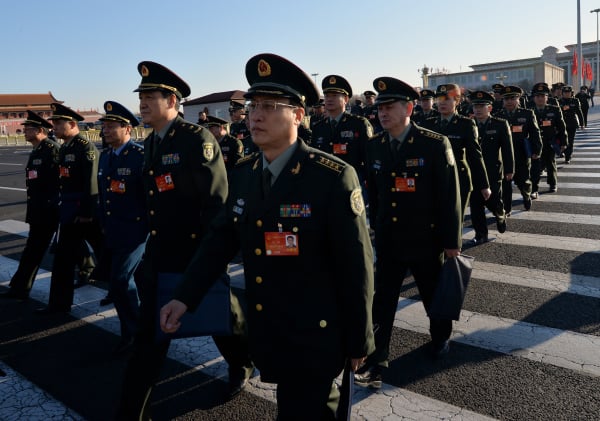
At the conclusion of the 4th Plenum on Oct. 23, the CCP shocked observers by expelling nine top generals — all promoted directly by Xi. The CMC then elevated Zhang Shengmin to vice chair, signaling a shift in military command away from Xi’s immediate circle.
Analysts note this is the most severe internal purge within the PLA since the Cultural Revolution. “He Weidong and Miao Hua’s fate will mirror Xu Caihou and Guo Boxiong,” wrote commentator Zhou Xiaohui, adding, “And Xi Jinping cannot fully cut ties with them.”
Growing unrest within the PLA
Discontent within China’s troops, the People’s Liberation Army (PLA), is no longer confined to whispers. On Nov. 7, the X-platform account “Spokesperson for Beijing Democratic Forces” published an open call titled “Urgent Appeal for PLA Soldiers to Rise Up.” It urged troops to ignite “a new Wuchang Uprising” to destroy “the darkness of CCP tyranny.”
While such statements may come from dissidents abroad, analysts say they reflect real grievances within the army. Commentator Du Zheng, writing in Taiwanese media, said that while senior commanders are too corrupt and risk-averse to lead a revolt, lower-level officers may already be preparing for one.
Two scenarios were identified:
- Wartime mobilization for an invasion of Taiwan
- The sudden death of Xi Jinping, plunging China into political chaos
Beijing views Taiwan as a breakaway province that must be reclaimed by any means necessary. Taiwan maintains its de facto independence as the Republic of China (ROC), which governed all of China before being driven off the mainland by communist rebels in 1949. A senior PLA insider reportedly told Du Zheng that many officers “cannot bear to watch the army rot” and are waiting for the right opening to strike. Despite strict bans, soldiers continue bypassing censorship to read uncensored news.
The PLA Daily itself admitted in late 2024 that “discipline is slack” and troops are still using software to circumvent the firewall. Zhang Youxia recently warned against “两面人” (two-faced officials) and “fake loyalty,” signaling that insubordination is widespread. According to Du Zheng: “The more the Party screams about loyalty, the less loyalty actually exists.”
A deepening power rift
On Nov. 25, Wu Renhua — a historian of the 1989 Tiananmen massacre — published a previously unseen video of the secret military trial of 38th Army commander Xu Qinxian, who famously refused to deploy troops against civilians. But the footage’s sudden leak amid intense factional struggles is telling: Someone inside the system wanted to send a message, analysts note.
Writers and former student leaders note that many 1989-era soldiers also refused to fire: “It shows there were many conscientious soldiers,” said Zhou Fengsuo. Despite Xi Jinping’s constant exhortations of loyalty, unity, and obedience, internal fractures have widened as his own proteges get purged, soldiers openly defy censorship, talks to uprisings intensify, and sensitive trial footage is being leaked.
The question now is not whether discontent exists, but whether it reaches a breaking point.