By Xiaofan Jia
Across the five centuries of the Spring and Autumn and Warring States periods, China produced an extraordinary constellation of thinkers, strategists, and statesmen. Among them, one story has never faded: the moment when Goujian, Fan Li, and Wen Zhong stood together inside the battered palace of Yue, determined to revive a kingdom on the edge of extinction.
Goujian’s legendary endurance—sleeping on brushwood and tasting gall to remember humiliation, leading three thousand soldiers to topple Wu—still inspires today. But behind that dramatic resurgence stood Fan Li, a man who not only guided Yue from ruin to power but later built three fortunes through commerce, gave them all away, and ultimately vanished across the Five Lakes, becoming one of China’s most admired figures.
Both history and folklore remember him by many titles: statesman, economist, military thinker, philosopher—and above all, “Merchant Sage.”
A native of Nanyang, land of sages
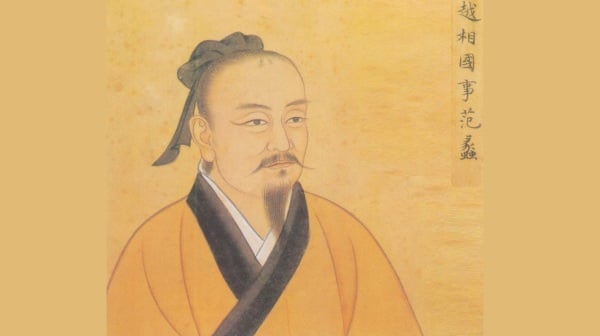
Fan Li, born in 536 BCE in the Chu state’s Wan region—modern Nanyang, Henan—came from a place renowned for producing remarkable minds. The region was home to Jiang Ziya, strategist of Zhou; Zhang Heng, polymath of the Eastern Han; Zhang Zhongjing, the “Sage of Medicine”; and Zhuge Liang, the famed chancellor of Shu. Fan Li became known as the “Sage of Commerce,” one of Nanyang’s Five Sages.
Success
You are now signed up for our newsletter
Success
Check your email to complete sign up
Even the poet Li Bai, in his Journey to the Southern Capital, placed Fan Li before Zhuge Liang among the luminaries of the region.
The state of Chu had once been a dominant power, but internal corruption drove Fan Li and his colleague Wen Zhong to seek service elsewhere. They chose the small but ambitious state of Yue, whose ruler Yunchang had long fought the neighboring state of Wu.
When Yunchang’s son Goujian became king, he rashly attacked Wu in 494 BCE—only to face catastrophic defeat. With his army annihilated and the kingdom collapsing, Goujian retreated to Mount Kuaiji. Wu forces pursued and surrounded him. Survival seemed impossible.
At this moment, Fan Li offered a strategy that would shape the next decade of Yue’s fate. He told Goujian:
“To maintain strength aligns with Heaven;
to stabilize decline depends on Man;
to manage affairs conforms to the Earth.”
This philosophy guided the king through crisis:
- Strength must be tempered with humility.
- Decline must be reversed through insight into human nature.
- Governance must follow practical, earthly conditions.
Three years as a slave—and the road to survival
Fan Li’s most daring proposal came next: submit to Wu as servants. Goujian, desperate, agreed.
They carried tribute and beautiful women to Wu and offered themselves in surrender. King Fuchai despised Goujian but admired Fan Li’s talent. He repeatedly attempted to recruit Fan Li, but the strategist refused, choosing instead to share Goujian’s humiliation.
For three years, they lived as slaves—sleeping by stables, eating coarse meals, and enduring constant ridicule. Goujian ran beside Fuchai’s chariot, cared for his prized horses, and performed the most degrading tasks. When Fuchai fell ill, Goujian, on Fan Li’s advice, even licked the king’s excrement to prove loyalty.
Their survival depended on these acts. And in time, Fuchai released them.
Ten years of patience before striking back
Once Goujian returned to Yue, he burned with desire for revenge. Fan Li stopped him. The kingdom was weak; the people were exhausted.
Fan Li counseled patience:
- restore agriculture and weaving,
- grow the population,
- rebuild economic strength.
When Fuchai later executed the loyal minister Wu Zixu—destabilizing Wu’s leadership—Goujian again asked to attack. Fan Li stopped him a second time. The time was not right.
Seven years passed. Goujian asked again. Fan Li refused.
Only a decade after returning from Wu did Fan Li finally say:
“Heaven’s timing, Earth’s conditions, and human readiness have aligned.”
Wu was weakened by wars with Jin and devastated by natural disasters. Yue struck—and Wu fell completely. Goujian became the only ruler in Chinese history to endure humiliation, rebuild his nation, and destroy the enemy that once crushed him.
Leaving power at its peak
After Wu’s destruction, Yue became a major power. Goujian made Fan Li his top general. But Fan Li knew the danger of “merit overshadowing the ruler.” He also knew Goujian’s character—grateful in hardship, ruthless in success.
Before leaving, he wrote a letter to Wen Zhong:
“When the birds are gone, the good bow is put away;
When the cunning hare dies, the hound is cooked.
The king of Yue can share hardship, but not glory.
Why do you not leave at once?
When the enemy is gone, the strategist perishes.”
Wen Zhong stayed. Goujian soon forced him to commit suicide.
Fan Li, having foreseen everything, boarded a small boat and drifted away across the Five Lakes.
Three fortunes and the wisdom to walk away
In the state of Qi, Fan Li lived under a new name and worked the land with his family—farming, fishing, and producing salt. His business method was deceptively simple:
“Take what others abandon, give what others seek;
follow nature, act with timing.”
He became wealthy within a few years. When disaster struck, refugees from distant regions sought his aid. His generosity earned him praise as a man who “used wealth to practice virtue.”
The king of Qi appointed him as a minister. After three prosperous years, Fan Li sensed danger again. He resigned, returned his seals, gave away all his wealth, and once more left with nothing.
Twice he rose to the pinnacle. Twice he walked away untouched.
Fan Li: A life remembered for wisdom, not power
Historian Sima Qian summarized Fan Li in sixteen characters:
“Loyal in serving the state;
wise in preserving himself;
wealthy through commerce;
renowned throughout the world.”
Su Shi praised him as the greatest master of advance and retreat since ancient times.
Fan Li understood that extremes lead to reversal:
- greatness leads to danger,
- wealth leads to risk,
- fame invites downfall.
So he avoided crowded markets, favored circulation over hoarding, and embraced modest profits—a mindset that resembles early economic cycle theory.
Having reached the heights of office and the heights of business, Fan Li never clung to either.