By Yang Tianzi, Vision Times
A major investigative report published by the BBC on Dec. 3 has reignited global scrutiny over a devastating environmental catastrophe that struck Zambia’s Copperbelt Province in February last year.
The disaster occurred when a tailings dam at Sino Metals Leach Zambia — a subsidiary of China Nonferrous Mining Group — collapsed without warning, releasing massive quantities of toxic waste containing arsenic, mercury, and lead into a tributary of the Kafue River, the country’s longest waterway and a critical source of drinking water and irrigation.
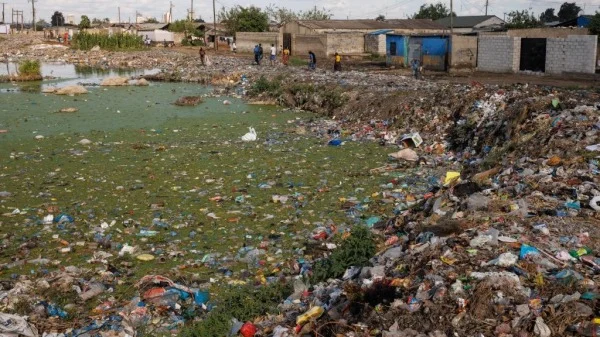
A second Getty image shows contaminated water near a residential area outside Lusaka on Feb. 24, 2024. Flies breeding in polluted water sources were believed to be vectors of a cholera outbreak that swept across southern and central Africa, underscoring the region’s fragile public health conditions.
A toxic spill on a massive scale
Official figures from the Zambian government claim that at least 50,000 tons of acidic mining waste leaked into surrounding waterways and farmland. But environmental groups estimate that the real figure may be closer to 1.5 million tons — a scale they describe as “catastrophic.”
Success
You are now signed up for our newsletter
Success
Check your email to complete sign up
RELATED: China’s Belt and Road Faces Wage Scandals and Stalled Projects Worldwide
Regardless of the exact number, experts warn that the contamination could take more than a decade to fully remediate. With the rainy season underway, heavy metals trapped in soil are expected to leach deeper into groundwater, triggering what many fear will become a “second wave” of pollution.
All along the affected region, from Chambishi to Kitwe, residents are facing the collapse of both their livelihoods and their health. To further complicate matters, early testing results released by local authorities have done little to reassure the public. Official statements claiming that heavy-metal levels fall “within safe limits” sharply contradict what residents are experiencing on the ground, including dead crops, contaminated wells, and a growing number of unexplained illnesses.
Communities left reeling
Farmers have watched fish die in massive numbers, crops wither, and wells turn toxic. For residents who rely on agriculture to survive, the spill has created both economic ruin and life-threatening uncertainty. Standing in her blighted field, 41-year-old farmer Mary Penge held samples of the chalky, contaminated soil. “Everything has changed,” she told reporters, her voice marked by exhaustion.
Another farmer, 28-year-old Abigail Nantowe, faces even harsher realities. Her six-year-old daughter is now showing signs of malnutrition after their crops failed. “I tried planting maize. I tried everything, just so hunger wouldn’t take my child. But it’s too hard.”
For 72-year-old Frederick Bwalya, who has lived in Twalima village for over three decades, the impact has been both economic and personal. He now suffers persistent pain in his legs, which doctors believe is linked to contact with contaminated water. Sino Metals had promised to drill a clean-water borehole for him, but the pledge was never fulfilled.
Inside the mine itself, workers had long feared a disaster. A miner identified as Lameck told BBC reporters: “If our protective gear is damaged, it’s not always replaced. We just have to risk using it again.” After the spill, he and his family spent two weeks without access to clean water until local authorities neutralized the acidity with lime.
Long-term poisoning
Dr. Mweene Himwiinga, a senior lecturer at the Copperbelt University, issued a stark warning: the spill could have long-term and irreversible health impacts. Heavy metals like arsenic, mercury, and lead accumulate in the human body, with the potential to cause issues including: permanent kidney damage, increased cancer risk, chronic gastrointestinal disorders, and even neurological conditions.
“These toxins can remain in soil and water for years, even decades,” said Dr. Himwiinga. The greatest threat now is the upcoming rainy season, which may wash buried toxins into deeper water systems and carry contaminants downstream toward Lusaka.
Though the Zambian government claims that tests in 21 Copperbelt locations showed heavy metal levels “within safe limits,” residents say this bears no resemblance to the conditions they are experiencing — a sign that the monitoring system itself may be flawed.
A crisis with diplomatic consequences
The disaster has thrust China–Africa relations into the spotlight. On paper, Chinese investment in Zambia is enormous, including:
- Over 30,000 local jobs created
- $1.7 billion in Chinese investment as of 2023
- Copper mining accounts for 70 percent of Zambia’s exports and 15% of GDP
But critics argue that Beijing’s model prioritizes resource extraction with limited transparency, weak environmental safeguards, and the use of Chinese labor over local talent. Zambia currently owes China an estimated $5 billion in sovereign debt — its largest creditor.
The Chinese embassy in Lusaka has rejected accusations of “neo-colonialism,” calling such claims, “Extremely unfair… and ignoring the broader picture of mutual benefit.”
Farmers launch historic $80 billion lawsuit
In September, 176 Zambian farmers filed what could become the largest environmental lawsuit in the country’s history, seeking a staggering $80 billion in damages from China Nonferrous Mining Group and Africa Metals.
The suit accuses the companies of grave negligence in design, construction, and operations—allegations that may become a landmark case for accountability across the continent. Professor Stephen Chan of SOAS University of London called the case: “A litmus test for how far African states can go in holding Chinese companies accountable for misconduct.”
But the legal battle is far from simple. While Chinese officials claim Sino Metals has compensated 454 families, payouts ranged only from $700 to $3,000, and some victims were reportedly pressured to sign agreements waiving future claims.
Zambia pushes back
The crisis comes as the U.S. and China compete for influence across Africa. Zambia, rich in copper and cobalt — critical minerals for electric vehicle batteries — has become a strategic battleground. This geopolitical tension has unexpectedly empowered Zambia.
Zambia’s Ministry of Green Economy and Environment issued a rare and forceful warning. Permanent Secretary Dr. Duthi Chibamba declared: “We will not go easy on them… We don’t care if we owe them money. That is not the issue.”
This unusually tough response signals that Zambia is no longer willing to accept environmental degradation as the price of foreign investment. Government actions include:
- Requiring Sino Metals to neutralize contaminated soil and water
- Launching reforestation efforts
- Imposing fishing bans across the Kafue River basin
- Evaluating additional cleanup costs to be charged to the company
But cleanup efforts remain delayed, and with the rainy season underway, time is running out.
For China, the message is clear: Economic power is no longer enough. For Zambia, the fight is not just for access to clean water and air; but for dignity, sovereignty, and justice for those afflicted.