By Jian Yi
It took less than a day for a one-minute, ten-second clip of Chinese Communist leader Xi Jinping to surpass two million views. The caption said it all: this was a moment “CCTV’s Xinwen Lianbo would absolutely never show.”
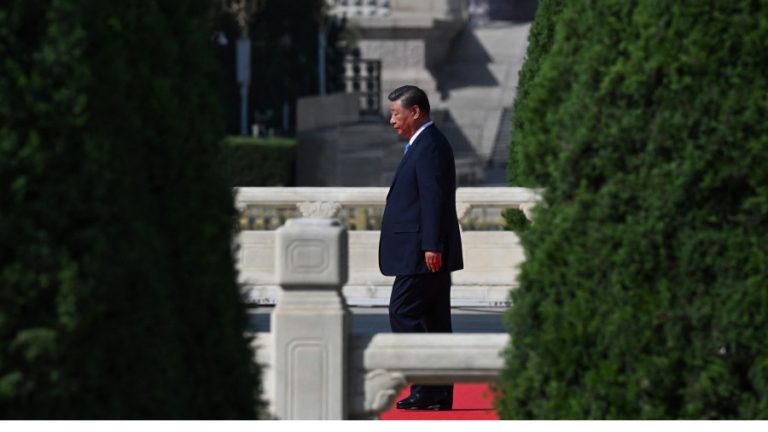
The video captures a rare, unfiltered glimpse of Xi Jinping. No flattering filters, no edited angles—just his natural gait, his visibly aged face, and a small exchange with staff members standing at his side. According to the poster, the footage was recorded on the morning of Dec. 4 at the Great Hall of the People, where Xi and his wife were preparing to welcome French President Emmanuel Macron and his wife.
What viewers saw first was Xi’s approach. Through the narrow gap between rows of Chinese and French flags, a figure swayed side to side, almost like a pendulum. As he drew closer, the camera revealed that it was Xi, walking with a noticeable wobble. Behind him, a staffer quickly pulled a yellow curtain across the background—a color many Chinese instinctively associate with imperial authority.
Imperial motifs have become increasingly visible at Xi’s public appearances. Dragon-patterned chairs, yellow porcelain cups, even ceremonial yellow umbrellas—objects reminiscent of imperial courts—have made repeated appearances in recent years. For many Chinese viewers, this symbolism is no coincidence.
A moment the propaganda system would never show
Success
You are now signed up for our newsletter
Success
Check your email to complete sign up
Online reactions erupted immediately.
Some joked darkly that “Xi Jinping in Qincheng”—China’s most notorious prison—or “Xi Jinping at Jingshan” would be the ending people most wanted to see. Others mocked the old Party slogan “people’s democratic dictatorship,” calling the phrase “absurd on its face.”
A widely circulated remark by Boris Yeltsin resurfaced as well: “The higher you climb in the Communist Party, the more you enjoy. Reach the top, and you enjoy everything—that is communism.”
But what shocked viewers most was not Xi’s gait. It was a small interaction beside him.
As Xi and his wife waited before the flags, a staff member hurried over, bent down, and appeared to adjust Xi’s pant leg or wipe his shoe. Xi did not move, flinch, or show embarrassment. The staffer—an older man, judging by his thinning hair—completed the gesture like a servant. Xi simply looked toward the doorway and then tapped the back of the man’s neck, gesturing for him to step aside.
State media frequently highlights Xi’s line: “We are servants of the people.”
But the scene in this video—a leader standing still while someone kneels at his feet—told a different story.
One viewer summed it up: “You can hear clearly—they noticed the reporters filming and said it wouldn’t look good. Which means this is normal. They just know it shouldn’t be seen.”
After the staffer withdrew, Xi turned toward the camera. His face, unretouched, appeared tired and deeply lined. The lack of CCTV’s usual “beauty filters” made every crease and swelling visible—sagging eyelids, heavy eye bags, an uneven forehead. Combined with his swaying gait, the moment reignited speculation about his health.
It also stirred up an old rumor: Why does Xi walk briskly and steadily in some appearances, yet so differently in others?
Speculation about doubles—long dismissed by many—no longer seemed as far-fetched to some viewers.
A wave of online backlash against Xi Jinping
As the clip spread, waves of anger, mockery, and bitterness swept across Chinese social media. Many saw the moment as a metaphor for their own lives: a leader treated like royalty while ordinary people feel like subjects rather than citizens.
China’s deepening economic crisis has intensified discontent throughout the country. More people now openly argue that the core problem is not the economy itself, but the CCP’s belief that its citizens are labor to be managed rather than human beings with rights. As public resentment grows, Xi’s taste for imperial symbolism only sharpens their irritation.
The comment sections reflected this mood vividly.
A recently popular four-character phrase—“stinking for a thousand years”—triggered a flurry of replies debating whether “ten thousand years” might be more appropriate. A commenter from Xi’s home province of Shaanxi called him “a disgrace to the Chinese nation.” Another teased back: “He’s your fellow townsman—why curse your own?”
Now, even the single character “习” (Xi) in an unrelated sentence often causes readers to assume it is a coded critique of the leader.
Some comments captured the rising frustration plainly:
“This place will collapse sooner or later.”
“Brothers, charge.”
Others quoted ancient Chinese rebellions: If death is inevitable whether one resists or not, why not choose resistance?
A user with a Winnie-the-Pooh avatar—long a symbol of political satire—received a flood of replies such as, “We know who you’re talking about.”
Overseas, these comments have been widely shared. One viewer wrote: “This is real public sentiment. Anti-Xi feeling is extremely high. Anti-CCP sentiment too. You can’t censor away what millions of people feel.”
The most chilling comment, from the regime’s perspective, was: “The day this energy moves from online to the streets, it’s over.”
A censorship campaign that only deepened the ridicule
To counter the backlash, the CCP launched a new “internet cleanup.” It produced more laughter than fear.
One user found his post deleted simply because a phrase sounded somewhat similar to “Jinping.”
Foreign commenters mocked the logic:
“They fear homophones now?”
“This beats Soviet jokes.”
“So much for confidence.”
Chinese netizens quickly adapted. One viral workaround used “thumbs-up emojis” to encode letters like Morse code. Soon someone posted a sequence spelling “XJP, XT”—short for “Xi Jinping step down.”
Another user wrote: “These last few days… it feels like the CCP is about to collapse. People are charging harder and harder.”
An evil cult must be eliminated
A separate video about Poland outlawing its Communist Party sparked another wave of online reactions in China.
Poland’s Constitutional Tribunal ruled on Dec. 3 that the party was illegal because it glorified regimes responsible for millions of deaths.
Chinese commenters erupted in applause:
“Great decision.”
“Thumbs up for Poland.”
“I’m drinking extra tonight.”
“Drive out darkness, welcome civilization.”
Some were blunt:
“Communism is an evil cult.”
“One less cult stronghold.”
“Evil cults must be eliminated.”
Others noted that the Czech Republic had adopted similar laws.
As one commenter wrote: “The tide of human civilization moves forward. Nothing can stop it.”