By Yang Tianzi
On the evening of December 14, 2025, Bondi Beach—one of Australia’s most recognizable public spaces—became the site of a mass-casualty attack during celebrations of the Jewish festival of Hanukkah.
As of the latest official update, 16 people have been confirmed dead, including a 10-year-old child. Dozens of others were injured. Australian authorities have classified the incident as an anti-Semitic terrorist attack, making it the country’s deadliest act of mass violence since the 1996 Port Arthur massacre.
A festival setting turns into a crime scene
The shooting occurred at approximately 6:47 p.m. local time at Archer Park, near the northern end of Bondi Beach, during the event “Chanukah by the Sea 2025.” Organized by Chabad of Bondi, the gathering began earlier that evening and drew around 1,000 attendees, many of them families with children.
The program included live music, children’s activities, and food stalls. According to journalists on the scene, the venue was secured with metal fencing and basic checkpoints but lacked heavy security presence.
Success
You are now signed up for our newsletter
Success
Check your email to complete sign up
Witnesses said the first sounds of gunfire were initially mistaken for fireworks. Within moments, panic spread as sustained shots rang out. Video footage later verified by media outlets showed people fleeing across open ground, some seeking shelter behind trees and structures as the shooting continued.
Elevated position, indiscriminate fire
Police said the attackers fired from a pedestrian overpass connecting a nearby parking area to the beachfront. From that elevated position, they had a clear view of the crowd gathered below.
Journalists located at nearby Bronte Beach reported hearing approximately 20 gunshots. Footage circulating online shows two individuals standing on the bridge, firing downward before police arrived.
The location and timing suggested an intent to maximize casualties during a moment of communal celebration.
Suspects identified as father and son
New South Wales police later confirmed that the attackers were a father-and-son pair.
The father, 50, was legally licensed to own firearms and had several weapons registered in his name. Police believe multiple firearms used in the attack were lawfully owned by him. He was killed at the scene during a confrontation with police.
The son, 24, was seriously injured and remains in critical condition under police guard.
Authorities said neither individual had been listed on known counterterrorism watchlists, and there was no prior intelligence indicating an imminent threat linked to the event.
A vehicle associated with the suspects was found nearby. Inside, police discovered a homemade explosive device. A bomb disposal unit secured the area overnight to prevent further harm.
Victims, injuries, and acts of courage
Initial reports placed the death toll at 12, but the number rose as critically injured victims later died in hospital. Among the confirmed dead was a 10-year-old girl. At least 29 people were injured, several of them seriously.
Two police officers responding to the scene were shot and hospitalized.
Victims ranged in age from 10 to 87. Foreign nationals were also among the dead, including a French citizen and an Israeli citizen, according to official confirmations from their respective governments.
Amid the chaos, witnesses and video footage documented acts of civilian bravery. One man, identified by authorities as Ahmed al Ahmed, was seen charging toward one of the shooters from behind, forcing him back and disrupting the attack. Ahmed sustained gunshot wounds to his arms and hands and underwent surgery.
New South Wales Premier Chris Minns publicly praised his actions, saying they likely prevented further loss of life.
Official response and international reaction
Australian Prime Minister Anthony Albanese described the shooting as “terrorism on our soil” driven by anti-Semitism. He said an attack targeting Jewish Australians was an attack on the country as a whole.
Security has since been increased at religious sites nationwide. Authorities said they are reviewing firearms licensing procedures and event-security protocols as part of the ongoing investigation.
International leaders and institutions condemned the attack. Statements of condolence were issued by the Israeli government, French officials, and King Charles III, who described the shooting as a “horrific anti-Semitic act” and expressed solidarity with Australia’s Jewish community.
Broader implications
Bondi Beach is both a major tourist destination and a focal point for Sydney’s Jewish community. The choice of location and timing has intensified concerns about public safety at religious and cultural events.
The attack comes amid a global rise in reported anti-Semitic incidents. In Australia, it has prompted renewed debate over community security, firearms oversight, and the balance between open public celebrations and protective measures.
Authorities said investigations are continuing into the suspects’ motivations, possible radicalization pathways, and whether any additional individuals were involved.
A nation in mourning
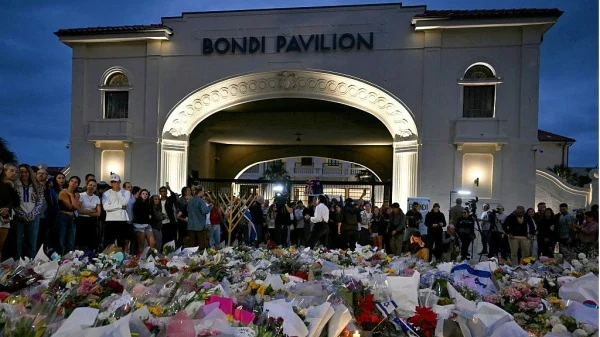
Bondi Beach remains partially closed as forensic examinations continue. Vigils and memorials have formed near the site, with mourners laying flowers and lighting candles.
Flags across Australia have been lowered to half-mast in honor of the victims.
For many Australians, the events of December 14 have shattered a long-held sense of distance from mass-casualty terrorism. The beach, long associated with leisure and openness, has become a symbol of collective grief—and a reminder of the vulnerabilities facing public life.