By Li Muzi
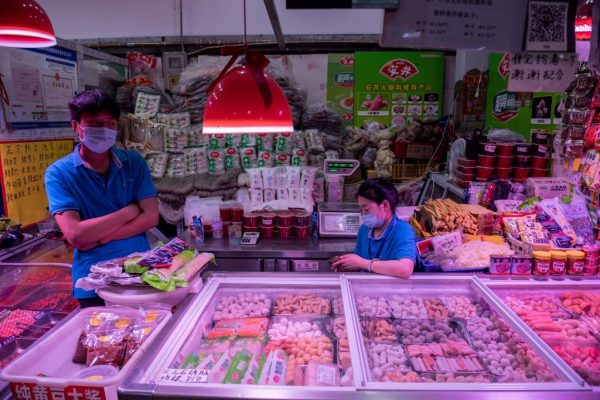
After Hainan implemented an island-wide “customs lockdown” on Dec. 18, food prices surged sharply, triggering widespread complaints from local residents. Spinach reportedly reached as high as 32 yuan (about $4.50) per jin, while other vegetables and daily necessities also saw steep increases. Online posts criticizing the price hikes were quickly deleted.
Some informed observers say the real beneficiaries of the lockdown policy had already reaped the rewards years ago, while traditional businesses and ordinary residents are now bearing the costs. Commentators have also warned that Xi Jinping’s approach reflects “Ye Gong loves dragons”—professing admiration for openness while fearing its reality—leaving Hainan once again at risk.
Residents complain of soaring prices as posts are deleted
On Dec. 18, a Hainan-based blogger wrote on Weibo that the lockdown operation offered “no benefits at all” to local residents. According to the post, prices were already higher than before, with vegetables and meat rising several-fold. Restaurants and hotels reportedly raised prices aggressively after the lockdown, while food delivery costs also climbed significantly.
The blogger noted that local wages remain low—typically 1,800 to 3,000 yuan per month (about $250–$420)—while living costs now exceed those of Shenzhen, despite salaries being roughly one-fifth as high. As a result, the blogger concluded that Hainan is no longer suitable for young people seeking work, since earnings often fail to cover expenses. The post was later deleted.
Success
You are now signed up for our newsletter
Success
Check your email to complete sign up
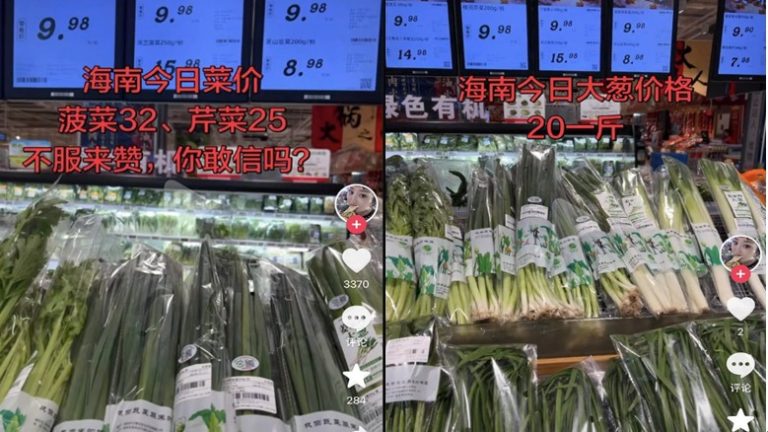
Following the lockdown, many other residents also complained online about rising prices. Some shared photos showing spinach priced at 32 yuan (about $4.50) per jin and celery at 25 yuan (about $3.50) per jin. One user said a single fried dough stick cost 7 yuan (roughly $1). Reports on rising food prices by NetEase and Wuyou News were also removed.
State media announces official launch of Hainan free trade port lockdown
According to the People’s Daily app, the Hainan Free Trade Port officially began island-wide customs lockdown operations on Dec. 18. The policy designates the entire island as a special customs supervision zone operating under the framework of “opening the first line, controlling the second line, and free circulation within the island.”
Under the policy, eligible enterprises importing certain goods from overseas will benefit from “zero-tariff” treatment. Officials emphasized that “lockdown does not mean sealing off the island,” and that travel in and out of Hainan remains unchanged, without additional permits.
State media reported that the scope of zero-tariff goods expanded from just over 1,900 tariff items to more than 6,600, covering 74 percent of all tariff categories. The rollout is described as part of a three-stage plan: establishing a basic free trade port policy framework by 2025, achieving greater institutional maturity by 2035, and building a globally influential free trade port by mid-century.
Insider: benefits already exhausted, losses borne by ordinary people
On Dec. 18, an X user identified as “RobinSeun_维京黑船” wrote that he had spent years accompanying major state-owned enterprises to the Yangpu Economic Development Zone in Hainan for research, land acquisition, planning, and investment promotion. He said that any early enthusiasm had long been worn away.
According to the post, the real benefits of the lockdown had already been consumed years ago. The government first proposed the Hainan International Tourism Island Development Plan in 2009, began supporting a free trade pilot zone in 2018, and formally launched the lockdown in December 2025.
The user argued that those who truly benefited were companies that secured land early, exploited institutional differences, operated across Hainan, the mainland, and overseas markets, and could move freely across customs boundaries. These firms, he said, had already competed aggressively for years in places such as Yangpu and Haikou.
For ordinary residents, the post continued, most daily necessities and services would become more expensive. The main beneficiaries would be employees tied to central state-owned enterprises, customs and cross-border trade workers, and those in logistics and finance. Those most disadvantaged, he said, are traditional local businesses—both manufacturing firms and others lacking competitiveness—as well as low-income residents.

Commentary: Xi’s ‘Ye Gong loves dragons’ approach leaves Hainan vulnerable
On Dec. 19, commentator Xin Gaodi published an article on X arguing that the idiom “Ye Gong loves dragons” best captures Xi Jinping’s approach to the free trade port. Xi frequently promotes “Chinese-style free trade ports,” high-level opening, and positioning Hainan as a gateway for reform, the article said, but retreats when it comes to genuine liberalization involving the rule of law, capital mobility, and institutional freedom.
The commentary noted that Hainan’s free trade port was personally planned and announced by Xi in 2018, yet remains constrained by structural flaws rooted in the mainland system. As a result, it is destined to remain a form of “pseudo-opening,” far removed from genuine international free ports and likely to impose new burdens on local residents.
The article further argued that Xi has a record of launching grand initiatives that later stall. From Xiong’an New Area to the Belt and Road Initiative (BRI), many projects were driven by top-down decision-making that ignored market realities. Xiong’an, announced in 2017 as a “millennium project,” absorbed massive investment yet remains underpopulated.
The BRI, launched in 2013, involved trillions in spending but left many overseas projects mired in debt and losses. China’s semiconductor investment funds similarly consumed vast resources but faltered amid corruption and inefficiency.
According to the commentary, Hainan’s free trade port faces similar risks and may ultimately become another “Chinese-style” showcase project. Without nationwide reforms—such as capital account liberalization and judicial independence—the article concluded, Hainan is unlikely to escape a stalled outcome. “Once again,” the author wrote, “Hainan’s people may be forced to pay a heavy price for a grand vision that is detached from reality.”