By Gao Yun
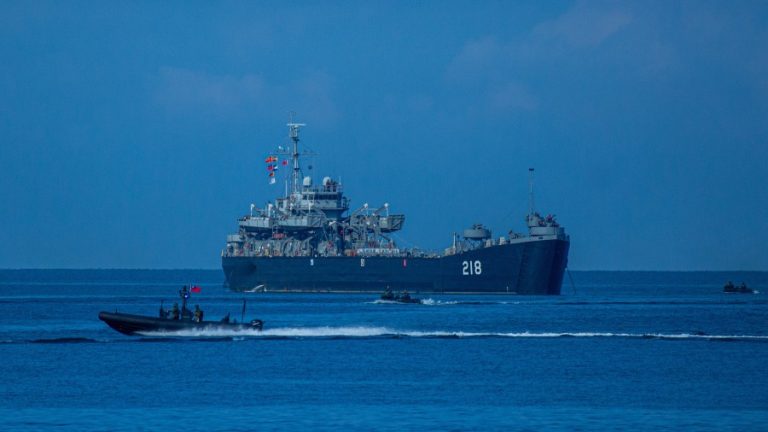
The Wall Street Journal reported on Tuesday, Dec. 30, that China is accelerating its activities in the Arctic, and its growing presence in the region is creating new military and strategic challenges for the United States and its allies.
The report noted that this summer, China’s research submarine navigated several thousand feet beneath the thick Arctic ice for the first time—a technological breakthrough viewed by Western security officials as having significant military and commercial implications. U.S. national security officials said this move further confirms the rising threat posed by China in the Arctic, also known as the “High North.”
A report released by the U.S. Department of Homeland Security in November indicated that the number of Chinese military and research vessels operating in Arctic waters near Alaska this year reached unprecedented levels. Western maritime strategy experts and military officials believe that China’s ability to navigate the Arctic and operate underwater not only helps it collect data on natural resources beneath the ice but also significantly shortens commercial shipping times and enables the deployment of nuclear submarines closer to potential target areas.
NATO’s top military leader, U.S. Air Force General Alexus Grynkewich, said China’s actions across the “High North” are increasingly aggressive, with research missions often serving as cover for military activity.
Success
You are now signed up for our newsletter
Success
Check your email to complete sign up
The report mentioned that China, which calls itself a “near-Arctic nation,” is attempting to position itself as an equal in Arctic affairs alongside the United States and Russia.

The Arctic is a global trade shortcut
The Wall Street Journal highlighted that Beijing views Arctic shipping routes as a global trade shortcut, the so-called “Polar Silk Road.” This summer, China sent a cargo ship through the Arctic route to the port of Gdańsk in Poland, cutting travel time by nearly half compared to the Suez Canal route. Chinese officials said they plan to expand cross-Arctic freight transport with Russia, particularly for liquefied natural gas shipments.
The report noted that during the Cold War, the Arctic was a key military front between NATO and the Soviet Union. Today, with Russia’s invasion of Ukraine and China’s growing involvement in the Arctic, regional tensions are rising again. The U.S. expects that China may have the capability to deploy armed submarines to the Arctic within the next few years. Currently, China already has military-grade surface ships in the region and continues to expand its icebreaker fleet.
To address potential risks, the U.S. and its allies are strengthening Arctic military deployments, including training specialized forces, expanding anti-submarine patrols, and accelerating icebreaker construction. The report noted that U.S. President Donald Trump has reached a shipbuilding agreement with Finland and pressured Denmark to bolster defenses of Greenland and surrounding areas.
At the same time, Trump is pursuing the acquisition of Greenland, aiming to strengthen U.S. presence there to prevent Russia and China from expanding influence in the Arctic and to protect strategic interests.
NATO has integrated Denmark, Sweden, and Finland into the unified command structure of the Atlantic and Arctic. Grynkewich said the move is based on the reality that “adversaries are forming alliances.”
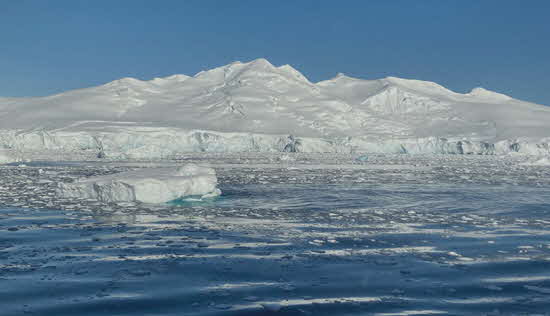
China cooperates with Russia in the Arctic
The Wall Street Journal also revealed that China-Russia military cooperation in the Arctic and surrounding airspace continues to deepen. Last year, Chinese and Russian aircraft conducted joint patrols near Alaska for the first time, with Chinese long-range bombers taking off from Russian air bases. NORAD Commander Gregory Guillot noted that this cooperation not only enhances China’s ability to strike North America but also increases the likelihood of coordinated attacks.
The U.S. is particularly wary of underwater operations. The report cited military experts saying that submarine operations rely heavily on precise knowledge of seabed topography and hydrological conditions, and China is systematically mapping global oceans to build models supporting submarine navigation and detection evasion.
At a 2024 conference in Canada, U.S. Indo-Pacific Command Commander Samuel Paparo said China’s long-term goal is to weaken and ultimately end “U.S. dominance in the underwater domain,” with Russia expected to provide technical assistance in submarine technology.
The report noted that although China’s Arctic presence currently benefits Russia, Western officials believe that over time, this relationship could pose new strategic risks for Moscow. NATO officials warned that once the Chinese navy can freely access the Atlantic via the Arctic, it will have a profound impact on the existing security framework.
French Navy Admiral Pierre Vandier said that if naval forces from Asia appear in the Atlantic, it would be a game-changing event, and NATO and the U.S. must prepare in advance.