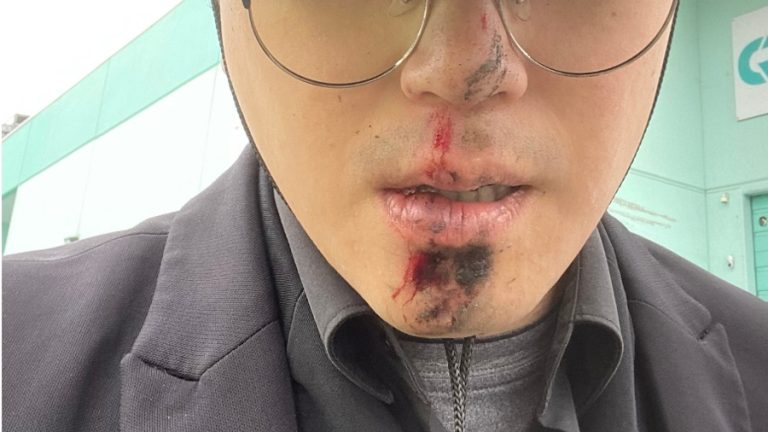
On the eve of the 37th anniversary of the June 4 Tiananmen Square Massacre, Hong Kong Legislative Council Speaker Keung Ka-wai was allegedly the target of a deliberate vehicle attack while cycling near the Marine Drive SkyTrain Station bike path in Vancouver on May 25. A vehicle that had been traveling in the roadway suddenly veered onto the bike path and struck him, leaving him injured and requiring emergency hospitalization.
In an interview with Vision Times, Keung recounted the incident in detail and questioned whether it was connected to the Chinese Communist Party’s (CCP) transnational repression network, describing it as a violent attack carrying clear political intimidation.
One day before the incident: Pressure from Chinese consulate-linked ‘security’
On May 24, the day before the attack, Keung was participating in a rally commemorating the 37th anniversary of June 4, organized by overseas Hong Kong groups.
During the event, a Chinese national wearing a jacket marked “Security” suddenly appeared and attempted to disperse participants, claiming they were obstructing traffic.
The demonstrators refused to leave and responded:
Success
You are now signed up for our newsletter
Success
Check your email to complete sign up
“Stop talking nonsense. If you have a concern, speak directly with the police officers on site. We have legal permission to use this space.”
Canadian police later intervened and reportedly reprimanded the individual:
“You do not have the authority to exercise any official powers in a public place in Canada. They are exercising their freedom of assembly, and you cannot interfere with the participants.”
While the individual was being confronted by police, Keung photographed and recorded him on his phone. He later published the footage and related information through Free Hong Kong Media, exposing the incident.
Less than 24 hours after publicizing the matter, Keung was struck by a vehicle.
The incident
On May 25, Keung was cycling along a bike path near Marine Drive SkyTrain Station as usual.
According to his account, a vehicle that had been traveling normally in the roadway suddenly and without warning made a sharp turn and drove directly onto the bike path, colliding with him.
Keung suffered serious injuries and was transported to a hospital by ambulance for treatment.
Speaking after the incident, he said:
“I will not allow the truth to be covered up, nor will I retreat because of violence.”
He believes that the timing of the Chinese consulate-linked interference at the rally the previous day and the vehicle attack the following day is too closely connected to be a coincidence, and that the incident bears the hallmarks of a premeditated act of political intimidation.
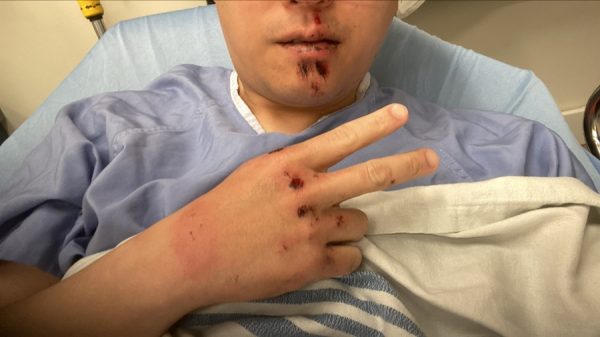
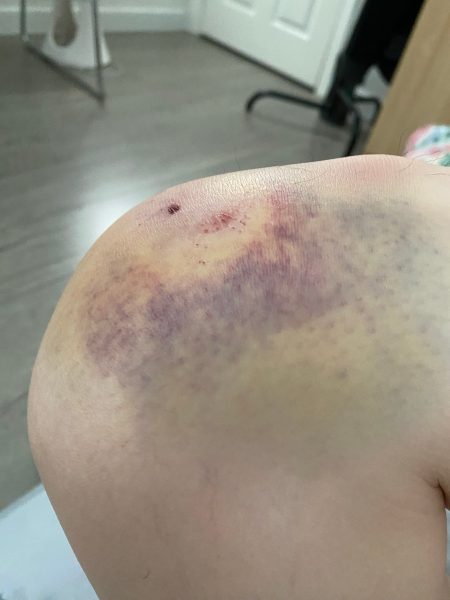
Who is behind it? Keung points to the CCP’s transnational repression network
Asked who should be held responsible, Keung expressed his views directly:
“In Hong Kong and overseas, what we should be most vigilant about in cases like this is the CCP and the intimidation mechanisms that extend from it. Whether through direct action or through proxies, sympathizers, or pro-Beijing networks, the objective is the same: to create fear, suppress dissent, and force people into silence. This is not an ordinary conflict—it is part of political repression.”
He noted that the CCP’s transnational repression tactics are no longer a secret. According to Keung, such tactics include surveillance, harassment, organizational infiltration, online smear campaigns, and even threats directed at family members, all aimed at creating a chilling effect among overseas Hong Kong residents and dissidents so they will hesitate to speak out, organize, or protest.
Attacked before June 4: Why does the CCP fear historical truth?
The timing of the incident is also significant, occurring only days before the anniversary of the June 4 Tiananmen Square Massacre.
Keung offered the following interpretation:
“The timing is far from insignificant. Commemorating June 4 is not only about mourning the victims; it is also a public indictment of CCP authoritarianism. The CCP fears June 4 commemorations because the truth about June 4 reveals its brutal nature: it maintains power through lies, conceals crimes through repression, and extends its rule through censorship and intimidation. Once the truth spreads, the control it fears losing begins to weaken.”
He believes that this is why pressure on overseas Hong Kong activists and dissidents often intensifies around each June 4 anniversary, as authorities attempt to use intimidation to prevent commemorative events and the dissemination of related information.
How should overseas Chinese and Hong Kong communities respond?
In recent years, participation by overseas Hong Kong residents in demonstrations and public protests has noticeably declined. Some observers have questioned whether the movement is losing momentum.
Keung offered a different explanation:
“I believe it is, and very clearly so. The CCP’s transnational repression is not an abstract concept—it is a reality. Surveillance, harassment, infiltration, smear campaigns, threats against family members, and the creation of a chilling effect are all intended to make overseas Hong Kong people and Chinese people afraid to speak out, gather, or protest. Participation has declined not because people no longer care, but because the pressure keeps increasing.”
He urged overseas Hong Kong and Chinese communities to abandon complacency and respond proactively:
“Overseas Hong Kong people and Chinese people can no longer afford to be naïve. We must stay vigilant, support one another, preserve evidence, expose incidents publicly, and seek help from local police, media, elected officials, and legal professionals when necessary. Most importantly, do not isolate yourself, because the CCP’s preferred strategy is to separate opponents and defeat them one by one.”
Greater determination
Keung’s alleged attack, he argues, highlights the reality of the CCP’s transnational repression, which he says is no longer confined to China but has extended to countries such as Canada, the United Kingdom, and Australia, targeting dissidents, democracy activists, and Hong Kong pro-democracy advocates through various forms of intimidation and persecution.
The incident has attracted attention from local Canadian community groups and human rights organizations. Authorities are reportedly investigating the vehicle collision.
Keung said he will continue documenting and exposing what he describes as CCP influence and infiltration activities overseas, while encouraging Hong Kong residents facing similar threats to come forward and seek legal protection.
“Violence only makes me more certain of how important our work is.”