By Li Muzi
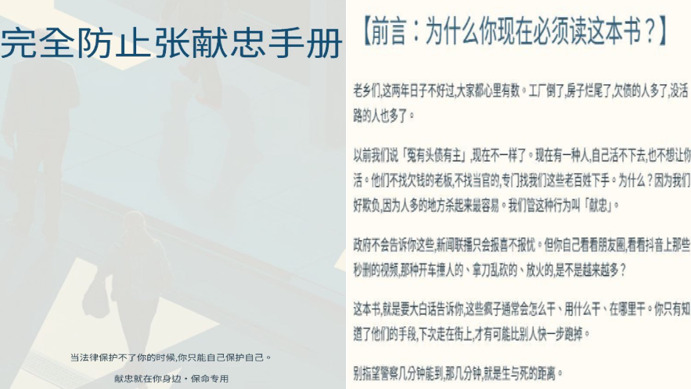
A mainland Chinese blogger’s post titled “A Complete Guide to Preventing ‘Zhang Xianzhong‘” was removed from Chinese social media platforms shortly after publication, according to screenshots and user accounts circulating online. The post was reportedly accessible for less than a day before disappearing across multiple platforms. The blogger’s account was also shut down.
The guide presented itself as a personal safety handbook. It argued that ordinary people should rely less on institutional protection and more on situational awareness in public spaces. Soon after it began circulating, reposts and related discussions were no longer visible.
According to online users, the post first appeared on Dec. 30, 2025. By Jan. 3, related keywords, screenshots, and references had largely vanished from major platforms.
What the guide described
Screenshots of the guide’s cover show a direct message: “When the law can no longer protect you, you can only protect yourself.”
Success
You are now signed up for our newsletter
Success
Check your email to complete sign up
The guide was organized into a preface, five short chapters, and a concluding section.
In the opening section, the author described recent economic difficulties, including factory closures, unfinished housing developments, rising debt, and increasing job insecurity. These pressures, the author argued, have contributed to heightened social tension.
The text repeatedly used the term “Zhang Xianzhong,” a phrase that has become online shorthand in China for acts of indiscriminate violence in public spaces. The term references a historical figure associated with mass violence, and in contemporary usage is often employed by netizens to describe attacks on strangers rather than targeted disputes.
The guide claimed that discussions of such incidents are often brief or absent in official media, while short online videos related to these events are frequently removed. Its stated purpose was to help readers recognize warning signs and reduce personal risk by avoiding high-risk situations.
Rather than encouraging confrontation, the author emphasized caution: staying alert in crowded areas, avoiding unnecessary gatherings, and keeping distance from individuals who appear emotionally unstable. The concluding section stressed that the guide was written to help people protect themselves, not to cause harm.
The rapid removal of the post prompted discussion among Chinese internet users.
Some commenters said the guide resonated because it addressed concerns people already feel but rarely see acknowledged. Others argued that deleting the post reinforced public anxiety rather than reducing it.
Several users suggested that removing discussions of personal safety does not address the underlying conditions that give rise to fear, while others criticized authorities for focusing on censorship instead of prevention.

Violence cited in online discussions
Online conversations about the censored guide often referenced a number of public incidents reported or discussed in late 2025.
On Dec. 5, a vehicle struck electric scooter riders near a bank in Jingdezhen, Jiangxi Province. Official statements described the incident as a traffic accident and reported injuries. Some online users questioned that account.
On Oct. 22, a vehicle hit students and parents near a primary school in Shiyan, Hubei Province. Online reports suggested multiple casualties, while official announcements issued later reported fewer injuries and said a suspect had been detained.
On Oct. 11, social media users discussed a vehicle-related incident in Chongqing’s Qijiang District that was not widely covered by official media.
On Oct. 1, images circulated online showing a vehicle incident in Guangzhou’s Tianhe Park. Several local users said related information was quickly removed.
Many netizens linked these discussions to economic slowdown, employment pressure, and rising social stress. They argued that only a small portion of such incidents receive sustained public attention, while others fade quickly from view due to content controls.