By Li Jingyao, Vision Times
On Jan. 4, the Chinese Communist Party (CCP) military launched its annual “nationwide military training” (全军开训) — a routine event that has traditionally served as a highly symbolic show of loyalty to CCP leader and Chinese President Xi Jinping. This year, however, official coverage conspicuously omitted any mention of Xi, his signature “strong military” slogans, or his guiding ideology, prompting renewed speculation that his authority within the People’s Liberation Army (PLA) is being eroded.
RELATED: Xi Jinping Told to ‘Know His Place’ as His Authority Suffers Further Downgrade
Military drills omit Xi
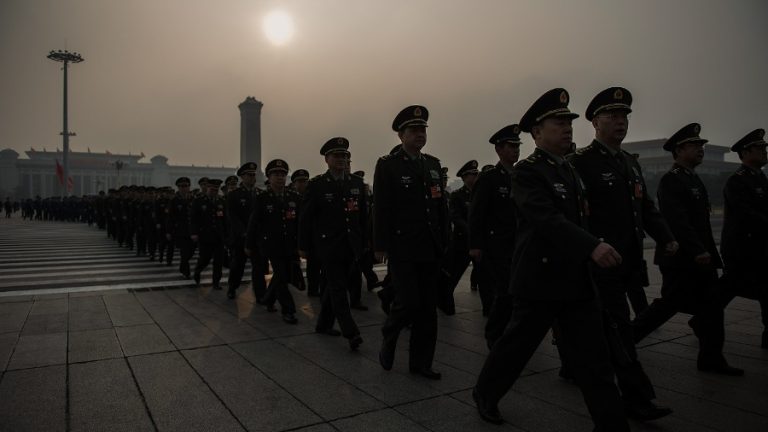
Since 2018, the CCP military has customarily launched nationwide drills on the first working day of each new year. According to state media, this year’s training focused on combat realism, emphasizing slogans such as “training begins as war begins” and “starting out means charging forward.” Showcased equipment included J-20 stealth fighter formations, DF-17 missiles, drones, and robotic “wolf” units.
Yet despite extensive photos and video footage, the roughly 1,000-word official report made no reference whatsoever to Xi Jinping, his “strong military thought,” or his leadership slogans.
Success
You are now signed up for our newsletter
Success
Check your email to complete sign up
By contrast, when the nationwide drills were first launched on January 3, 2018, Xi personally issued the training order and inspected troops alongside Central Military Commission (CMC) leaders. From 2019 to 2022, Xi signed the CMC’s annual “No. 1 Order,” with state media lavishly promoting his military ideology and emphasizing loyalty pledges from the armed forces.
A shift became evident in 2023, when the drills were scaled down in political symbolism: Xi issued no training order, and the military made no public pledges of loyalty. From 2024 through 2026, official reports have consistently omitted Xi’s name and slogans entirely.
Xi’s standing in question
Shen Ming-shi, a researcher at Taiwan’s Institute for National Defense and Security Research, told overseas media that Xi had previously treated military training as a top priority, using it to demand loyalty displays from the troops.
“Now there is no sign of such mobilization orders,” Shen said, adding that this could indicate Xi’s military authority has weakened, or that he no longer prioritizes such symbolic control. Due to the PLA’s opacity, however, this cannot be independently verified.
Shen also suggested another possibility: Xi may have delegated operational authority to Zhang Youxia, who reportedly dislikes political formalism and prefers allowing individual branches to manage their own training.
Su Tzu-yun, director of the Institute’s Division of Strategy and Resources, noted that omitting both Xi’s name and slogans inevitably raises questions about his political standing. He added that amid ongoing military purges, official military publications have increasingly emphasized “collective leadership” and “the Party commands the gun,” suggesting Xi may now be softly sidelined rather than openly challenged.
Xi allies purged
Since the CCP’s Third Plenum two years ago, Xi’s grip on the military has been the subject of intense speculation. Rumors circulated that Xi suffered a medical emergency during the meeting, after which military authority shifted to Zhang Youxia, the first-ranking vice chairman of the CMC.
Backed by CCP elders and so-called “red second-generation” elites, Zhang reportedly launched a sweeping purge of Xi-aligned officers. Two of Xi’s most trusted military lieutenants, CMC Political Work Department Director Miao Hua and CMC Vice Chairman He Weidong, have both fallen.
RELATED: Senior Xi Ally Ma Xingrui Vanishes as Purges Spread in China
“Miao Hua controlled personnel appointments and ideological enforcement,” observers noted. “He Weidong, long regarded as Xi’s closest military confidant and former Eastern Theater Command chief overseeing Taiwan affairs, was a core pillar of Xi’s power.”
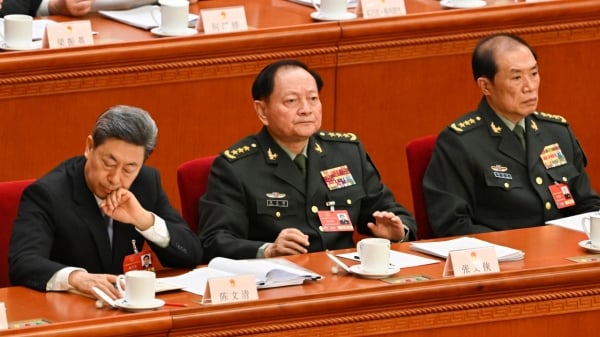
Xi personally promoted 79 generals during his tenure, nearly half have now been purged. Of the seven-member CMC, after the downfalls of Li Shangfu, Miao Hua, and He Weidong, only four remained by late 2025: Xi Jinping, Zhang Youxia, Zhang Shengmin, and Liu Zhenli. Analysts believe Zhang Shengmin and Liu Zhenli have aligned with Zhang Youxia, leaving Xi isolated in a 3-to-1 minority.
Independent commentator Du Zheng wrote in Up Media that Zhang Youxia now dominates the military and is effectively “ruling as king” within the PLA.
Internal power struggles
Du Zheng argued that Miao Hua and He Weidong were removed due to an internal power struggle with Zhang Youxia. Though Zhang ranked first among CMC vice chairmen, He Weidong controlled military discipline, personnel, and propaganda, giving him even greater de facto power.
He’s ambitions reportedly escalated in mid-2023, when he ordered a retrospective investigation into military procurement, leading to the downfall of Rocket Force commander Li Yuchao and former defense minister Li Shangfu, both allies of Zhang Youxia.
In March 2024, during the CCP’s annual “Two Sessions,” He publicly called for cracking down on “false combat capabilities,” a remark widely interpreted as a veiled attack on equipment procurement overseen by Zhang.
Zhang responded by exposing corruption allegations against Miao Hua for selling military posts. Xi was reportedly forced to approve an investigation. Shortly after Miao was suspended, He Weidong also abruptly “disappeared.”
Change in PLA rankings
Commentator Zhong Yuan noted that repeated military media emphasis on collective leadership, the purge of Xi-appointed loyalists, and earlier U.S. diplomatic signals, such as Jake Sullivan requesting to meet Zhang Youxia, have all pointed to Xi’s declining military control.
Veteran journalist Guo Jun said on the Elite Forum program that power at the CCP’s top has been restructured, with the military now firmly under Zhang Youxia’s control and no longer explicitly loyal to Xi.
Notably, at the CCP’s Second and Third Plenums following the 20th Party Congress, Zhang Youxia pledged loyalty to “Chairman Xi.” After the Fourth Plenum, however, his language changed: he now emphasizes “resolutely implementing the decisions of the Party Central Committee and the Central Military Commission.”
In CCP political culture, analysts say, this linguistic downgrade is highly significant. It effectively signals to the military that its loyalty lies with “the Center” rather than with Xi personally — a subtle but profound shift in power.
Editorial note: Views expressed in this article are the opinions of the author and do not necessarily reflect the views of Vision Times.