By Li Jingyao, Vision Times
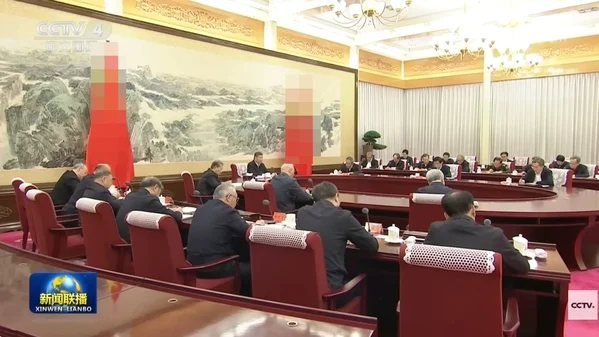
From Dec. 25-26, the Chinese Communist Party’s (CCP) Politburo met for its annual “Democratic Life Meeting,” chaired by Party leader Xi Jinping. While the gathering followed established ritual, observers noted that the official communiqué released afterward differed markedly from previous years, revealing several unusual and potentially far-reaching signals. The Politburo serves as China’s top ruling body.
According to political commentator Jiang Feng, insider sources suggest that a major internal bargain has taken shape within the CCP leadership — one that trades political concessions for economic extraction. Clues to this shift can be discerned by comparing the official language used in the 2024 and 2025 Politburo meeting communiqués.
RELATED: Xi’s Authority Appears Weakened as Rumors Swirl of Politburo Pushback
First signal: A ‘dimensional downgrade’ in political status
In 2024, Xinhua’s official summary emphasized that officials must “strictly hold themselves to the standards of Marxist politicians.” By comparison, the 2025 communiqué replaced this with a noticeably weaker formulation: “be steadfast Marxists.”
Success
You are now signed up for our newsletter
Success
Check your email to complete sign up
Jiang Feng argues that this wording represents a clear downgrading of political standing. In CCP parlance, the difference between a “politician” and a mere “Marxist” is significant—the latter implying a follower rather than a decision-maker. He described this as a “dimensional downgrade” in authority.
Second signal: The appearance of ‘knowing one’s place’
Even more striking was a line that appeared near the end of the communiqué: “Leading cadres, especially senior officials, must always preserve their original character and know their place.” Jiang Feng noted that “know your place” is language typically used by superiors to reprimand subordinates who have overstepped their authority. Its inclusion in a Politburo summary, particularly within the remarks attributed to the top leader, admits only two plausible interpretations.
First, Xi Jinping may have been compelled, under intense internal pressure, to make a public commitment binding not only others but himself as well. Second, the collective decision-making body may be issuing a direct warning against Xi’s pattern over recent years of over-centralization and excessive intervention.
Jiang Feng argued that, when viewed alongside prior reports of Zhang Youxia pushing back within the military, the phrase “know your place” amounts to a written record of an internal power confrontation—a textual trace of a clash that had already unfolded behind closed doors.
Third signal: ‘Strictly observe decision-making rules’
This year’s communiqué also included an unprecedented formulation: “Strictly observe deliberative and decision-making rules, and consciously act in accordance with institutional norms.” Behind these few words, analysts say, lies a mechanism that could fundamentally reshape China’s power structure.
In June, the Politburo announced the creation of a Central Party Decision-Making and Coordination Body, though it did not disclose its membership. According to insider accounts, the body includes not only the seven current Politburo Standing Committee members, but also former Standing Committee elders and Zhang Youxia.
RELATED: China’s ‘Live-Fire’ Exercises Near Taiwan Heighten Regional Tensions
If true, this would give non-Xi aligned forces a numerical majority — even though many current Standing Committee members were originally promoted by Xi himself. Under such a structure, Xi would no longer be able to make unilateral decisions; instead, major issues would require collective voting under strict procedural rules.
Former National Committee member of the CPPCC and Hong Kong government policy adviser Liu Mengxiong described the creation of this body as highly unusual, saying it signals that decision-making power has effectively returned to a collective leadership framework—one that now supersedes both the Party General Secretary and the Politburo.
Political commentator “Wall-Inside Observer” went further, arguing that the body effectively revives the long-defunct Central Advisory Commission, hollowing out the authority of Xi’s Politburo Standing Committee and placing ultimate power elsewhere.
Fourth signal: The rare emergence of ‘stabilizing the foundations’
Another unexpected phrase appeared in the communiqué: “stabilize the foundations and restore vitality.” This expression has long been associated with Premier Li Qiang. At the June 25, 2024 Davos Forum, Li stated: “China’s economy has just recovered from a serious illness. It cannot be treated with harsh medicine; it must stabilize the foundations and restore vitality.”
At the time, state media did not quote the remark and later removed it altogether. Jiang Feng argues that its sudden appearance in the Politburo communiqué signals a harsh reality: the reserves are gone. The era of political bravado unconstrained by economic consequences has ended. The phrase’s inclusion, he says, represents a declaration of victory by the pragmatic bureaucratic camp led by Li Qiang.
A de facto truce
Taken together, analysts say, the 2025 Democratic Life Meeting communiqué reads less like a routine Party document and more like a ceasefire agreement, marking the end of an era defined by unchecked political struggle.
It signals the beginning of a new phase in which the leadership must “stabilize the foundations” and “know its place” — a tacit acknowledgment that the once-dominant, all-encompassing power of Xi Jinping has entered structural retreat.
In the language of the CCP itself, the age of relentless confrontation appears to have given way to one of enforced restraint and more coded strategic frameworks.
Editorial note: This article is based on publicly circulating reports and commentary from independent analysts. The claims described have not been independently verified by Vision Times, and relevant authorities have not publicly confirmed the allegations.