By Cai Siyun
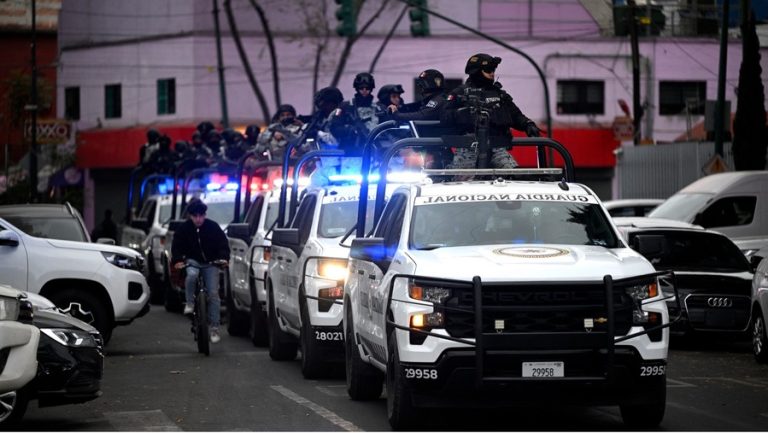
A middle school student in Xincai County, Henan Province, died suddenly this month, triggering protests by family members and local residents. According to multiple accounts, the local government responded by restricting traffic, including closing highways, and deploying large numbers of armed police to the area.
The incident occurred on Jan. 8, when a male student at a local middle school reportedly died on campus. Before the student’s parents arrived, school staff attempted to transfer the body, prompting what family members described as a confrontation over the remains. The transfer was reportedly halted only after the student’s uncle intercepted the vehicle.
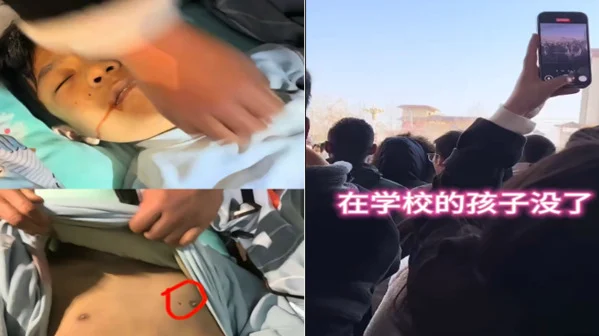
Family members later accused the school of obstructing their efforts to view the body. They said the student had blood around his mouth and a visible hole near the heart area, roughly the size of a nail head. Videos and images circulated widely on Chinese social media before being removed by major platforms.
Allegations and public reaction
Various explanations for the student’s death circulated online, including allegations of organ harvesting and blood extraction. Local residents told media outlets that the school initially prevented the family from seeing the body, forcing them to wait outside the campus gates.
Success
You are now signed up for our newsletter
Success
Check your email to complete sign up
“They were kept outside the school,” one resident said. “Armed police are now everywhere at the entrance. The family should request an independent forensic examination. This is heartbreaking.”
Another nearby resident said many people went to the scene to show support and help share information online. “I was there in the morning. By the afternoon, the entire area around the school was sealed off. Armed police were everywhere,” the resident said. “The roads were blocked. Hundreds, maybe close to a thousand people were there earlier.”
Online commentary and official response
An overseas X-platform blogger using the name “News Investigation” posted a video criticizing the authorities’ response, saying that a government claiming to “serve the people” appeared most fearful of public gatherings. The blogger argued that stability maintenance had become a reflex, focused on suppressing those raising questions rather than addressing the underlying issue.
Online comments beneath related posts included strong political language and calls for protest. Some users accused China’s police and judicial system of shielding organ harvesting practices, while others urged people to renounce the Chinese Communist Party or called for renewed mass demonstrations. These remarks reflect online reactions and have not been independently verified.
On Jan. 9, Xincai County’s Education Bureau issued a statement saying that a student at Jinshi Qinghuayuan School had died in what it described as an accidental incident. The statement said public security authorities had intervened immediately and that a preliminary investigation had ruled out a criminal case. Officials said they were handling post-incident arrangements.
Disputes over investigative authority
The official explanation drew skepticism online. Prominent internet commentator Song Zude questioned the Education Bureau’s authority to rule out criminal involvement.
“A statement from an education bureau has no legal effect. It represents only one side,” Song said. He argued that even a police report would need to be accompanied by a forensic autopsy and prosecutorial oversight. “An education bureau is not an investigative body. It has no standing to declare that criminal activity has been ruled out.”
Song further alleged that the education bureau was acting to protect the school rather than the family. He echoed claims that the school failed to explain the cause of death, restricted the family’s access to the body, and that when access was eventually granted, relatives observed blood at the mouth and a puncture-like mark near the heart.
Questions surrounding medical response
Additional allegations focused on the handling of the incident after the student collapsed. One source claimed that the vehicle prepared to remove the body was not a local emergency ambulance but came from another county, despite a hospital located approximately 400 meters from the school.
Song questioned whether the student was already dead at the time of transfer or possibly in a state of shock. “These are questions that must be clarified,” he said. “There is reason to question whether someone intended to remove the child’s organs.”
Medical claims and comparisons to past cases
Political commentator Li Muyang cited opinions from individuals described as medical professionals, who suggested that marks on the student’s chest resembled puncture wounds caused by a large medical-grade needle used to access the heart. They described the circumstances of death as highly unusual.
Some observers have referred to the case as the first “Hu Xinyu case” of 2026, drawing a comparison to a 2022 incident in Jiangxi Province in which a 15-year-old student disappeared from school and was later found dead. That earlier case was officially ruled a suicide, though it also generated widespread public suspicion and allegations of organ harvesting.
Li said that, according to medical analyses shared online, a rapid extraction of blood from the heart could cause sudden pressure changes, potentially explaining the presence of red fluid around the mouth. Another individual familiar with clinical medicine and organ donation procedures wrote that punctures near the heart are sometimes used in experiments requiring highly active samples. The post claimed that, after cardiac arrest, preservation fluids may be infused through such puncture sites to extend the viability of organs during transport.
These assertions remain unverified and are based on online commentary rather than official forensic findings.
Family’s account and official findings
The student’s father said his son appeared normal on Jan. 7. In the early hours of Jan. 8, around 5:00 or 6:00 a.m., the family received a call from the school saying the child was “not going to make it.” The student had been staying on campus for supplementary classes. According to the father, the school provided no clear explanation for the sudden death.
When family members went to the dormitory, they found that the student’s personal belongings were gone and the room had been cleaned. The school reportedly said surveillance cameras were malfunctioning and refused to allow the family to view footage.
After several hours, and under police supervision, the family was allowed to see the body in a hospital morgue. They said the body had already been frozen. Photos shared online showed blood at the mouth, a small puncture-like hole in the chest, and dark bruising around the waist.
Joint investigation announcement
On Jan. 11, Sichuan Observation News cited a statement from a joint investigation team formed by authorities in Xincai County, Zhumadian City. The statement said that at around 6:00 a.m. on Jan. 8, a 13-year-old seventh-grade male student surnamed Zhu was found dead in his dormitory.
According to the investigation team, interviews with classmates, teachers, relatives, and others found no prior conflicts or abnormalities. Officials said examinations found no external injuries, toxicology tests ruled out poisoning, and consultations concluded that the student died from a cardiac condition. The statement said the puncture on the left chest was caused by forensic blood sampling for toxicology tests, and that the red fluid at the mouth resulted from bodily fluids released when the body was moved.
Many internet users rejected the official explanation as an attempt to deflect public scrutiny, saying the questions surrounding the student’s death remain unresolved. As of publication, the incident continues to generate widespread attention online, even as related posts are removed from major platforms.