By Li Jingyao, Vision Times
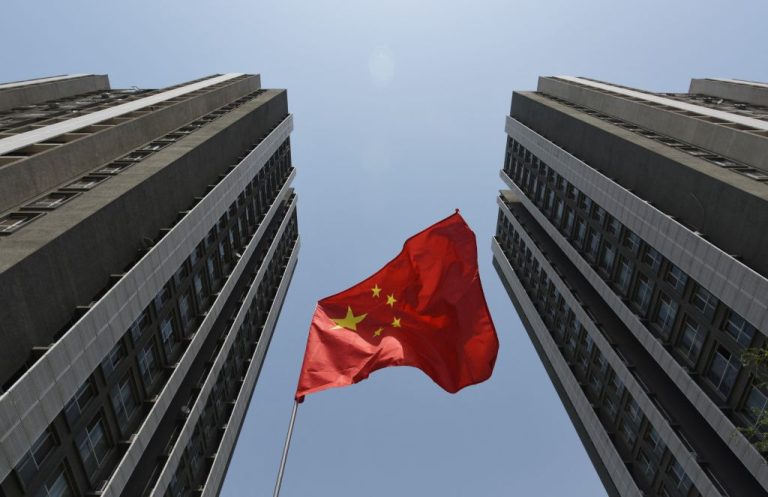
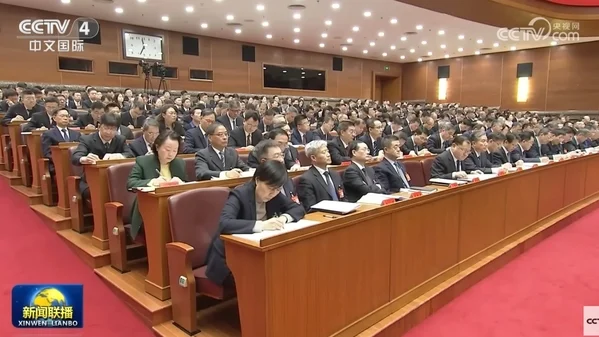
The Fifth Plenary Session of the 20th Central Commission for Discipline Inspection (CCDI) of the Chinese Communist Party (CCP) was held in Beijing from Jan. 12-14. According to the official communiqué, 13 CCDI members were absent — the highest number in the history of CCDI plenary sessions.
Analysts note that the unusually high number of absences, along with several irregularities in the communiqué itself, has intensified speculation that current leader Xi Jinping’s authority within the party has weakened, particularly in Beijing’s military and disciplinary sectors.
RELATED: Xi Jinping’s Allies Targeted in Historic Anti-Corruption Sweep
13 CCDI members absent
On Jan. 14, state mouthpiece Xinhua released the official communiqué of the Fifth Plenum. It reported that 120 CCDI members attended, with 265 participants listed as non-voting attendees. Because the 20th Party Congress produced 133 CCDI members, the figures indicate that 13 members failed to attend, representing a near-10 percent absence rate, the highest on record. By comparison:
- At the Fourth CCDI Plenum in January 2025, 131 members attended, with only 2 absences.
- At the Third CCDI Plenum in 2024, 132 members attended, with just 1 absence.
Success
You are now signed up for our newsletter
Success
Check your email to complete sign up
According to the X account China Personnel Watch (中国人事观察), 10 of the 13 absentees came from the military system. The remaining three were:
- Xu Xianping, former chairman of China North Industries Group,
- Shen Xiaohui, head of the CCDI disciplinary inspection team at the Ministry of Civil Affairs,
- Jiang Xinjun, secretary of the Xinjiang Production and Construction Corps Discipline Inspection Commission, who passed away in November last year.
Both Xu Xianping and Shen Xiaohui were also absent from the Fourth Plenum in 2025. Xu, in particular, is regarded as one of several “disappeared” executives from major defense-related state-owned enterprises. The sharp increase has drawn widespread attention among analysts who note the record number of absences is not standard practice.
Senior military figures purged in batches
Of the 133 CCDI members, 22 came from the People’s Liberation Army (PLA), accounting for 15.6 percent of the total. All 22 attended the Fourth Plenum in 2025. One year later, only 12 military members appeared at the Fifth Plenum, meaning 10 were absent, a 45.5 percent absence rate among military CCDI members. The absent officers reportedly include:
- Lieutenant General Chen Guoqiang, former deputy secretary of the CMC Discipline Inspection Commission
- Lieutenant General Leng Shaojie, Navy deputy political commissar
- Lieutenant General Cheng Dongfang, Navy deputy political commissar
- Lieutenant General Li Jun, assistant director of the CMC Political Work Department
- Lieutenant General Chen Jianfei, Armed Police deputy political commissar
- Lieutenant General Yang Xiaoxiang, Academy of Military Sciences deputy political commissar
- Lieutenant General Miao Wenjiang, political commissar of the Central Theater Command Army
- Lieutenant General Lou Chunsi, deputy political commissar of the Central Theater Command
- Major General Sun Bin, former auditor general of the CMC Audit Office
- Major General Liu Jun, director of the Political Work Bureau of the CMC Equipment Development Department
Hong Kong’s “Sing Tao Daily” noted that because the CCP rarely discloses senior military personnel changes, analysts often infer developments based on who appears, or fails to appear, at major meetings.
At the CCP’s Fourth Plenum of the 20th Central Committee in October last year, 27 of 42 military Central Committee members were absent, a staggering 63 percent, including 22 full generals — a pattern widely interpreted as reflecting the intensity of military anti-corruption purges.
Observers note that many of the absent officers were political work cadres, some reportedly linked to Miao Hua, the former director of the CMC Political Work Department who has already fallen from power. Analysts describe the situation bluntly: “After the purge, only a handful of full generals remain—and even lieutenant generals are rapidly disappearing.”
‘Anomalies’ in the communiqué
Political commentator Li Yanming, writing for overseas Chinese media, identified multiple unusual features in the Fifth Plenum communiqué beyond the record absences.
The Fifth Plenum listed 265 non-voting participants, compared with 238 at the Third Plenum and 247 at the Fourth Plenum. While attendance has risen steadily, this year’s increase was the largest yet, raising questions about who is now being brought in to observe or oversee disciplinary power.
Li also noted that the language praising Xi Jinping was cut by roughly 30 percent. Traditionally, CCDI communiqués follow a fixed template, with the fourth paragraph devoted to extolling Xi’s guidance. But this year, the readings were noticeably curbed:
- Fifth Plenum: 319 characters
- Third Plenum: 446 characters
- Fourth Plenum: 457 characters
Previously common phrases such as “far-reaching historical vision,” “towering strategic foresight,” and “ear-splitting guidance” were entirely absent.
No explicit ‘Xi directives’
For the first time in recent years, the communiqué did not state that Xi Jinping issued explicit requirements for anti-corruption work. Both the Third and Fourth Plenum communiqués explicitly cited Xi’s instructions, but the Fifth did not. Earlier communiqués called for:
- “Expanding the results of thematic education” (Third Plenum),
- “Consolidating and deepening Party discipline education” (Fourth Plenum).
- Such political-movement language disappeared entirely from the Fifth Plenum communiqué.
Instead, the Fifth Plenum placed more emphasis on “two-faced cfficials” and young cadres by emphasizing phrases like:
- “Purging ‘two-faced people’,”
- “Focusing investigations on the ‘key minority’ and corruption among young cadres.”
- Analysts note that these formulations were absent in prior communiqués, suggesting a shift in internal targeting priorities.
Prolonging the inevitable
Li Yanming argues that the cumulative signals, including reduced praise for Xi, missing directives, shifting language, and unprecedented absences, reinforce rumors that Xi has lost further control within the Politburo, which serves as China’s top ruling body. “After losing control over the military and personnel appointments, signs now suggest Xi may also have lost authority over the disciplinary apparatus,” said Li.
According to sources inside the system, the new round of anti-corruption investigations is no longer limited to provincial-level officials, but has expanded to prefecture-level party secretaries, mayors, and public security chiefs.
One insider described the current logic as: “It’s no longer about waiting to see who causes trouble. It’s about where you sit, who backs you, and whether your background can withstand scrutiny. If your position is wrong, you’re targeted first.”
Some scholars argue that the pattern underscores a deeper structural problem. Without institutional reform, they say, the CCP can only maintain control through continuous purges, not self-correction. “When a system survives solely by arresting its own officials,” one analyst noted, “it has already lost the ability to govern normally, and is merely prolonging collapse through internal cleansing.”
Editorial note: Views expressed in this article are the opinions of the author and do not necessarily reflect the views of Vision Times.