By Li Jingyao
Recently, the CCP’s Central Commission for Discipline Inspection (CCDI) reported that 65 centrally managed officials were investigated in 2025, setting a historical record. The fifth plenary session of the 20th CCDI was held in Beijing, and analysts believe the meeting has sounded the “attack horn” against Xi Jinping’s faction within the party and government system. Anti-corruption within the CCDI has always been a tool of political struggle; this time, however, Xi’s own people are unable to escape.
Record number of officials fall
On Jan. 6, 2026, the China Discipline Inspection and Supervision News reported that the CCDI and the National Supervisory Commission opened investigations into centrally managed officials including Jiang Chaoliang, Jin Xiangjun, Lan Tianli, Liu Hui, and Yi Huiman. Among these five fallen officials at the ministerial level, Jiang Chaoliang, Jin Xiangjun, Lan Tianli, and Liu Hui previously served as “first-in-command” of provincial party committees or provincial governments, while Yi Huiman served as chairman of the China Securities Regulatory Commission. Jiang, Jin, Lan, and Yi had also been members of the CCP Central Committee.
All five were investigated while in office: Jin Xiangjun and Lan Tianli were investigated during their tenure as provincial leaders, while Jiang Chaoliang, Liu Hui, and Yi Huiman were investigated while serving in the National People’s Congress or the Chinese People’s Political Consultative Conference.
The report further noted that a total of 65 centrally managed officials were investigated throughout 2025, a historical high.
Success
You are now signed up for our newsletter
Success
Check your email to complete sign up
Commentator Wang Youqun compiled statistics showing that in 2023, 2024, and 2025, at least 289 centrally managed officials were investigated; at least 122 military generals; and at least 256 officials at provincial-ministerial level or above.
The number of centrally managed officials investigated in 2025 was the highest since the 18th CCP National Congress in 2012, breaking previous records. Similarly, the number of generals investigated in 2025 was also the highest since 2012.
The anti-corruption campaign in the military system has been particularly intense, with many high-ranking officers falling. After the 20th CCP National Congress, the Standing Committee of the National People’s Congress released the list of this term’s military selection committee in December 2022. The director was Zhang Youxia, with deputy director He Weidong, and committee members including Li Shangfu, Liu Zhenli, Miao Hua, Zhang Shengmin, Zhong Shaojun, Wang Renhua, He Hongjun, Wang Chengnan, and Sun Bin — 11 in total.
Among these 11, seven — He Weidong, Miao Hua, Li Shangfu, Zhong Shaojun, Wang Renhua, He Hongjun, and Sun Bin — have already fallen. Most were personally promoted by Xi Jinping and are considered part of Xi’s faction. The downfall of He Weidong and Miao Hua was a particular blow to Xi. Additionally, Fang Yongxiang, who replaced Zhong Shaojun, also ran into trouble.
At the provincial-ministerial level, 106 high-ranking officials fell in 2025, the highest number since the 18th CCP National Congress.

Authoritarian regimes cannot solve corruption
Xi Jinping launched his anti-corruption campaign at the 2nd Plenary Session of the 18th CCDI, and by the 5th Plenary Session of the 20th CCDI in 2026, the campaign had lasted 13 years. Logically, the number of corrupt officials should decrease over time, but in reality, the number keeps increasing.
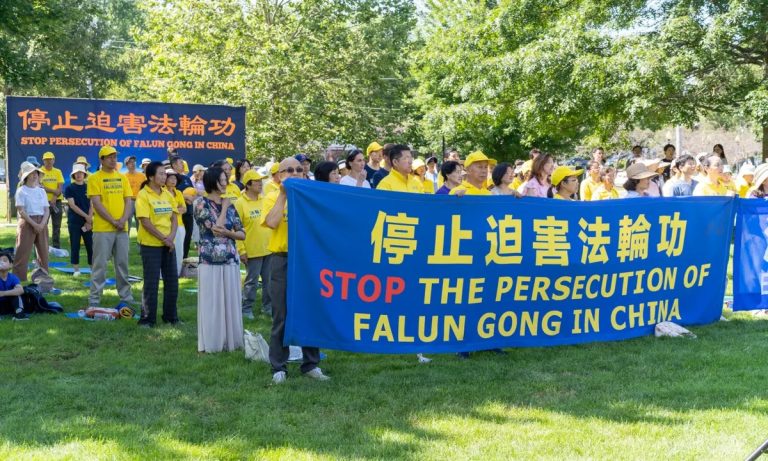
Wang Youqun believes the reason Xi’s anti-corruption measures have made corruption worse includes the CCP’s ideology (essentially “fake, evil, struggle”), its system (acting as both player, coach, and referee), and its legal framework (the party and power above the law). He also emphasized that the CCP has persecuted Falun Gong practitioners for over 26 years, and in order to maintain this persecution, many corrupt officials have been promoted — a key reason why anti-corruption campaigns have fueled more corruption.
Veteran journalist Wang Jian stated that the CCP has never established a systemic logic to fight corruption. Authoritarian regimes are characterized by unchecked power, which is the root of corruption. The CCP cannot solve corruption itself because it is an authoritarian regime.
Wang Jian cited a journalist who revealed that a CCDI official said that anti-corruption has reached a new phase: “Now, those caught by the CCDI first go after officials who have already fallen, then officials who are in prison, then retired officials, and finally those currently in office.”

The Fifth Plenary of the CCDI sounds the ‘attack horn’ against Xi
In recent years, opinions on anti-corruption and mass purges have been polarized. Some see it as Xi strengthening anti-corruption, while others see it as a purge by anti-Xi forces.
Commentator “Ordinary People Inside the Wall” said that recent purges target Xi’s faction. Since the 3rd Plenary Session in 2024, the military has undergone brutal purges. He stated, “The 5th Plenary of the 20th CCDI on January 12 sounded the horn for an attack against Xi Jinping’s party and government system. Anti-corruption in the CCDI is a tool of political struggle, and this time Xi’s people cannot escape.”
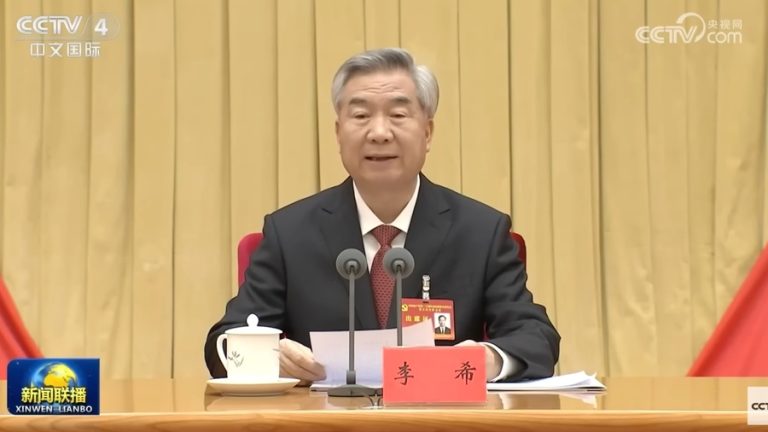
“Because Xi has lost control of the military and party, he is powerless against the upcoming purge. CCDI Secretary Li Xi has transformed from Xi’s enforcer into Hu-Wen’s ‘swift blade.’ Last year, Li Xi took down Ma Xingrui, effectively sending a loyalty signal to Hu-Wen.”
“Ordinary People Inside the Wall” said that Xi’s anti-corruption, like Mao’s anti-revolution campaigns, is merely a political tool. “Now Wen Jiabao has picked up Xi’s anti-corruption sword and is targeting Xi’s faction.” This CCDI plenary is seen as Hu-Wen’s mobilization meeting. In the year or so until the 21st CCP Congress, major corruption cases are expected to continue, until Hu Chunhua takes office. He speculated that following He Weidong and Ma Xingrui, more Politburo members may fall.
“Ordinary People Inside the Wall” suggested that whether Hu-Wen intends to target officials like Cai Qi and Wang Xiaohong or extend to Xi and other elite families will depend on Hu Jintao’s determination and Wen Jiabao’s methods. As Li Xi is Hu-Wen’s anti-corruption blade, having taken down Ma Xingrui, Chen Weijun, Fang Hongwei, Wang Lixia, and Liu Jianchao last year, he will likely work even harder this year to ensure his own safety.