By Fu Longshan
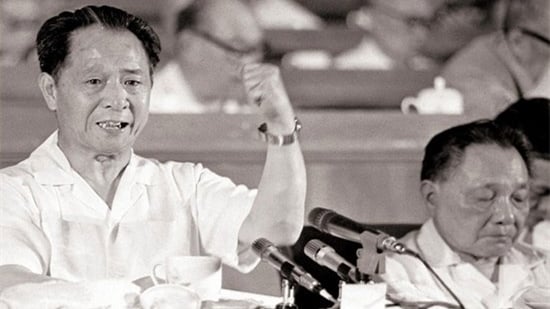
In official Chinese textbooks, Hu Yaobang’s life ends with three sterile words: “died of illness.”
Nothing more.
On the morning of April 15, 1989, a burst of urgent telephone calls inside Zhongnanhai—the sealed compound where China’s top leaders live and govern—quietly announced the end of an era. Hu Yaobang, former General Secretary of the Chinese Communist Party, had died. Officially, the cause was cardiac arrest. Unofficially, many believed something far more corrosive had killed him.
Hu Yaobang did not simply die of illness. He died of heartbreak under political struggle—of humiliation, betrayal, and suffocation inside a system he had once hoped to reform.
Success
You are now signed up for our newsletter
Success
Check your email to complete sign up
The ‘democratic life meeting’ that broke him
To understand Hu Yaobang’s death, one must return to January 1987 and a political ritual known as a “democratic life meeting.” In theory, such meetings were meant for self-criticism and collective reflection. In reality, this one became a carefully choreographed political purge.
By the mid-1980s, Hu Yaobang had earned a reputation as unusually open-minded for a Communist Party leader. He was tolerant of student activism, sympathetic to intellectuals, and resistant to ideological campaigns against so-called “bourgeois liberalization.” These positions made him deeply suspect to the Party’s conservative elders.
At the meeting, Hu was accused of violating the principle of “collective leadership” and of failing to suppress ideological deviation. What hurt most was not the criticism itself, but who delivered it. Officials he had personally promoted—men whose careers he had protected—turned on him to demonstrate their political loyalty.
According to later recollections by Li Rui and other insiders, Hu Yaobang was utterly unprepared for this spectacle. He was direct, emotionally transparent, and unused to this kind of coordinated political assault. When the meeting ended, he left the hall alone, sat on the steps of Zhongnanhai, and broke down sobbing—openly, uncontrollably, like a child.
For a senior Communist leader, this was not merely personal pain; it was profound disgrace. To be denounced by comrades and abandoned by the system he had served for decades left a wound that never healed. From that moment on, Hu Yaobang entered a long emotional decline.
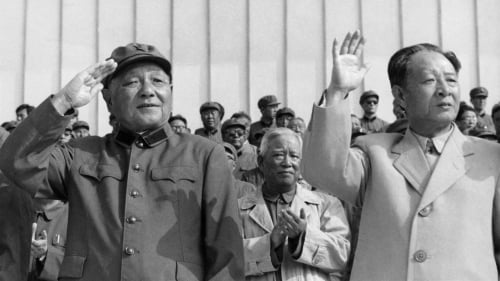
Although he held the title of General Secretary, Hu was never the true center of power. Above him loomed the so-called “Eight Elders,” led by Deng Xiaoping and Chen Yun—revolutionary veterans who exercised ultimate authority behind the scenes.
Hu’s gravest offense went beyond his tolerance of dissent. He had dared to challenge the elders’ collective interests by repeatedly advocating the abolition of lifetime tenure for senior officials. He even suggested—without euphemism—that Deng Xiaoping himself should set an example by retiring. In a political system dominated by aging revolutionaries obsessed with stability, this was tantamount to political suicide.
At the 1987 meeting, Bo Yibo—father of future Politburo member Bo Xilai—emerged as one of Hu’s fiercest critics. This, more than anything, shattered Hu Yaobang emotionally. After the Cultural Revolution, it was Hu who had taken personal political risks to rehabilitate wrongly imprisoned officials, including Bo Yibo, allowing them to return from prisons and labor camps to the heights of power.
To Hu Yaobang, this reversal felt like betrayal of the deepest kind.
Afterward, the man once known for his vitality and optimism seemed to vanish. He became withdrawn and silent, spending long hours sitting alone at home. To friends, he once sighed bitterly: “I never imagined that, in this lifetime, they would try to completely ruin me.”
The two minutes that never came back
On April 8, 1989, a Politburo meeting convened at Huairen Hall inside Zhongnanhai. The topic was education policy, but the atmosphere was tense and heavy.
Roughly forty-five minutes into the meeting, Hu Yaobang’s face suddenly turned gray. He slumped in his chair, raised his hand with visible effort, and addressed Zhao Ziyang, who was chairing the session: “Comrade Ziyang, I feel tightness in my chest. I request permission to leave the meeting.”
He did not finish the sentence. His body collapsed.
Zhao Ziyang shouted in alarm: “Comrade Yaobang, don’t move! Who has medicine? Who has nitroglycerin?”
What followed became one of the most unsettling moments in modern Chinese political lore. The senior officials present exchanged glances. No one moved. The room fell into a silence described by witnesses as suffocating.
Among those present was Jiang Zemin, then Party Secretary of Shanghai. He did, in fact, have emergency heart medication with him. Yet he did not step forward.
According to Bao Tong, Zhao Ziyang’s secretary, this paralysis lasted approximately two minutes. In cases of acute myocardial infarction, two minutes can determine life or death.
Why the hesitation? Later interpretations pointed to the cruel logic of elite Chinese politics: a known history of heart disease was seen as a “health weakness,” potentially fatal to one’s career. To reveal he carried heart medication would be to expose vulnerability. Faced with that choice, Jiang Zemin hesitated—even as a colleague lay dying.
Only after two minutes did Jiang slowly take out the pills, adding defensively: “I never carry medicine. My wife insisted I bring this this morning.”
The medication stabilized Hu Yaobang temporarily, buying him a few more days of life. But that delayed gesture became an indelible stain on Jiang Zemin’s moral reputation in the eyes of many observers.

Zhao Ziyang’s gloom and Li Zhao’s resolve
On April 15, Hu Yaobang suffered a second attack and died in hospital. News of his death spread rapidly, shocking the country and igniting student demonstrations that soon transformed into a nationwide movement.
At the memorial service on April 22, Zhao Ziyang stood before Hu Yaobang’s body to deliver the eulogy. His position was excruciating. He faced students who revered Hu as a symbol of reform, while confronting hardliners—Deng Xiaoping and Premier Li Peng among them—who were preparing to crush the protests.
Witnesses recall Zhao Ziyang’s face as dark and drawn, his voice low and strained. When he shook hands with Hu Yaobang’s widow, Li Zhao, his eyes reflected a shared sense of helplessness.
Li Zhao, however, displayed remarkable composure. She refused to sit during the ceremony, standing throughout as she received thousands of mourners. To many, this silent insistence was a wordless protest—an attempt to reclaim dignity for a man whose heart had been worn down by politics.
The official medical verdict listed the cause of death as acute myocardial infarction. Among the public, the verdict was different: Hu Yaobang had been angered to death.
From the Memorial Hall to Tiananmen Square
Hu Yaobang’s family soon made a decision that deeply embarrassed China’s leadership. They refused to bury his ashes at Babaoshan Revolutionary Cemetery, the resting place reserved for top Party figures. Instead, Li Zhao chose Gongqingcheng in Jiangxi Province—a place Hu had once visited during his life.
It was widely interpreted as a final, silent rebuke to Beijing’s political elite: this place does not welcome us.
From the moment of Hu Yaobang’s death, his personal tragedy became a national reckoning. In Tiananmen Square, students chanted: “The ones who should die didn’t die; the one who shouldn’t have died is dead.”
Their anger was directed squarely at the aging leaders who had forced Hu from power.
After the funeral, Zhao Ziyang reportedly reflected: “Yaobang’s death has pushed all of us into the eye of the storm.”
He attempted to continue Hu Yaobang’s reformist approach. Before long, he too would be removed.
Hu Yaobang’s death was the suffocation of an enlightened spirit inside a rigid system. The missing two minutes—the delayed pill—symbolized more than one man’s hesitation. They exposed a bureaucracy that, when forced to choose between humanity and power, consistently chose power.
Inside China today, searching for “Hu Yaobang” yields little more than sanitized images and official verdicts. But the humiliations of the political purge, the silence in Huairen Hall, and the sorrow etched on the faces of Zhao Ziyang and Li Zhao tell a far truer story.
Officially, Hu Yaobang “died of illness.” Unofficially, he was angered to death—by institutional rigidity, by the coldness of former comrades, and by a political culture that could not spare two minutes of human decency.
In China’s textbooks, this history has been reduced to three words. Everything else—the pills, the betrayal, the humiliation—remains sealed behind the high walls of Zhongnanhai.