By Yuan Bin, Vision Times
Before the Cultural Revolution erupted into nationwide chaos, Peng Zhen stood near the very center of Chinese Communist Party (CCP) zenith of power. As the sixth-ranking leader in the CCP hierarchy, mayor and first party secretary of Beijing, and vice chairman of the Standing Committee of the National People’s Congress, Peng was once regarded as one of the regime’s most senior and revered figures.
Peng Zhen later recalled that he was the first person in CCP history to shout “Long live Chairman Mao.” Yet when Mao Zedong launched the Cultural Revolution, Peng, despite his loyalty, became the earliest major victim, crushed precisely because he stood in the way.
RELATED: Top Secret: How Mao Zedong Silenced a Senior Spy—and Why His Finance Chief Knew Everything
The spark: Hai Rui dismissed
The chain of events began in 1965. Acting on Mao’s instructions, the Shanghai newspaper Wenhui Daily published Yao Wenyuan’s polemical article, “On the New Historical Play Hai Rui Dismissed from Office,” on November 10. The article drew a deliberate parallel between the Ming-dynasty official Hai Rui and the disgraced CCP leader Peng Dehuai, implicitly attacking the 1959 Lushan Conference.
Success
You are now signed up for our newsletter
Success
Check your email to complete sign up
Mao intended the piece to ignite a sweeping political movement, what would soon become the Cultural Revolution. Yet the operation was kept secret even from Premier Zhou Enlai. Peng Zhen, unaware of Mao’s deeper intent, treated the article as an academic dispute. As a result, Beijing and other regions refused to reprint it.
RELATED: How the Cultural Revolution Systematically Destroyed China’s Cultural Heritage
That refusal proved fatal. To Mao, the Beijing Party Committee under Peng appeared to be a “fortress impervious to outside influence.” From that moment, Mao resolved to remove him.
The February outline
On Feb. 13, 1966, Peng convened the Five-Man Cultural Group, composed of Peng Zhen, Lu Dingyi, Kang Sheng, Zhou Yang, and Wu Lengxi. As group leader, Peng sought to rein in the growing political firestorm. At an expanded meeting, Peng stated, “Wu Han’s issue is an academic matter. It has nothing to do with Peng Dehuai. Do not bring up the Lushan Conference. Academic criticism must not go too far. Once it does, it rebounds.”
Most attendees agreed. Only Kang Sheng dissented, insisting Wu Han’s play was a political attack linked directly to Peng Dehuai.
Based on Peng’s position, the group drafted the “Report Outline on the Current Academic Discussion,” later known as the February Outline. It emphasized seeking truth from facts, equality before truth, and persuasion through reason rather than political coercion.
Mao turns the tide
On Feb. 8, Peng, Lu Dingyi, and Kang Sheng traveled to Wuhan to brief Mao. Mao rejected the February Outline outright. He pressed Peng twice: “Is Wu Han anti-Party and anti-socialist?” Peng did not answer directly and the meeting ended in visible tension.
By mid-March, Mao escalated matters. At an enlarged Politburo Standing Committee meeting, he declared that newspapers, journals, and publishing houses must be seized from “bourgeois academic authorities,” naming Frontline magazine as “anti-Party and anti-socialist.”
He announced that literature, history, philosophy, law, and economics all required a “Cultural Revolution.” The signal had been given.
In late March, Mao told close allies, including Kang Sheng and Jiang Qing, that the February Outline “confused class boundaries” and must be overturned. He warned: “If the Beijing Party Committee and government continue to shield bad people, they must be dissolved.”
From target to sacrifice
By April, Peng was publicly accused of “anti-Party crimes.” On May 16, 1966, the Politburo passed the May 16 Notification, abolishing the Five-Man Cultural Group and replacing it with the Central Cultural Revolution Group, led by Chen Boda, with Jiang Qing as deputy. The Politburo serves as China’s top ruling body. Peng Zhen’s fall marked the first signal that the Cultural Revolution had begun.
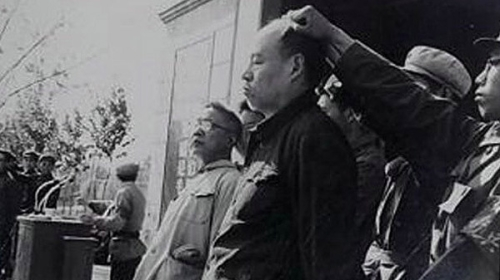
Afterward, a special case team interrogated Peng relentlessly, demanding confessions to fabricated crimes. He refused, and paid the price. With the rise of the Red Guards, Peng was repeatedly dragged out for public struggle sessions. On Jan. 4–5, 1967, a mass rally titled “Rally to Defend Chairman Mao and Struggle Against the Peng-Luo-Lu-Yang Anti-Revolutionary Clique” was held at Beijing Workers’ Stadium. 36,000 people attended.
Exile and rehabilitation
Peng, nearly 65 years old, was forced onstage with his arms twisted behind his back, a placard bearing his name crossed out in red. Exhausted from years of abuse, he stood drenched in sweat, face pale, while speakers shouted accusations and crowds screamed “Down with him!” Some observers even spat and threw objects at him.
In late 1969, Lin Biao ordered senior cadres dispersed across the country. Peng was sent into internal exile for “labor reform.” Only in February 1979, three years after the Cultural Revolution ended, was he finally rehabilitated and allowed to return home.
His fate remains one of the clearest early warnings of what the Cultural Revolution would become: Absolute loyalty offered no protection once Mao decided someone had become an obstacle on his way to achieving full power over the Chinese people.