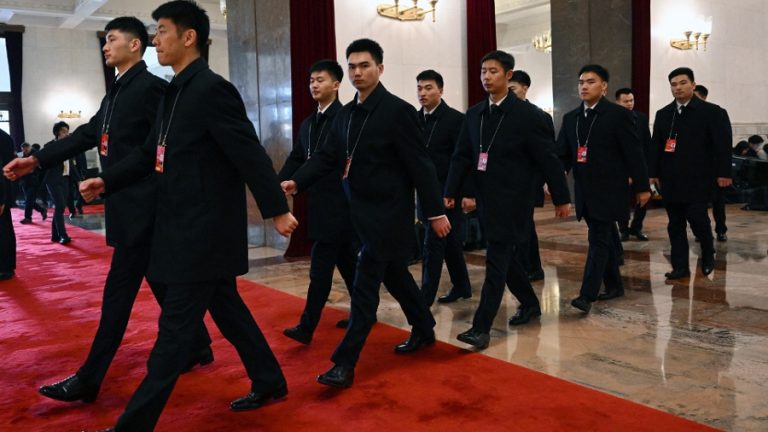
The Chinese Communist Party abruptly announced it would review the legislative credentials of unnamed delegates later this month, in what appears to be a direct response to weeks of intense online speculation about the detained former Vice Chairman of the Central Military Commission, Zhang Youxia, and former chief of the Joint Staff Department, Liu Zhenli. The episode reveals a deepening pattern: ordinary Chinese citizens, armed with nothing but questions the Party refuses to answer, are increasingly forcing Xi Jinping’s government to react on their terms.
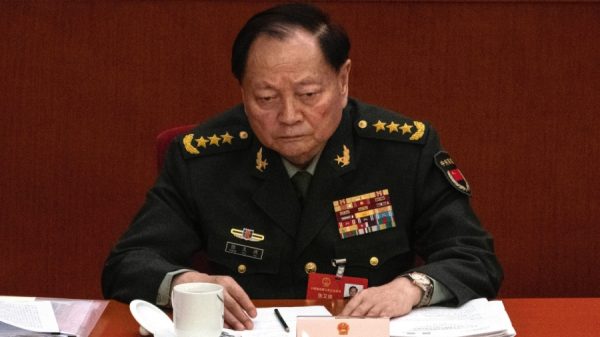
The CCP announced a sudden review of delegate credentials, and everyone knows why
On Feb. 10, 2026, the CCP’s flagship newspaper People’s Daily reported that Zhao Leji, chairman of the National People’s Congress (NPC) Standing Committee and China’s top legislative officer, convened a meeting in Beijing. The meeting scheduled the NPC’s twenty-first session for Feb. 25–26 and announced that the agenda would include a review of “the delegate credentials of certain individuals” and “relevant appointment and removal cases.”
No names were given. None were needed. The announcement landed in the middle of a firestorm of public speculation about Zhang Youxia and Liu Zhenli, two senior military figures whose sudden disappearance and official purge had dominated Chinese internet discussion for weeks.
The expectation had been widespread: when the NPC Standing Committee held its twentieth session on Feb. 4, most observers assumed the body would formally strip Zhang Youxia and Liu Zhenli of their NPC delegate status and military positions. Instead, the session terminated the credentials of three obscure delegates, Zhou Xinmin, Luo Qi, and Liu Cangli, and said nothing whatsoever about Zhang or Liu.
The silence was deafening. Speculation exploded online, with claims cascading across Chinese social media: “Zhao Leji is backing Zhang Youxia and openly defying Xi.” “Zhao Leji is resisting Xi Jinping.” “The power struggle has gone public.” “Zhao Leji has secured military support.”
Success
You are now signed up for our newsletter
Success
Check your email to complete sign up
Citizens dug into the CCP’s own legal framework and found a glaring contradiction. Under NPC regulations, any measure restricting the personal freedom of a sitting delegate, whether arrest, criminal prosecution, administrative detention, or surveillance, requires prior approval from the NPC Standing Committee or its presidium. Yet as multiple media outlets confirmed, both Zhang Youxia and Liu Zhenli remained listed as NPC delegates on the legislature’s official website. By the Party’s own rules, their detention without NPC authorization was flatly illegal, a self-contradiction that critics seized on immediately.
More damningly, this contradiction reinforced a charge that the Party’s opponents have pressed since the purge began: that Xi Jinping’s arrest of Zhang Youxia and Liu Zhenli, carried out in defiance of the CCP’s own legislative procedures, amounted to a de facto coup, a raw exercise of personal power that bypassed even the regime’s own institutional safeguards.
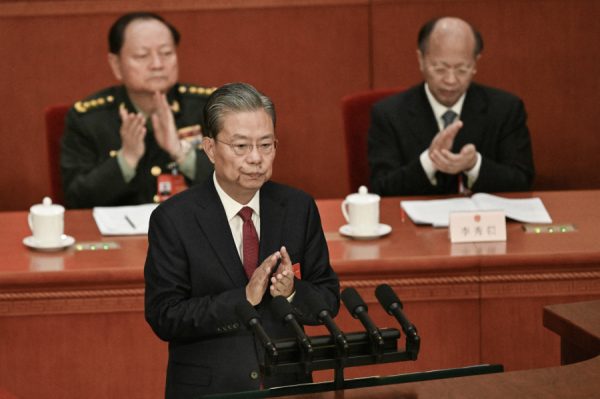
Did Zhao Leji actually defy Xi Jinping? Probably not, but that’s beside the point
Some commentators pushed back on the most dramatic interpretations, arguing that Zhao Leji neither possesses the courage nor the institutional leverage to openly resist Xi Jinping.
If that assessment is correct, then the February 10 announcement, hinting that delegate credentials and personnel changes would be reviewed at month’s end, was likely the Party’s attempt to extinguish the rumors. The goal: to prove that the claims of a Zhao–Xi split were, as Beijing would put it, nothing but “rumor.”
Even this damage-control effort, however, proved the critics’ deeper point. The CCP acted on the public’s timeline, reacting to pressure from below, a dynamic that vindicates a theory the Party itself once publicized.
In a striking irony, the CCP’s own state media outlet Guangming Daily published excerpts in 2009 from Rumors, a book by French sociologist Jean-Noël Kapferer. The book’s core thesis now reads like a diagnosis of the Party’s current predicament.
Kapferer defined rumor as “improvised news produced in the course of collective discussion” and argued that rumors invariably originate from events that are both important and shrouded in ambiguity. He offered a formula: Rumor = Importance × Ambiguity. When people want answers and official channels provide none, rumor becomes what Kapferer called “the black market of information.”
He illustrated the point with an example that could have been written about China in 2026: “At night, dozens of tanks pass through a small town. In a country where the news is strictly controlled, people ask: What happened? Rumors appear. Was there a riot over rising prices? Maybe it was just a military exercise? Has the president died?”
This is precisely what unfolded on the Chinese internet in recent weeks. Columns of military vehicles were spotted across multiple Chinese provinces. Citizens flooded social media with questions: What is happening? Is this connected to Zhang Youxia and Liu Zhenli? Is the military revolting and marching on Beijing? The CCP, maintaining the most severe information controls of any major government on earth, provided no answers, and so speculation filled the vacuum.

The people are not the problem
Throughout this cycle, from the initial purge, through the Party’s unexplained silence, to the eruption of speculation, ordinary citizens have been engaged in a collective search for truth. That search deserves no condemnation. The CCP government itself created the conditions for rumor by aggressively suppressing all credible information, and it alone deserves scrutiny.
As Kapferer observed, rumor is “a pooling of a group’s intelligence in an attempt to find a satisfactory explanation for an event.” The content of rumors evolves because each retelling layers in new interpretation and commentary, a natural process of collective sense-making under conditions of enforced ignorance. Faulty memory plays little part.
The harder the CCP cracks down on genuine information, the larger the “black market of information” grows. And the Party will find itself compelled, again and again, to respond to speculation it cannot control. At some point, perhaps already, the balance of power in this contest shifted. Ordinary Chinese citizens now occupy the strategically dominant position in their informational confrontation with the Xi Jinping regime. The Party speaks when the people force it to speak.