“If Xi Jinping comes to inspect our unit, I will personally take him out.”
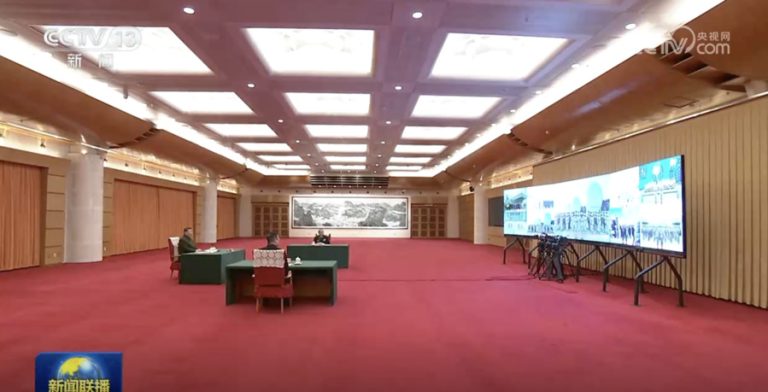
Those words, attributed to a military corps commander facing political purge, were made public by a former Chinese government official identified as Du. Xi Jinping, China’s paramount leader and chairman of the Central Military Commission (CMC), the body that commands all of China’s armed forces, was evidently terrified by the threat. On the afternoon of Feb. 10, he traveled to the Bayi Building, the People’s Liberation Army’s ceremonial headquarters in central Beijing, and delivered his Lunar New Year greetings to military personnel entirely by video link. Outside observers widely interpreted the decision as proof that Xi fears assassination by his own military.
At this same sensitive moment, two of the Chinese Communist Party’s most powerful propaganda organs, the Xinhua News Agency and the PLA Daily, published a joint article that appeared designed to embarrass Xi further. The effect was a propaganda maneuver that the Party itself has previously condemned: a “low-level red, high-level black” act, meaning praise so clumsy and tone-deaf that it functions as sabotage.
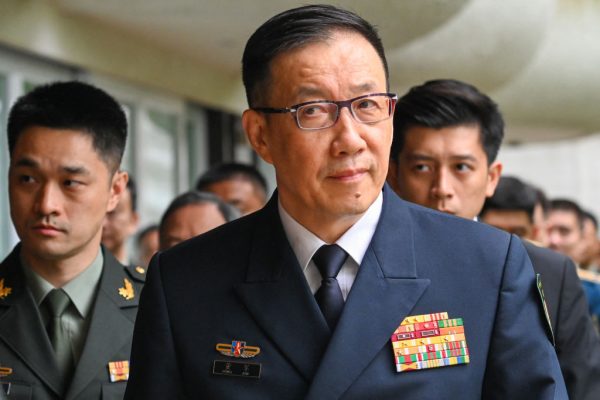
Meanwhile, rare camera footage captured Dong Jun, China’s Defense Minister and one of only two officials at Xi’s side during the address, sitting behind the leader with a visibly grim expression, his face heavy with unspoken anxiety.
The video broadcast by China Central Television (CCTV) showed Xi waving energetically at his audience, but when the camera pulled back, the audience turned out to be three large screens propped against a wall. The only people physically present beside Xi were Zhang Shengmin, the CMC’s top political discipline officer, and Dong Jun, the Defense Minister.
Success
You are now signed up for our newsletter
Success
Check your email to complete sign up
Xi’s words revealed what is driving his actions. His first two sentences were enough to send a chill through the military officer corps, including Zhang Youxia, the CMC’s former first vice chairman now under investigation, and Liu Zhenli, the former chief of the Joint Staff Department who has been detained.
Xi declared that over the past year, the military had “deeply advanced political rectification and effectively responded to various risks and challenges.” The meaning was plain: Xi regards the purge itself as the tool for countering the threats he perceives. And those threats, by his own framing, come from inside the military, from officers like Zhang Youxia and Liu Zhenli, men who bled and were wounded in service to the regime.

‘Revolutionary reforging:’ Xi Jinping’s threat to break the military until it submits
Xi then used the phrase “revolutionary reforging” (geming xing duanzao), a term drawn from CCP ideological vocabulary that carries an unmistakable menace. In plain language, it means Xi intends to hammer the military relentlessly until he is satisfied that he controls it absolutely, that no officer at any level can threaten his power, and that the armed forces exist as an instrument of personal dictatorship. The ultimate goal, in the author’s assessment, extends to dynastic succession.
Another line was equally telling. Xi said: “Officers and soldiers across the entire military, especially those at the grassroots level, listen to the Party and follow the Party… they are completely reliable and trustworthy.”
The key phrase is “especially those at the grassroots level.” The deliberate emphasis on junior enlisted troops and low-ranking officers carries an obvious implication: Xi does not consider the middle and upper ranks trustworthy. He has already purged most of the military’s top generals. The next targets will be the mid-level officers, the major generals, lieutenant generals, and every commander Xi does not yet feel certain he controls.
Xi’s characterization of Zhang Youxia and Liu Zhenli confirmed the severity of what lies ahead. He accused them of “seriously trampling and undermining the CMC Chairman Responsibility System,” “seriously encouraging and affecting the Party’s absolute leadership over the military,” and “seriously damaging the political and ideological foundations of all military officers and soldiers.”
Xi’s speech, in sum, disclosed the great secret of 2026: a merciless, military-wide purge that will extend far below the senior ranks. This is exactly why he did not dare follow precedent and visit a base in person. He may have told the cameras he trusts the rank and file, but he trusts no one, least of all after a corps commander openly pledged to kill him during an inspection.
During the Feb.10 video address, CCTV did not give Dong Jun, the Defense Minister, a single individual camera shot. The omission was conspicuous. Days earlier, on February 6, Dong had appeared at a Lunar New Year performance for retired military cadres in Beijing, seated directly behind Xi. Throughout the event, Dong’s face was dark and troubled, his expression that of a man weighed down by anxiety.
State media published a timeline of Xi’s past troop visits, highlighting his absence this year
On Feb. 11, the day after Xi’s video-only appearance, Xinhua and the PLA Daily jointly published an article with a seemingly innocuous title: “Reporters Revisit the Grassroots Units Xi Jinping Has Inspected.” The piece methodically listed the dates of Xi’s past visits to military bases: 2014, 2015, 2017, and as recently as Nov. 5, 2025. The contrast with his February 2026 decision to stay behind a screen was impossible to miss.
This is a pattern the CCP’s own propaganda apparatus has identified and condemned. The Zhejiang provincial propaganda department’s official WeChat account once catalogued examples of “low-level red, high-level black” behavior, a term for supposed praise that is so transparently absurd it achieves the opposite effect. The examples the department cited included a state media report celebrating a female Party cadre for working 28 consecutive days without changing her clothes or washing her hair, a story about a poverty alleviation official who married a woman classified as impoverished, and a headline boasting that “a deputy mayor finally got to eat a mooncake he paid for himself,” a line so comically out of touch that it became a shorthand for Party self-sabotage.
The People’s Daily was caught doing the same thing in 2023 when it published an article that dutifully recorded how long it took Xi to visit each natural disaster site: five months after the 2014 Ludian earthquake in Yunnan, one month after severe flooding in Anhui in 2020, three months after rare rainstorms devastated Shanxi in 2021. Chinese internet users immediately noticed the pattern. “They put the dates right there; were they afraid people wouldn’t see the problem?” one commenter wrote. Others were blunter: “The reporter did this on purpose.” “This is absolutely high-level black.”
The Xinhua and PLA Daily article landed at the worst possible moment for Xi. Zhang Youxia and Liu Zhenli had just been detained. Reports of open defiance within the ranks were circulating. By listing every previous base inspection Xi had made, the article all but dared the public to ask the obvious question: why didn’t Xi visit his troops this year? The answer writes itself: the detentions of his most senior generals, the reported assassination threat, and a military seething with resentment all point to a leader who fears his own armed forces.
Xinhua and the PLA Daily, working in concert, had managed to serve Xi the very mooncake he bought himself.