By Li Deyan, Vision Times
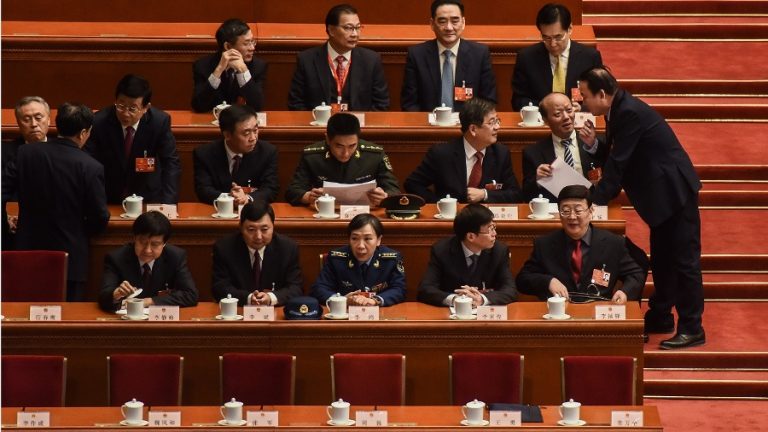
Ahead of the Lunar New Year on Jan. 17, Chinese state media released its annual list of senior Communist Party (CCP) leaders, including President Xi Jinping, visiting or sending representatives to visit retired top officials, a long-standing ritual meant to project stability and continuity at the highest levels of power.
State mouthpiece Xinhua News listed on Feb. 13 that 125 retired officials at or above the “vice-national” rank were included this year, with former leaders such as Hu Jintao, Zhu Rongji, Li Ruihuan, and Wen Jiabao appearing near the top. But compared with last year’s list, five names were absent due to reported deaths, including Re Di, Wang Binggan, Zou Jiahua, Peng Peiyun, and Xu Qiliang.
State media claimed that retired officials expressed “wholehearted support” for Xi’s leadership and offered “high praise” for the regime’s accomplishments in 2025 — language widely seen as part of the Party’s effort to reinforce an image of elite consensus.
Shifting winds
Observers outside China, however, questioned the authenticity of such messaging. Shen Ming-shih, a researcher at Taiwan’s Institute for National Defense and Security Research, told overseas Chinese media that these announcements are largely symbolic.
Success
You are now signed up for our newsletter
Success
Check your email to complete sign up
He argued that many veteran officials and “red second generation” elites may harbor significant dissatisfaction with Xi, making such reports primarily propaganda rather than genuine expressions of unity.
Former Inner Mongolia official Du Wen, now living in Europe, wrote on X: “There was no meeting, no resolution, no consensus — so where does this ‘unified stance’ come from? It seems the old men have been spoken for again.”) Commentator Li Linyi noted that CCP factional struggles often unfold behind closed doors. Even when conflicts are “life-and-death,” the Party still performs unity on the surface.
He added that while some retired elites may choose compromise to protect their interests, Xi’s most unpredictable challenge may come from the so-called “princeling” class — a factor some analysts cite when discussing the political downfalls of figures such as Liu Yazhou and, more recently, Zhang Youxia.
Military turbulence
The report comes amid heightened attention to China’s military leadership. In late January, official announcements indicated major disciplinary action involving senior PLA figures, including Zhang Youxia and Liu Zhenli. Overseas commentary has speculated about internal power struggles and possible resistance to Xi’s consolidation of control ahead of future Party congresses, though such claims remain difficult to verify independently.
Adding to the unusual political atmosphere, Chinese state media has also issued a series of delayed death announcements involving retired senior military officers.
On Feb. 11, Xinhua reported that Wang Tailan, a former deputy head of the General Logistics Department, died on January 25 in Beijing at age 86 after illness. Wang, a Shandong native who joined the military in 1958, previously served as chief of staff and deputy commander of the Jiangsu Military District, as well as logistics chief within the Nanjing Military Region.
While Wang had no obvious direct connection to Zhang Youxia, the timing, and the more than 10-day delay in reporting his death, drew attention given the broader military uncertainty. In addition, three other retired senior officers were reported dead in January, with similarly delayed announcements:
- On Jan. 30, Xinhua reported that Kui Fulin, a former deputy chief of the General Staff, died on January 15 at age 88. Authorities waited roughly two weeks before publishing the news. Kui had previously been a superior officer to Zhang Youxia.
- On Jan. 29, state media reported that Liao Xilong, a former Central Military Commission member and head of the General Logistics Department, died on January 23 at age 85 after “serious illness.” His death was announced six days later. Liao and Zhang both had ties to China’s Vietnam War era and were described as having served in overlapping hierarchies.
- On Jan. 19, Party media reported that Wang Zheng, a former Navy lieutenant general and political commissar, died on January 3 at age 64. His death was not announced until 16 days later — a delay that fueled speculation given his relatively younger age.
While illness-related deaths among elderly retired officers are not uncommon, the clustering of announcements, combined with delayed reporting, has prompted renewed discussion among observers about instability within China’s military and political elite.
At minimum, analysts note that the glaring difference between state media’s choreographed display of “unity” and the undercurrent of rumor and uncertainty underscores the opaque nature of Zhongnanhai politics — where official narratives often conceal far more than they reveal.