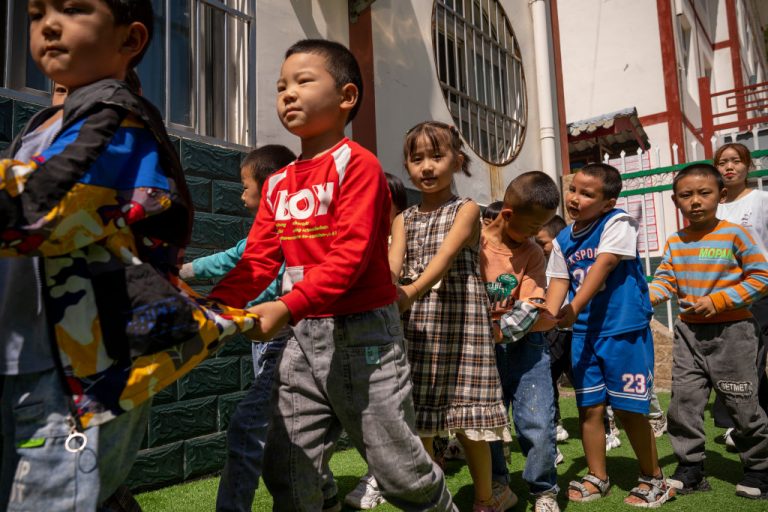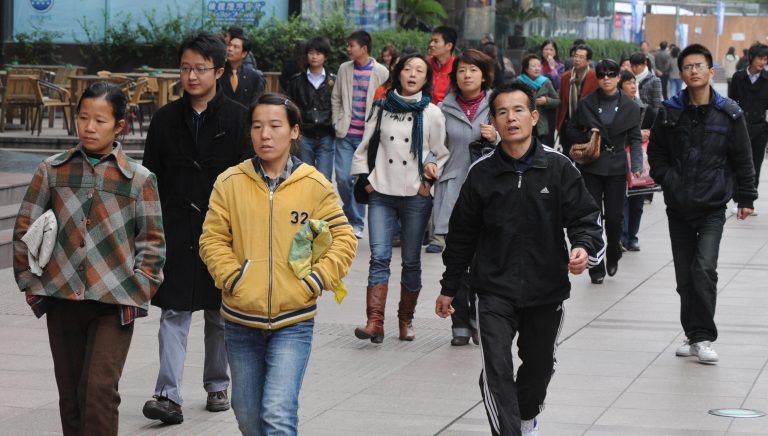
A sentence that once opened the Chinese Lunar New Year has been replaced. Instead of wishing each other prosperity, young people across China are now circulating a different kind of greeting: “Wish me an accidental death this year.” The phrase is delivered with irony. The exhaustion behind it is real.
The posts appear by the thousands on China’s heavily censored social media platforms, where even oblique criticism of the Chinese Communist Party (CCP) can trigger deletion. That this language survives at all signals how widespread the sentiment has become, and how difficult it is for censors to suppress a mood shared by millions.
“What ‘hard work brings rewards,’ what ‘perseverance is success’; the result of hard work is being optimized,” one widely shared post reads. “It’s not that we don’t want to work hard, it’s that working hard has no meaning. The money saved after working desperately for a whole year isn’t enough for a down payment.”
The people writing these posts describe a society in which mobility has stalled. Those at the bottom struggle near subsistence. Those at the top control resources and live in abundance. The gap between them keeps widening, and the escalator that the CCP once promised would carry the diligent upward has stopped moving.
Young Chinese workers describe lives of debt, cold, and invisibility
The posts are specific. They name the cold, the hunger, the isolation.
Success
You are now signed up for our newsletter
Success
Check your email to complete sign up
“Last night, it was very cold. I slept until midnight and was frozen painfully, especially my feet. Really, after that I couldn’t fall asleep. To tell the truth, if I disappeared, really no one would know.”
“Because I didn’t earn money again, and there is such a high mortgage every month, and housing prices have fallen. Every day I can’t bear to eat or drink, just saving money. My own life is already very difficult, but I still really want to go home for the New Year. If there is no money, going home is not pleasant.”
Others describe scenes of visible poverty. “With the current situation, you may not believe it, but at the entrance of our residential compound there are seven or eight garbage bins. From day to night, they can be rummaged through more than ten times.” In a country whose regime still claims to have eliminated extreme poverty, the image of neighbors picking through trash a dozen times a day tells a different story.
China’s endless competition cycle offers no exit for young people
For many young Chinese, the treadmill of competition begins in childhood. After-school tutoring consumes evenings and weekends. Postgraduate entrance exams and civil service exams draw thousands of applicants for a handful of spots. Those who make it through enter workplaces defined by “996” schedules, the tech industry shorthand for working 9 a.m. to 9 p.m., six days a week, a practice that is technically illegal under Chinese labor law but remains endemic.
Housing is unaffordable for most young workers. Having children feels financially reckless. Retirement, in a country where the CCP recently raised the retirement age over widespread public anger, appears uncertain at best.
Under these conditions, the CCP’s long-promoted narrative that hard work changes destiny, that enduring hardship ensures mobility, and that education guarantees advancement rings hollow. Economic growth in China has slowed sharply, the result of decades of CCP mismanagement, a collapsing real estate bubble inflated by Party-connected developers, and Xi Jinping’s erratic crackdowns on the private sector. Youth unemployment has repeatedly hit record highs, with the regime at one point simply ceasing to publish the figures because they were so embarrassing. Effort does not translate into security.
Win one round of competition and you enter another, more crowded one. Lose and you are eliminated. There is no rest, no plateau, no middle ground.
During graduation season, after layoffs, after failing exams, after setbacks in blind dates, or during late-night emotional lows, comment sections fill with replies: “same wish,” “+1,” “let’s have an early death together.” The language is exaggerated. The repetition forms a pattern too large to dismiss.
Migrant workers cannot afford to go home for Chinese New Year
The traditional new year, China’s most important holiday, has traditionally been a time when hundreds of millions of migrant workers return to their home villages. For many, the trip is the only time they see their families all year. Increasingly, workers say they cannot afford to go.
One exchange, circulated widely on Chinese social media, captures the situation:
“Abin, it’s almost New Year, do you want to go home?” “My family doesn’t care about me anymore.” “How long have you been outside?” “Three years.” “How have you solved food and drink during these three years?” “Picking things to eat everywhere on the streets.”
Others frame the crisis in precise financial terms.
“Everyone, if you can take out 5,000 yuan for the New Year now, you are considered a rich person.” Five thousand yuan is roughly $685 U.S. dollars. “Now most ordinary families use all their income to repay debts. With 5,000 yuan, in the village you can walk sideways, you can buy many things, many New Year goods, buy a lot of pork ribs. Some people now find it difficult even to take out 2,000 yuan.”
“People always ask me why I still don’t go home for the New Year. It’s not that I don’t want to go home. I’m afraid that if I go home too early, the money will be spent before the New Year is over. I went out to work for half a year and ended up owing 5,000 yuan. I haven’t even gone home yet. If I go home, I’ll owe 10,000.”
The shame of returning with nothing compounds the financial burden. “I’m 40 years old, no car, no house, no wife. Every year when I go back, I am looked down upon and pointed at by others. If you have no money, wherever you go, others won’t look at you more, won’t invite you to eat, and won’t ask you to play.”
A 3,000-yuan bonus reveals how little separates Chinese workers from desperation
In one workplace group chat, a message spread quickly. A manager announced that employees who stayed on duty through the New Year holiday would receive a 3,000-yuan bonus, roughly $410 U.S. dollars. Workers who had been counting the days until they could see their families instantly reversed course and volunteered to stay.
“Originally everyone was looking forward to going home to accompany their parents and hug their wives and children. Not a single person wanted to stay. As soon as the 3,000 yuan came out, all changed their words and stayed.”
The post concluded: “Who doesn’t want to go home? It’s just that the 3,000 yuan is more practical than reunion. Adults’ choices always bow to reality. This is the helplessness of ordinary people. For a little money, even the New Year requires trade-offs.”
The anecdote distills the broader crisis into a single, concrete image. Family, tradition, and emotional need all lose to a sum that, in a functioning economy, would barely register. For China’s migrant workers, it represents the difference between solvency and deeper debt.
‘No next life:’ why young Chinese are rejecting even the hope of reincarnation
The phrase at the center of the trend carries a specific cultural weight. In traditional Chinese folk belief and in Buddhist-influenced popular culture, reincarnation implies that suffering in this life may eventually be rewarded in the next. The “next life” has long served as a psychological pressure valve: endure now, and things may improve later.
Young Chinese are now closing that valve. “May I die early, and have no next life; may you die early, and have no next life,” one widely shared post reads. “A few words, tears hard to restrain. Half is despair, half is fulfillment of others.”
The logic is bleak and coherent. If another life would bring the same pressures, the same fixed hierarchy, the same rigged system, then reincarnation offers no relief. The phrase rejects the premise that the future will be better, in this life or any other.
The CCP once promoted narratives of struggle, counterattack, and entrepreneurial ascent during the decades of rapid economic growth that enriched Party-connected elites and coastal cities while leaving hundreds of millions of rural workers behind. State media pumped out rags-to-riches stories. Party propaganda insisted that China’s system rewarded the hardworking and the loyal. As growth has slowed and insecurity has risen, the regime has shifted to criticizing young people for “lying flat,” a term for refusing to participate in the rat race, and for embracing “involution,” the sense that competition has become pointless because it produces no winners.
The Party’s response has been to blame young people for giving up, rather than to address the structural conditions that drove them to that point. Meanwhile, the phrase “no next life” continues to circulate, quiet in tone and persistent in presence.
It does not necessarily signal a literal wish for death. It appears alongside debt calculations, job rejections, postponed family reunions, and late-night confessions. On screens after midnight, the sentence reappears, a marker of a generation that has stopped believing the promises its government made.