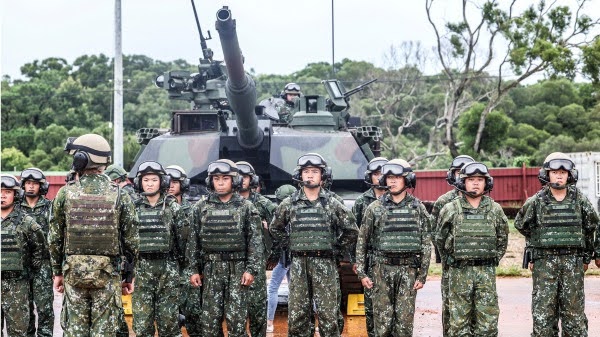
Taiwan’s special defense budget has been stalled for a long time, drawing widespread attention. According to Liberty Times, former United States Department of Defense (DOD) official, Hu Zhendong stated bluntly that the core purpose of the defense budget is to build deterrence capability and strategic confidence.
He said the United States Congress is well aware of who is blocking the budget; opposition parties cannot deceive the people of Taiwan, nor can they deceive Americans.
According to Liberty Times, Hu said in an interview that Taiwan’s Ministry of National Defense has repeatedly explained the details through classified briefings, but many opposition lawmakers failed to attend, reported Liberty Times.
“We give you the opportunity to understand, but you choose not to, and then you say you oppose passing the budget?” he remarked. He emphasized that the U.S. Congress clearly understands Taiwan’s situation and knows who is obstructing the budget; opposition parties cannot mislead either the Taiwanese public or Americans.
Regarding opposition lawmakers delaying the review of arms procurement budgets on the grounds that a Letter of Offer and Acceptance (LOA) has not yet been issued, Hu pointed out that this does not align with actual procedures.
Success
You are now signed up for our newsletter
Success
Check your email to complete sign up
When the U.S. provides “Price and Availability” (P&A), it has already completed policy assessments and interagency coordination—“at that point, the United States has already agreed to sell.” If the U.S. did not intend to sell weapons, it would neither provide pricing nor give allies false hope, Hu said.
He further explained that a Letter of Offer and Acceptance (LOA) is typically valid for only about one month, but it is impossible for Taiwan’s legislature to complete deliberations within such a short period. If lawmakers insist on waiting for the LOA before voting, “this cycle will never be resolved, and in the end it means you will never be able to make the purchase.” He believes such reasoning is not sound.
Hu Zhendong pointed out that in recent times, the Chinese Communist Party has expanded its pressure on Taiwan in a comprehensive manner, extending beyond political and diplomatic spheres into non-political areas. This indicates that Beijing has issued directives from a higher level to restrict Taiwan’s international space.
He noted that while the CCP obstructed President Lai Ching-te from visiting diplomatic allies in Africa, voices within Taiwan emerged calling for self-criticism—“as if the CCP could also help decide Taiwan’s future?”
He stressed, “The future of the Taiwanese people belongs to themselves and should not be influenced by the CCP in any way.”
Without strength, it is hard to say ‘no’ to the CCP
Hu emphasized that the core of the defense budget is to build deterrence capability.
Even if cross-strait negotiations were to take place, Taiwan must have stronger leverage.
“Without strength, it is very difficult to say ‘no’ to the CCP—you wouldn’t dare to say it. The outcome would inevitably be surrender, which is completely different from the usual definition of peace.”
He added that such appeasement policies have never succeeded in history; the weaker side ultimately ends up being occupied, oppressed, and losing its freedom.
Regarding the development of Taiwan’s military capabilities, Hu Zhendong believes that, in addition to focusing on hardware such as missiles and drones, Taiwan should also strengthen its Command, Control, Communications, Computers, Cyber, Intelligence, Surveillance, and Reconnaissance (C5ISR) capabilities. He said these systems can integrate battlefield information and are a crucial element of modern warfare.
Hu also noted that multi-domain operations have become a trend. Through cyber and information warfare methods, it is even possible to weaken an opponent’s capabilities without launching missiles. He pointed out that Taiwan has advantages in information technology, with highly skilled talent, and can enhance its overall combat strength in these areas.
Budget deadlock may delay arms procurement deliveries
Taiwan’s ruling and opposition parties have held three rounds of negotiations on the special defense budget without reaching a consensus. Legislative Speaker Han Kuo-yu announced that another round of talks will be held on May 6. Both sides have proposed three different versions of the defense budget.
Taiwan News reports that the Executive Yuan has proposed an eight-year, NT$1.25 trillion special budget titled “Enhancing Defense Resilience and Asymmetric Warfare Capabilities,” which includes U.S. arms purchases, domestically produced drones, and the “Taiwan Shield” program, emphasizing that its completeness should not be compromised.
Within the Kuomintang, disagreements remain over the total amount, with no consensus reached between proposals of “NT$380 billion + N” and NT$800 billion. Opposition parties tend to limit the budget to “U.S. arms purchases only,” while the Executive Yuan’s version includes domestic programs such as building national warships and aircraft (worth about NT$300 billion).
According to an earlier report by Yahoo News, Chuang Jui-hsiung, secretary-general of the legislative caucus of the Democratic Progressive Party, said in an interview on April 23 that the core objective of the arms procurement bill is to address military threats from the Chinese Communist Party. However, the opposition alliance removed the term “CCP” and replaced it with the more vague phrase “international forces.” He criticized this move, saying that Taiwan must safeguard its national security against military threats from any source, but there is no need to “deceive oneself.”
The prolonged delay in passing the special defense budget has drawn attention from the United States, which has sent bipartisan officials to Taiwan to understand the situation.
The American Institute in Taiwan (AIT) emphasized that a “comprehensive” special budget is crucial for building Taiwan’s deterrence in the coming years and sending an important signal to the international community. The U.S. side is concerned that delays in the budget could cause Taiwan to lose its place in the production and delivery queue for U.S. weapons.
By Li Jingyao