On April 29, all 31 of China’s provinces released their resident population data for the end of 2025, revealing a widening demographic downturn across the country. Roughly 80 percent of provinces reported population declines, with only seven regions recording growth.
Data from mainland Chinese outlets such as Yicai show that 24 provinces experienced population decreases to varying degrees. Among the hardest hit were Shandong, which saw a decline of approximately 371,700 people; Anhui and Hubei in central China, which lost 410,000 and 230,000 residents respectively; and Sichuan in the southwest, which dropped by 460,000. In the northeast, Liaoning and Heilongjiang also saw significant declines of 240,000 and 280,000.
In one mid-sized city in Anhui Province, the number of births rose by only 914 in the first quarter of this year, a sharp year-on-year drop of 67.4 percent. Analysts say the data suggest China’s population decline is no longer confined to specific regions but is spreading across coastal areas and industrial hubs, signaling a broader nationwide trend.
Population growth limited to 7 provinces
Only seven provincial-level regions, Guangdong, Zhejiang, Xinjiang, Hainan, Shanghai, Tibet, and Ningxia, reported population growth. Guangdong led the group, adding approximately 790,000 residents, driven by both natural population growth and strong inflows of migrants. In comparison, some regions maintained growth only through inward migration despite declining birth rates.
RELATED: New Statistics From a Shanghai District Fuel Concerns Over China’s Rapid Population Decline
Success
You are now signed up for our newsletter
Success
Check your email to complete sign up
Shanghai provides a clear example. In 2025, the city recorded around 107,000 births and 164,000 deaths, resulting in a natural decrease of roughly 57,000. However, a net inflow of more than 100,000 people allowed its overall population to continue growing.
Over the past decade, China’s demographic structure has shifted dramatically. In Beijing, the number of residents aged 20 to 29 dropped from 4.618 million in 2015 to 2.489 million in 2024, a decline of more than 2.1 million. At the same time, the population aged 60 and above rose by over 1.7 million.
Similar patterns have emerged in provinces such as Henan, Hebei, and Anhui, where the proportion of younger residents has steadily declined. These trends point to a rapidly aging society combined with a shrinking pool of young workers, two factors that are expected to place increasing pressure on China’s long-term economic outlook.
Kindergartens vanish as birth rates dwindle
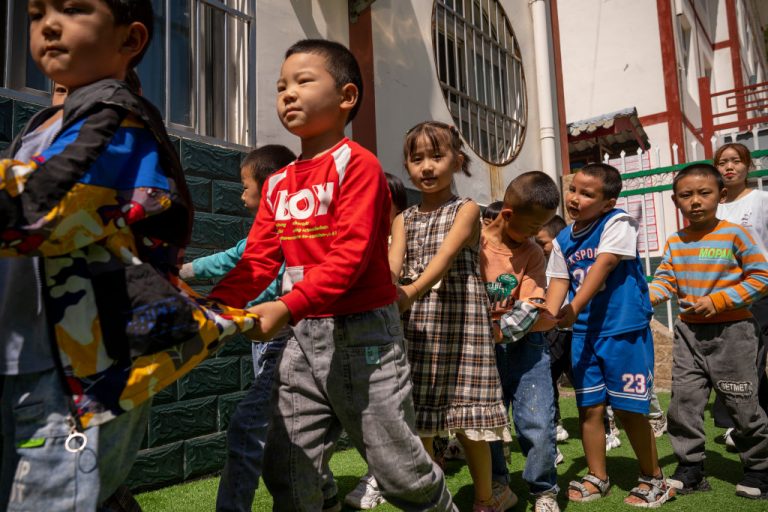
The impact of declining birth rates is now becoming increasingly visible in China’s education system, particularly in early childhood education.
According to China’s 2024 National Statistical Bulletin on Education Development, the number of kindergartens nationwide fell from 274,400 in 2023 to 253,300 in 2024, a drop of more than 21,000 in a single year. That equates to roughly two kindergartens closing every hour. This marks the third consecutive year of decline since 2022, reversing a long period of expansion.
At the same time, preschool enrollment has dropped sharply. Between 2020 and 2024, the number of children in preschool education declined by more than 12 million nationwide. Traditionally populous provinces such as Shandong, Hebei, and Hunan have seen some of the largest decreases. Even economically developed regions like Guangdong and Jiangsu have not been immune, reporting significant declines in enrollment.
Private kindergartens have been hit particularly hard. Their numbers fell by more than 9 percent year-on-year in 2024, compared to a smaller decline among public institutions.
Structural changes
The underlying cause of these shifts is a sustained decline in China’s birth rate. According to official data, the birth rate fell from 13.27 percent in 2011 to 6.39 percent in 2023, nearly halving over just over a decade. The steepest drop occurred after 2018, and by 2022, the birth rate had fallen below the death rate, marking the onset of negative population growth.
At the same time, the proportion of young children in the population has declined sharply. Between 2011 and 2023, the share of those aged 0 to 4 fell from 5.66 percent to 3.88 percent, a decrease of about 31 percent. As fewer children are born, the effects are cascading across sectors, from education to labor markets.
Analysts point to broader economic factors as a key driver behind the demographic downturn. Slowing economic growth, rising unemployment, and declining incomes have made it increasingly difficult for many families to afford marriage and child-rearing. As a result, more people are delaying or opting out of having children altogether. The consequences are now becoming visible across the country.
As China’s population continues to shrink, kindergartens are closing in large numbers, educators are leaving the profession, and the ripple effects are beginning to spread throughout the economy.