Feb. 19 marks the anniversary of Deng Xiaoping’s death in 1997.
Chinese philosopher Li Zehou once wrote that Mao Zedong left the deepest imprint on modern China. Yet Deng, remembered for his “black cat, white cat” pragmatism, was hailed as the architect of China’s ascent. A handful of aphorisms persuaded a nation of more than a billion people. Less than a decade later, admiration had turned into accusation.
Deng’s legacy defies simple moral judgment. Measured against Mao in terms of achievement and guilt, glory and infamy, no clear verdict emerges. If anything, Deng’s place in history is more ambiguous.
With Deng, revolutionary charisma receded. That retreat was praised as progress. It stripped politics of its mystique. “Saving the Party through the economy” was not mystical brilliance but political instinct. Yet the decision that defines his moral horizon remains June 4, 1989.
Economic growth requires stability, Ezra Vogel argued in his biography of Deng. Stability justified suppression. Fang Lizhi posed a harder question: if repression ensures order, why must the state continue pouring resources into “maintaining stability”? Can killing be defended in the name of development? Can one group’s survival be sacrificed for another’s prosperity?
Success
You are now signed up for our newsletter
Success
Check your email to complete sign up
Deng chose two generations of successors. Ultimate authority carries ultimate responsibility. The failures of the Jiang Zemin and Hu Jintao eras cannot be separated from the structure he left behind. Whether history will ultimately legitimize his authority remains uncertain.
China’s rise drew heavily on resources that belonged to the future. Environmental strain, widening inequality and corruption embedded in reform itself remain part of his inheritance.
Deng has been described as someone who “hid a needle in cotton.” He did not dismantle Maoism outright, but he ended charismatic rule. Politics became procedural, technocratic and tightly managed. Leadership style shifted from Jiang Zemin’s theatrical presence to Hu Jintao’s colorless reserve.
In that muted environment, Bo Xilai sought to restore drama. He cast himself as Mao’s heir and mocked what he saw as diminished stature in Zhongnanhai, likening Hu Jintao to “Emperor Xian of Han” and Xi Jinping to “Liu Adou,” rulers remembered for weakness.

White cat, black cat; crossing the river by feeling the stones
A final verdict on Deng lies beyond this generation.
His incremental pragmatism altered China’s path. “Crossing the river by feeling the stones” set China apart from the abrupt ruptures that shook Russia and Eastern Europe. The system that emerged — sometimes described as “digital Leninism” — produced prosperity and global influence while tightening centralized control. It now stands as a structural challenger to liberal democratic systems.
The famous “two cats” were never just practical advice. They set the tone for how power would operate.
China’s transformation is often called a miracle. Reform and opening expanded markets and multiplied opportunities for corruption. Growth and power advanced together.
Ambitious economic targets were paired with strict population control. The one-child policy, said to have prevented hundreds of millions of births, reshaped Chinese society at every level. Its demographic and social consequences remain visible.
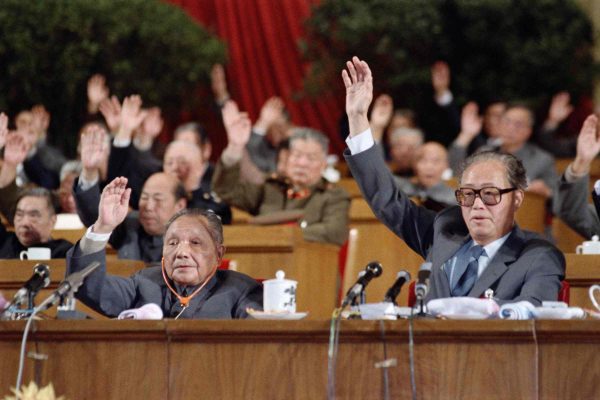
The June Fourth massacre
June 4, 1989, marked the decisive rupture.
Deng removed his own designated successor, General Secretary Zhao Ziyang, during the crisis. Party succession yielded to force.
Against a dwindling group of unarmed demonstrators in Tiananmen Square, the state deployed troops, armored vehicles and live ammunition. The scale of force set the boundary of permissible dissent.
After June Fourth, reform could no longer claim innocence. The consequences did not stop at the square.
The Tiananmen crackdown coincided with the collapse of the Soviet bloc, deepening the regime’s vulnerability.
Deng responded with strategic restraint: “hiding capabilities and biding time,” “never taking the lead.” Do not carry the banner. Do not expose the edge. Preserve space to recover.
China simultaneously expanded overseas study. After June Fourth, U.S. policy allowed large numbers of Chinese students to remain in the United States. Many of the country’s most highly trained graduates did not return.
Deng had restored the national college entrance examination, reopening a narrow path of meritocratic mobility. From a population of more than a billion, only a small fraction reached higher education. An even smaller fraction trained in the West. The loss of that cohort reshaped China’s intellectual balance.
“Deng at the helm” was not symbolic. Politburo Standing Committee members reported directly to him. Major decisions were settled at his residence.
It was never written into law, yet it governed in practice. Authority operated outside formal structures while shaping them from above.
Reform and repression remain inseparable in his legacy. History will decide the rest.
The views expressed are solely those of the author.
By Su Xiaokang