China’s local governments are drowning in debt, and the Chinese Communist Party (CCP) has found its scapegoats. On Feb. 23, 2026, the CCP’s central office launched a sweeping ideological campaign condemning the reckless borrowing, vanity construction, and inflated growth statistics that have defined local governance for years. The problem: those behaviors were the system working as designed. Now the regime is using them as a pretext to go after the very officials who carried out its orders, just as thousands of them are expected to gather in Beijing for the Party’s annual legislative meetings.
On Feb. 23, 2026, the CCP’s central office issued a directive launching a half-year campaign aimed at local leaders across China. The target list reads like a catalog of how China’s local governments have operated for decades. It calls on officials to examine whether they have engaged in “vanity projects,” “image-building projects,” “reckless investment solicitation,” “illegal borrowing to expand,” or “launching projects beyond their fiscal capacity.” These behaviors drove China’s growth model at the local level. Officials advanced their careers by delivering GDP numbers, which meant borrowing heavily, selling land to developers, and building infrastructure whether or not it was needed. The real estate collapse has since destroyed the land-sale revenues that made the whole cycle function. Local governments across China are now unable to pay their debts, fund basic services, or sustain the construction-driven economic activity that kept their numbers up.
The document was released by the General Office of the CCP’s Central Committee, the administrative nerve center that executes Xi Jinping’s directives. Titled “Notice on Launching Party-Wide Education to Establish and Practice the Correct View of Political Performance,” it targets leadership teams and officials at the county-bureau level and above, with particular emphasis on “number-one leaders,” the Party term for the top official in any given jurisdiction. The directive retroactively frames the predictable outcomes of this system as individual moral failures by local leaders. According to the state news agency Xinhua, the campaign will proceed “without phases or batches,” meaning every targeted official faces the process simultaneously. It is scheduled to run through the end of July 2026.

The purges removed four million officials and changed nothing
Xi Jinping, the CCP’s general secretary and China’s top leader, has purged more than four million Party and government officials under the banner of “anti-corruption” since coming to power over a decade ago. If the problem were individual corruption, four million removals should have made a dent. The behaviors the new directive condemns are as widespread as ever. The purges eliminated people. They did not alter the machinery that produces the behavior.
Wei Xin, a scholar who has studied CCP bureaucratic politics extensively, told Radio Free Asia that the campaign represents “a movement-style rectification of cadres” and reveals that the CCP’s bureaucratic system has “fallen into a structural bottleneck.” Wei characterized the shift as an attempt to reshape bureaucratic behavior through ideology because punishment alone has failed.
Success
You are now signed up for our newsletter
Success
Check your email to complete sign up
But the reaction from officials themselves tells a different story. Delegates to the Two Sessions are worried about being arrested, not reeducated. The campaign’s vague language, which defines “incorrect political performance” broadly enough to cover virtually any decision a local leader has made in the past decade, hands the regime a new pretext for detention that requires far less evidence than a corruption charge.
A retired professor from Renmin University, identified as Mr. He, sharpened the point in an interview with Radio Free Asia. The directive’s explicit focus on “number-one leaders” means the CCP is placing the blame squarely on the decision-makers themselves, he said, skipping past the lower-level functionaries who carried out their orders.
“Since the problem is located at the decision-making level,” He observed, “the question of who exactly constitutes the decision-making level becomes very interesting.”
That line deserves to linger. In the CCP’s centralized system, local “number-one leaders” do not set their own policy frameworks. They execute priorities handed down from the national leadership. The growth targets, the GDP benchmarks, the pressure to attract investment and build infrastructure all flow from the top. If the decision-making level is the problem, the trail does not stop at the county line.
The regime needs money, and its own delegates are the easiest targets
The question of blame, though, may matter less to the regime than the question of money. For decades, the behaviors the directive now condemns were standard practice at every level of local government. Officials borrowed, built, and inflated growth numbers because the system rewarded them for it. The real estate collapse broke the cycle. China’s local governments fund most public services, pay most government salaries, and build most infrastructure. The destruction of land-sale revenues left them unable to meet these basic obligations. The regime is now cash-strapped, and the very behaviors it once rewarded have become the pretext for squeezing the officials who carried them out.
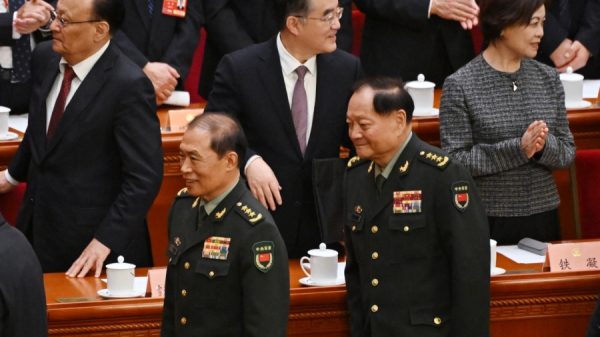
The regime’s current operating logic amounts to systematic wealth seizure from the politically exposed, according to Hu Liren, a Shanghai-born entrepreneur now based in the United States who reported the claim on his self-media program. Hu, who said he personally knew several delegates to the National People’s Congress (the Party-controlled rubber-stamp legislature) and the Chinese People’s Political Consultative Conference (the Party’s political advisory body) during his years in China, described how the regime’s relationship with these delegates has inverted.
Many of China’s local officials also serve as delegates to these two bodies, which hold joint annual meetings in Beijing known as the Two Sessions. Delegates once treated their positions as shields. Hu recounted an incident in which a friend with a Political Consultative Conference credential flashed it during a police identity check, and the officers immediately backed off. Since Xi Jinping consolidated power, and especially since his removal of presidential term limits through a 2018 constitutional change, those shields have become bullseyes. The most prominent example is Xu Jiayin, the founder of the Evergrande real estate conglomerate, who held a Political Consultative Conference seat before being detained and prosecuted as the company collapsed under more than $300 billion in liabilities.
Hu’s assessment was blunt. Entrepreneurs and business owners who have risen to delegate status are universally entangled in deals that could be prosecuted as serious crimes under Chinese law. Any single case could serve as pretext. This is the lever the regime uses: everyone is guilty of something, so everyone can be squeezed. Some delegates have had their family members threatened to extract money. The “anti-corruption” apparatus functions as a collection mechanism.

Local officials fear being purged at China’s annual legislative meetings
China’s annual Two Sessions are scheduled to open in Beijing on March 4 and March 5, 2026. The meetings require thousands of delegates to leave their home provinces and concentrate in the capital under the direct gaze of central authorities.
According to Hu’s latest sources, delegates to both bodies are now refusing to go. They fear detention. They fear saying the wrong thing. Some are so anxious that they are checking themselves into hospitals, pretending to have sudden illnesses, to create a pretext for absence.
The fear has a specific, mechanical basis. Many delegates simultaneously hold positions as local CCP officials. Some have already been “registered” by the Central Commission for Discipline Inspection, the Party’s internal anti-corruption enforcers, but remain untouched because they are still in their local posts. The Two Sessions change that calculus. Once these individuals travel to Beijing, they can be seized and held for interrogation, forced to account for their problems. Leaving their home jurisdictions removes whatever distance and bureaucratic inertia has shielded them.
Hu predicted that this year’s meetings may see an unusually high number of delegate absences. The annual Two Sessions have long served as political theater meant to project the image of a unified Party governing with broad consent. If significant numbers of delegates stay home this March, the theater tells a different story. The regime’s own participants no longer believe the performance is safe to attend.
By Li Deyan